


 Cart
Cart
 sales@molnova.com


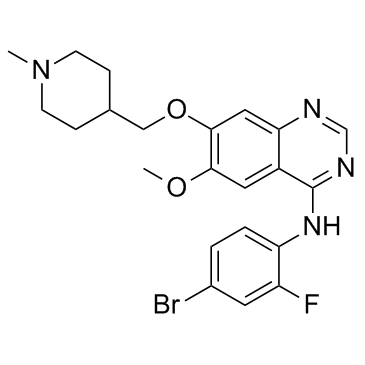
Vandetanib
CAS No. 443913-73-3
Vandetanib( ZD6474 )
Catalog No. M14519 CAS No. 443913-73-3
Vandetanib is an orally bioavailable 4-anilinoquinazoline. Vandetanib selectively inhibits the tyrosine kinase activity of vascular endothelial growth factor receptor 2 (VEGFR2), thereby blocking VEGF-stimulated endothelial cell proliferation and migration and reducing tumor vessel permeability.
Purity : >98% (HPLC)
 COA
Datasheet
HNMR
HPLC
MSDS
Handing Instructions
COA
Datasheet
HNMR
HPLC
MSDS
Handing Instructions
| Size | Price / USD | Stock | Quantity |
| 1 mL x 10 mM in DMSO | 48 | In Stock |


|
| 10MG | 43 | In Stock |
|
| 25MG | 60 | In Stock |
|
| 50MG | 91 | In Stock |
|
| 100MG | 166 | In Stock |
|
| 200MG | 231 | In Stock |
|
| 500MG | 370 | In Stock |
|
| 1G | Get Quote | In Stock |
|
Biological Information
-
Product NameVandetanib
-
NoteResearch use only, not for human use.
-
Brief DescriptionVandetanib is an orally bioavailable 4-anilinoquinazoline. Vandetanib selectively inhibits the tyrosine kinase activity of vascular endothelial growth factor receptor 2 (VEGFR2), thereby blocking VEGF-stimulated endothelial cell proliferation and migration and reducing tumor vessel permeability.
-
DescriptionVandetanib is an orally bioavailable 4-anilinoquinazoline. Vandetanib selectively inhibits the tyrosine kinase activity of vascular endothelial growth factor receptor 2 (VEGFR2), thereby blocking VEGF-stimulated endothelial cell proliferation and migration and reducing tumor vessel permeability. This agent also blocks the tyrosine kinase activity of epidermal growth factor receptor (EGFR), a receptor tyrosine kinase that mediates tumor cell proliferation and migration and angiogenesis.(In Vitro):Vandetanib inhibits VEGFR3 and EGFR with IC50 of 110 nM and 500 nM, respectively. Vandetanib is not sensitive to PDGFRβ, Flt1, Tie-2 and FGFR1 with IC50 of 1.1-3.6 μM, while almost has no activity against MEK, CDK2, c-Kit, erbB2, FAK, PDK1, Akt and IGF-1R with IC50 above 10 μM. Vandetanib inhibits VEGF-, EGF- and bFGF-stimulated HUVEC proliferation with IC50 of 60 nM, 170 nM and 800 nM, with no effect on basal endothelial cell growth. Vandetanib inhibits tumor cell growth with IC50 of 2.7 μM (A549) to 13.5 μM (Calu-6). Odanacatib is a weak inhibitor of antigen presentation, measured in a mouse B cell line (IC50=1.5±0.4 μM), compared to the Cat S inhibitor LHVS (IC50=0.001 μM) in the same assay. Odanacatib also shows weak inhibition of the processing of the MHC II invariant chain protein Iip10 in mouse splenocytes compared to LHVS (minimum inhibitory concentration 1-10 μM versus 0.01 μM, respectively). Vandetanib suppresses phosphorylation of VEGFR-2 in HUVECs and EGFR in hepatoma cells and inhibits cell proliferation.(In Vivo):Vandetanib (15 mg/kg, p.o.) has a superior anti-tumor effect than gefitinib in the H1650 xenograft model, and suppresses tumor growth with IC50 of 3.5±1.2 μM. In tumor-bearing mice, vandetanib (50 or 75 mg/kg) suppresses phosphorylation of VEGFR-2 and EGFR in tumor tissues, significantly reduces tumor vessel density, enhances tumor cell apoptosis, suppresses tumor growth, improves survival, reduces number of intrahepatic metastases, and upregulates VEGF, TGF-α, and EGF in tumor tissues.
-
In VitroVandetanib inhibits VEGFR3 and EGFR with IC50 of 110 nM and 500 nM, respectively. Vandetanib is not sensitive to PDGFRβ, Flt1, Tie-2 and FGFR1 with IC50 of 1.1-3.6 μM, while almost has no activity against MEK, CDK2, c-Kit, erbB2, FAK, PDK1, Akt and IGF-1R with IC50 above 10 μM. Vandetanib inhibits VEGF-, EGF- and bFGF-stimulated HUVEC proliferation with IC50 of 60 nM, 170 nM and 800 nM, with no effect on basal endothelial cell growth. Vandetanib inhibits tumor cell growth with IC50 of 2.7 μM (A549) to 13.5 μM (Calu-6). Odanacatib is a weak inhibitor of antigen presentation, measured in a mouse B cell line (IC50=1.5±0.4 μM), compared to the Cat S inhibitor LHVS (IC50=0.001 μM) in the same assay. Odanacatib also shows weak inhibition of the processing of the MHC II invariant chain protein Iip10 in mouse splenocytes compared to LHVS (minimum inhibitory concentration 1-10 μM versus 0.01 μM, respectively). Vandetanib suppresses phosphorylation of VEGFR-2 in HUVECs and EGFR in hepatoma cells and inhibits cell proliferation.
-
In VivoVandetanib (15 mg/kg, p.o.) has a superior anti-tumor effect than gefitinib in the H1650 xenograft model, and suppresses tumor growth with IC50 of 3.5±1.2 μM. In tumor-bearing mice, vandetanib (50 or 75 mg/kg) suppresses phosphorylation of VEGFR-2 and EGFR in tumor tissues, significantly reduces tumor vessel density, enhances tumor cell apoptosis, suppresses tumor growth, improves survival, reduces number of intrahepatic metastases, and upregulates VEGF, TGF-α, and EGF in tumor tissues.
-
SynonymsZD6474
-
PathwayAngiogenesis
-
TargetEGFR
-
RecptorEGFR| VEGFR2| VEGFR3
-
Research AreaCancer
-
IndicationThyroid Cancer
Chemical Information
-
CAS Number443913-73-3
-
Formula Weight475.31
-
Molecular FormulaC22H24BrFN4O2
-
Purity>98% (HPLC)
-
SolubilityDMSO: 4 mg/mL (8.41 mM)
-
SMILESCOC1=C(OCC2CCN(C)CC2)C=C2N=CN=C(NC3=C(F)C=C(Br)C=C3)C2=C1
-
Chemical Name——
Shipping & Storage Information
-
Storage(-20℃)
-
ShippingWith Ice Pack
-
Stability≥ 2 years
Reference
1.Wedge SR, et al. Y Res. 2002, 62(16), 4645-4655.
molnova catalog



related products
-
WZ4002
WZ4002 is a novel, mutant-selective EGFR inhibitor for EGFR(L858R)/(T790M) with IC50 of 2 nM/8 nM.
-
EGFR-IN-5
EGFR-IN-5 is a selective inhibitor of EGFR. The IC50s for EGFR, EGFR(L858R), EGFR(L858R/T790M), and EGFR(L858R/T790M/C797S) are 10.4, 1.1, 34, 7.2 nM, respectively.
-
AG 99
AG-99 is an inhibitor of EGFR kinase (IC50: 10 μM in the human epidermoid carcinoma cell line A431).
