


 Cart
Cart
 sales@molnova.com


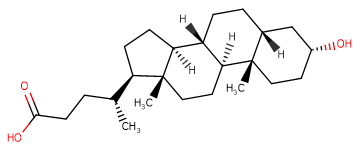
Lithocholic acid
CAS No. 434-13-9
Lithocholic acid( 3α-hydroxy Cholanic Acid | LCA | Lithocholate | NSC 683770 )
Catalog No. M14480 CAS No. 434-13-9
Lithocholic acid is a toxic secondary bile acid, causes intrahepatic cholestasis, has tumor-promoting activity.
Purity : >98% (HPLC)
 COA
Datasheet
HNMR
HPLC
MSDS
Handing Instructions
COA
Datasheet
HNMR
HPLC
MSDS
Handing Instructions
| Size | Price / USD | Stock | Quantity |
| 1 mL x 10 mM in DMSO | 28 | In Stock |


|
| 100MG | Get Quote | In Stock |
|
| 200MG | Get Quote | In Stock |
|
| 500MG | 27 | In Stock |
|
| 1G | Get Quote | In Stock |
|
Biological Information
-
Product NameLithocholic acid
-
NoteResearch use only, not for human use.
-
Brief DescriptionLithocholic acid is a toxic secondary bile acid, causes intrahepatic cholestasis, has tumor-promoting activity.
-
DescriptionLithocholic acid is a toxic secondary bile acid, causes intrahepatic cholestasis, has tumor-promoting activity.
-
In Vitro——
-
In Vivo——
-
Synonyms3α-hydroxy Cholanic Acid | LCA | Lithocholate | NSC 683770
-
PathwayMetabolic Enzyme/Protease
-
TargetFXR
-
RecptorFXR| PXR| VD
-
Research AreaMetabolic Disease
-
Indication——
Chemical Information
-
CAS Number434-13-9
-
Formula Weight376.58
-
Molecular FormulaC24H40O3
-
Purity>98% (HPLC)
-
SolubilityEthanol: 47 mg/mL (124.81 mM); DMSO: 75 mg/mL (199.16 mM)
-
SMILESC[C@H](CCC(O)=O)[C@H]1CC[C@@]2([H])[C@]3([H])CC[C@]4([H])C[C@H](O)CC[C@]4(C)[C@@]3([H])CC[C@]12C
-
Chemical Name3alpha-Hydroxy-5beta-cholan-24-oic acid
Shipping & Storage Information
-
Storage(-20℃)
-
ShippingWith Ice Pack
-
Stability≥ 2 years
Reference
1.Kozoni V, et al. Carcinogenesis. 2000 May;21(5):999-1005.
molnova catalog



related products
-
Cilofexor
Cilofexor (GS-9674, GS9674, PX-104)?is a novel specific, non-steroidal farnesoid X receptor (FXR) agonist that reduces liver fibrosis and ameliorates portal hypertension in rat NASH models.
-
Androsterone
Androsterone is a metabolic product of testosterone and can activate Farnesoid X Receptor (FXR).
-
Glyco-Obeticholic ac...
Glyco-Obeticholic acid is an active metabolite of Obeticholic acid. Obeticholic acid is an agonist of the farnesoid X receptor (FXR).
