


 Cart
Cart
 sales@molnova.com


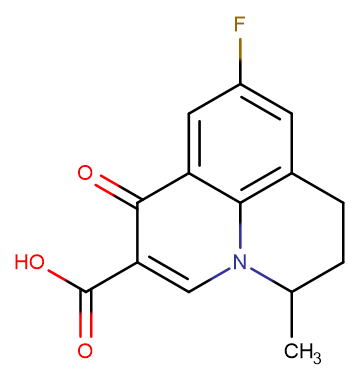
Flumequine
CAS No. 42835-25-6
Flumequine( (±)-Flumequine )
Catalog No. M14452 CAS No. 42835-25-6
Flumequine is a synthetic chemotherapeutic antibiotic of the fluoroquinolone drug class used to treat bacterial infections.
Purity : >98% (HPLC)
 COA
Datasheet
HNMR
HPLC
MSDS
Handing Instructions
COA
Datasheet
HNMR
HPLC
MSDS
Handing Instructions
| Size | Price / USD | Stock | Quantity |
| 1 mL x 10 mM in DMSO | 46 | In Stock |


|
| 50MG | 31 | In Stock |
|
| 100MG | 43 | In Stock |
|
| 200MG | Get Quote | In Stock |
|
| 500MG | 91 | In Stock |
|
| 1G | 136 | In Stock |
|
Biological Information
-
Product NameFlumequine
-
NoteResearch use only, not for human use.
-
Brief DescriptionFlumequine is a synthetic chemotherapeutic antibiotic of the fluoroquinolone drug class used to treat bacterial infections.
-
DescriptionFlumequine is a synthetic chemotherapeutic antibiotic of the fluoroquinolone drug class used to treat bacterial infections.(In Vitro):Flumequine (R-802) is a topoisomerase II inhibitor, with an IC50 of 3.92 μg/mL, and less potently inhibits Gyrase, with an IC50 of 1764 μg/mL. Flumequine (0-625 μg/mL) increases migration of nuclear DNA from CHL cells. Flumequine (R-802) inhibits Spanish field isolates of B. hyodysenteriae with MIC50 and MIC90 of 50 and 100 μg/mL, and MBC50 and MBC90 of 50, 200 μg/mL, respectively. Flumequine (R-802) suppresses A. salmonicida isolates with MIC ranging from 0.06 to 32 μg/mL.(In Vivo):Flumequine (R-802) (0-500 mg/kg, p.o.) causes dose-related DNA damage in the stomach, colon, and urinary bladder of mice, 1 and 3 h but not 24 h after its administration.
-
In VitroFlumequine (R-802) is a topoisomerase II inhibitor, with an IC50 of 3.92 μg/mL, and less potently inhibits Gyrase, with an IC50 of 1764 μg/mL. Flumequine (0-625 μg/mL) increases migration of nuclear DNA from CHL cells. Flumequine (R-802) inhibits Spanish field isolates of B. hyodysenteriae with MIC50 and MIC90 of 50 and 100 μg/mL, and MBC50 and MBC90 of 50, 200 μg/mL, respectively. Flumequine (R-802) suppresses A. salmonicida isolates with MIC ranging from 0.06 to 32 μg/mL.
-
In VivoFlumequine (R-802) (0-500 mg/kg, p.o.) causes dose-related DNA damage in the stomach, colon, and urinary bladder of mice, 1 and 3 h but not 24 h after its administration.
-
Synonyms(±)-Flumequine
-
PathwayCell Cycle/DNA Damage
-
TargetTopoisomerase
-
RecptorTopo II
-
Research AreaInfection
-
Indication——
Chemical Information
-
CAS Number42835-25-6
-
Formula Weight261.25
-
Molecular FormulaC14H12FNO3
-
Purity>98% (HPLC)
-
SolubilityDMSO: 3 mg/mL (11.48 mM)
-
SMILESO=C(C(C1=O)=CN2C(C)CCC3=C2C1=CC(F)=C3)O
-
Chemical Name7-Fluoro-12-methyl-4-oxo-1-azatricyclo[7.3.1.05,13]trideca-2,5,7,9(13)-tetraene-3-carboxylic acid
Shipping & Storage Information
-
Storage(-20℃)
-
ShippingWith Ice Pack
-
Stability≥ 2 years
Reference
1.Kashida Y, et al. Toxicol Sci, 2002, 69(2), 317-32
molnova catalog



related products
-
Teniposide
Teniposide(VM-26) is a semisynthetic derivative of podophyllotoxin and are increasingly used in Y medicine.
-
Alalevonadifloxacin
Alalevonadifloxacin is a DNA gyrase and DNA topoisomerase inhibitor and a novel antibacterial compound of the quinolone class targeting MRSa.
-
Topovale
Topovale is a potent inhibitor of topoisomerase I. Topovale inhibits hypoxia-mediated accumulation of hypoxia-inducible factor-1alpha.
