


 Cart
Cart
 sales@molnova.com


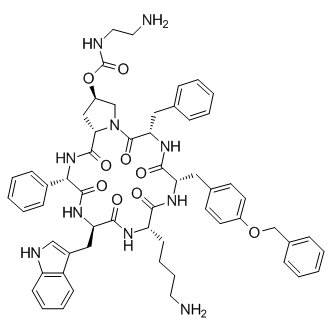
Pasireotide
CAS No. 396091-73-9
Pasireotide( SOM 230 | SOM 320 )
Catalog No. M14362 CAS No. 396091-73-9
A potent, stable cyclohexapeptide somatostatin mimic that exhibits unique high-affinity binding to human somatostatin receptors.
Purity : >98% (HPLC)
 COA
Datasheet
HNMR
HPLC
MSDS
Handing Instructions
COA
Datasheet
HNMR
HPLC
MSDS
Handing Instructions
| Size | Price / USD | Stock | Quantity |
| 100MG | Get Quote | In Stock |


|
| 200MG | Get Quote | In Stock |
|
| 500MG | Get Quote | In Stock |
|
| 1G | Get Quote | In Stock |
|
Biological Information
-
Product NamePasireotide
-
NoteResearch use only, not for human use.
-
Brief DescriptionA potent, stable cyclohexapeptide somatostatin mimic that exhibits unique high-affinity binding to human somatostatin receptors.
-
DescriptionA potent, stable cyclohexapeptide somatostatin mimic that exhibits unique high-affinity binding to human somatostatin receptors (pKi=8.2/9.0/9.1/<7.0/9.9 for sst1/2/3/4/5, respectively); effectively inhibits GHRH-induced growth hormone release in primary cultures of rat pituitary cells with IC50 of 0.4 nM, also potently suppresses GH secretion in rats.Cushing's Disease Approved.
-
In VitroPasireotide exhibits unique high-affinity binding to human somatostatin receptors (subtypes sst1/2/3/4/5, pKi=8.2/9.0/9.1/<7.0/9.9, respectively).Pasireotide effectively inhibits the growth hormone releasing hormone (GHRH) induced growth hormone (GH) release in primary cultures of rat pituitary cells, with an IC50 of 0.4 nM.
-
In VivoPasireotide (160 mg/kg/mouth; s.c. for 4 months) significantly decreases the serum insulin, increases serum glucose, reduces the tumor size and increases apoptosis in Pdx1-Cre.Pasireotide (2-50 μg/kg; s.c. twice daily for 42 days) exerts the antinociceptive and antiinflammatory actions via the SSTR2 receptor in a mouse model of immune-mediated arthritis. Animal Model:12 month-old conditional Men1 knockout mice with insulinoma Dosage:160 mg/kg/mouth Administration:S.c. every month for 4 monthsResult:Decreased the serum insulin from 1.060 μg/L to 0.3653 μg/L and increased the serum glucose from 4.246 mM to 7.122 mM.Significantly reduced the tumor size and increased apoptosis.
-
SynonymsSOM 230 | SOM 320
-
PathwayGPCR/G Protein
-
TargetSomatostatin Receptor
-
RecptorSomatostatin Receptor
-
Research AreaEndocrinology
-
IndicationCushing Disease
Chemical Information
-
CAS Number396091-73-9
-
Formula Weight1047.206
-
Molecular FormulaC58H66N10O9
-
Purity>98% (HPLC)
-
Solubility10 mM in DMSO
-
SMILESC1C(CN2C1C(=O)NC(C(=O)NC(C(=O)NC(C(=O)NC(C(=O)NC(C2=O)CC3=CC=CC=C3)CC4=CC=C(C=C4)OCC5=CC=CC=C5)CCCCN)CC6=CNC7=CC=CC=C76)C8=CC=CC=C8)OC(=O)NCCN
-
Chemical NameCyclo[(2S)-2-phenylglycyl-D-tryptophyl-L-lysyl-O-(phenylmethyl)-L-tyrosyl-L-phenylalanyl-(4R)-4-[[[(2-aminoethyl)amino]carbonyl]oxy]-L-prolyl]
Shipping & Storage Information
-
Storage(-20℃)
-
ShippingWith Ice Pack
-
Stability≥ 2 years
Reference
1. Lewis I, et al. J Med Chem. 2003 Jun 5;46(12):2334-44.
2. Bruns C, et al. Eur J Endocrinol. 2002 May;146(5):707-16.
3. Hofland LJ, et al. Eur J Endocrinol. 2005 Apr;152(4):645-54.
molnova catalog



related products
-
L-796,778
L-796,778 is an SST3 agonist and a selective ligand of SST3, which can increase the level of cAMP in the body.
-
Pasireotide ditriflu...
A potent, stable cyclohexapeptide somatostatin mimic that exhibits unique high-affinity binding to human somatostatin receptors.
-
Seglitide acetate
Seglitide acetate (MK-678) is a selective agonist of sst2 somatostatin receptor.
