


 Cart
Cart
 sales@molnova.com


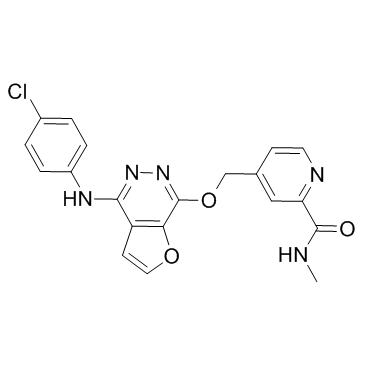
Telatinib
CAS No. 332012-40-5
Telatinib( Bay 57-9352 )
Catalog No. M14115 CAS No. 332012-40-5
An orally active, small molecule inhibitor of VEGFR-2 (IC50=6 nM), VEGFR-3 (IC50=4 nM), PDEGFRα (IC50=15 nM) and c-Kit (IC50=1 nM) in biochemical assays.
Purity : >98% (HPLC)
 COA
Datasheet
HNMR
HPLC
MSDS
Handing Instructions
COA
Datasheet
HNMR
HPLC
MSDS
Handing Instructions
| Size | Price / USD | Stock | Quantity |
| 1 mL x 10 mM in DMSO | 28 | In Stock |


|
| 10MG | 31 | In Stock |
|
| 25MG | 69 | In Stock |
|
| 50MG | 110 | In Stock |
|
| 100MG | Get Quote | In Stock |
|
| 200MG | Get Quote | In Stock |
|
| 500MG | Get Quote | In Stock |
|
| 1G | Get Quote | In Stock |
|
Biological Information
-
Product NameTelatinib
-
NoteResearch use only, not for human use.
-
Brief DescriptionAn orally active, small molecule inhibitor of VEGFR-2 (IC50=6 nM), VEGFR-3 (IC50=4 nM), PDEGFRα (IC50=15 nM) and c-Kit (IC50=1 nM) in biochemical assays.
-
DescriptionAn orally active, small molecule inhibitor of VEGFR-2 (IC50=6 nM), VEGFR-3 (IC50=4 nM), PDEGFRα (IC50=15 nM) and c-Kit (IC50=1 nM) in biochemical assays.Gastric Cancer Phase 2 Clinical(In Vitro):Telatinib has low affinity for the Raf kinase pathway, epidermal growth factor receptor family, the fibroblast growth factor receptor (FGFR) family, or the Tie-2 receptor. Telatinib is metabolized by various cytochrome P450 (CYP) isoforms including CYP3A4/3A5, CYP2C8, CYP2C9, and CYP2C19 as well as by uridine diphosphate glucuronosyltransferase 1A4 (UGT1A4), with the formation of the N-glucuronides of telatinib as the major biotransformation pathway in man. In vitro studies show telatinib to be a weak substrate of the adenosine triphosphate binding cassette (ABC) B1 (ABCB1) transporter. Telatinib at 1 μM significantly enhances the intracellular accumulation of [3H]-mitoxantrone (MX) in ABCG2-overexpressing cell lines. In addition, telatinib at 1 μM significantly reduces the rate of [3H]-MX efflux from ABCG2-overexpressing cells. Furthermore, telatinib significantly inhibits ABCG2-mediated transport of [3H]-E217βG in ABCG2 overexpressing membrane vesicles. (In Vivo):Telatinib causes a significant decrease in endothelium-dependent and endothelium-independent vasodilation. VEGF inhibition by itself decreases NO synthesis, which promotes vasoconstriction, increases peripheral resistance, and therefore can induce an increase in blood pressure. Telatinib (15 mg/kg) with doxorubicin (1.8 mg/kg) significantly decreases the growth rate and tumor size of ABCG2 overexpressing tumors in a xenograft nude mouse model.
-
In VitroTelatinib has low affinity for the Raf kinase pathway, epidermal growth factor receptor family, the fibroblast growth factor receptor (FGFR) family, or the Tie-2 receptor. Telatinib is metabolized by various cytochrome P450 (CYP) isoforms including CYP3A4/3A5, CYP2C8, CYP2C9, and CYP2C19 as well as by uridine diphosphate glucuronosyltransferase 1A4 (UGT1A4), with the formation of the N-glucuronides of telatinib as the major biotransformation pathway in man. In vitro studies show telatinib to be a weak substrate of the adenosine triphosphate binding cassette (ABC) B1 (ABCB1) transporter. Telatinib at 1 μM significantly enhances the intracellular accumulation of [3H]-mitoxantrone (MX) in ABCG2-overexpressing cell lines. In addition, telatinib at 1 μM significantly reduces the rate of [3H]-MX efflux from ABCG2-overexpressing cells. Furthermore, telatinib significantly inhibits ABCG2-mediated transport of [3H]-E217βG in ABCG2 overexpressing membrane vesicles.
-
In VivoTelatinib causes a significant decrease in endothelium-dependent and endothelium-independent vasodilation. VEGF inhibition by itself decreases NO synthesis, which promotes vasoconstriction, increases peripheral resistance, and therefore can induce an increase in blood pressure. Telatinib (15 mg/kg) with doxorubicin (1.8 mg/kg) significantly decreases the growth rate and tumor size of ABCG2 overexpressing tumors in a xenograft nude mouse model.
-
SynonymsBay 57-9352
-
PathwayAngiogenesis
-
TargetVEGFR
-
Recptorc-Kit|PDGFRα|VEGFR2|VEGFR3
-
Research AreaCancer
-
IndicationGastric Cancer
Chemical Information
-
CAS Number332012-40-5
-
Formula Weight409.8257
-
Molecular FormulaC20H16ClN5O3
-
Purity>98% (HPLC)
-
SolubilityDMSO: ≥ 46 mg/mL
-
SMILESO=C(C1=NC=CC(COC2=NN=C(NC3=CC=C(Cl)C=C3)C4=C2OC=C4)=C1)NC
-
Chemical Name2-Pyridinecarboxamide, 4-[[[4-[(4-chlorophenyl)amino]furo[2,3-d]pyridazin-7-yl]oxy]methyl]-N-methyl-
Shipping & Storage Information
-
Storage(-20℃)
-
ShippingWith Ice Pack
-
Stability≥ 2 years
Reference
1. Steeghs N, et al. Clin Cancer Res. 2008 Jun 1;14(11):3470-6.
2. Strumberg D, et al. Br J Cancer. 2008 Nov 18;99(10):1579-85.
3. Sodani K, et al. Biochem Pharmacol. 2014 May 1;89(1):52-61.
molnova catalog



related products
-
AMG-Tie2-1
AMG-Tie2-1 is a potent inhibitor of endothelial endothelial cell kinase 2 (Tie2) and VEGFR2 with anticancer and antitumor activity that affects cardiovascular production, and may be used in the study of cardiovascular disease and cancer.
-
TG 100801
TG 100801 is a dual inhibitor of VEGFr2 and Src family (Src and YES) kinases and is a candidate compound for the treatment of age-related macular degeneration (AMD).
-
Takeda-6d
Takeda-6d is a novel, potent DFG-out RAF/vascular endothelial growth factor receptor 2 (VEGFR2) inhibitor with IC50 of 7.0 nM and 2.2 nM, respectively.
