


 Cart
Cart
 sales@molnova.com


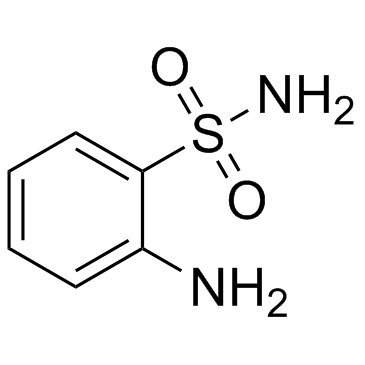
2-Aminobenzenesulfonamide
CAS No. 3306-62-5
2-Aminobenzenesulfonamide( —— )
Catalog No. M14098 CAS No. 3306-62-5
2-Aminobenzenesulfonamide is a molecule containing the sulfonamide functional group attached to an aniline.
Purity : >98% (HPLC)
 COA
Datasheet
HNMR
HPLC
MSDS
Handing Instructions
COA
Datasheet
HNMR
HPLC
MSDS
Handing Instructions
| Size | Price / USD | Stock | Quantity |
| 1 mL x 10 mM in DMSO | 48 | In Stock |


|
| 50MG | 36 | In Stock |
|
| 100MG | 50 | In Stock |
|
| 200MG | 77 | In Stock |
|
| 500MG | 128 | In Stock |
|
| 1G | Get Quote | In Stock |
|
Biological Information
-
Product Name2-Aminobenzenesulfonamide
-
NoteResearch use only, not for human use.
-
Brief Description2-Aminobenzenesulfonamide is a molecule containing the sulfonamide functional group attached to an aniline.
-
Description2-Aminobenzenesulfonamide is a molecule containing the sulfonamide functional group attached to an aniline.
-
In Vitro——
-
In Vivo——
-
Synonyms——
-
PathwayAutophagy
-
TargetAutophagy
-
RecptorDHPS
-
Research AreaOther Indications
-
Indication——
Chemical Information
-
CAS Number3306-62-5
-
Formula Weight172.21
-
Molecular FormulaC6H8N2O2S
-
Purity>98% (HPLC)
-
SolubilityDMSO: 10 mM
-
SMILESNC1=CC=CC=C1S(N)(=O)=O
-
Chemical Name——
Shipping & Storage Information
-
Storage(-20℃)
-
ShippingWith Ice Pack
-
Stability≥ 2 years
Reference
1.RAFFA L. Farmaco Sci. 1957;12(5):387-93.
molnova catalog



related products
-
AMG PERK 44
AMG PERK 44 is an orally active and selective PERK inhibitor (IC50: 6 nM) that induces autophagy. It also inhibits GCN2 (IC50: 7300 nM) and B-Raf (IC50 >1000 nM), making it useful for cancer research.
-
Sofalcone
Sofalcone a gastric antiulcer agent in clinical use is known to induce the expression of Heme oxygenase-1 (HO-1) in gastric epithelium.
-
Sulfacetamide sodium...
Sulfacetamide sodium monohydrate is a sulfonamide antibiotic, has been investigated for use in the treatment of pityriasis versicolor and rosacea.
