


 Cart
Cart
 sales@molnova.com


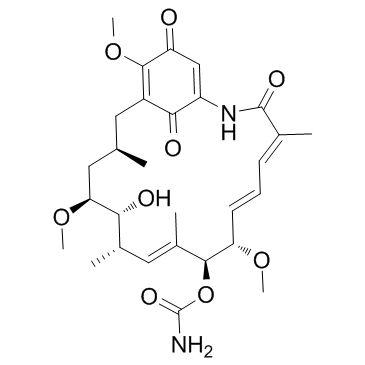
Geldanamycin
CAS No. 30562-34-6
Geldanamycin( NSC 122750 )
Catalog No. M13974 CAS No. 30562-34-6
Geldanamycin is a natural existing HSP90 inhibitor with Kd of 1.2 μM, specifically disrupts glucocorticoid receptor (GR)/HSP association.
Purity : >98% (HPLC)
 COA
Datasheet
HNMR
HPLC
MSDS
Handing Instructions
COA
Datasheet
HNMR
HPLC
MSDS
Handing Instructions
| Size | Price / USD | Stock | Quantity |
| 1 mL x 10 mM in DMSO | 41 | In Stock |


|
| 10MG | 37 | In Stock |
|
| 25MG | 68 | In Stock |
|
| 50MG | 113 | In Stock |
|
| 100MG | 184 | In Stock |
|
| 200MG | Get Quote | In Stock |
|
| 500MG | Get Quote | In Stock |
|
| 1G | Get Quote | In Stock |
|
Biological Information
-
Product NameGeldanamycin
-
NoteResearch use only, not for human use.
-
Brief DescriptionGeldanamycin is a natural existing HSP90 inhibitor with Kd of 1.2 μM, specifically disrupts glucocorticoid receptor (GR)/HSP association.
-
DescriptionGeldanamycin is a natural existing HSP90 inhibitor with Kd of 1.2 μM, specifically disrupts glucocorticoid receptor (GR)/HSP association.(In Vitro):Geldanamycin significantly delays and reduces viperin expression, indicating that IRF3 is involved in viperin induction in RAW264.7 cells. Geldanamycin (GA), a benzoquinone ansamycin, protected against neuronal injury induced by oxygen-glucose deprivation (OGD)/zVAD treatment in cultured primary neurons. More importantly, Geldanamycin decreases RIP1 protein level in a time and concentration-dependent manner. Geldanamycin also decreases the Hsp90 protein level, which causes instability of RIP1 protein, resulting in decreased RIP1 protein level but not RIP1 mRNA level after Geldanamycin treatment. Geldanamycin (GA) is identified as the first natural product inhibitor of Hsp90 that binds to the N-terminal ATPase domain of Hsp90 to inhibit its chaperone function, and significantly induces tumor cell death via an apoptotic mechanism.
-
In Vitro——
-
In Vivo——
-
SynonymsNSC 122750
-
PathwayCytoskeleton/Cell Adhesion Molecules
-
TargetHSP
-
RecptorHSP90| HSP90| p185
-
Research AreaCancer
-
Indication——
Chemical Information
-
CAS Number30562-34-6
-
Formula Weight560.64
-
Molecular FormulaC29H40N2O9
-
Purity>98% (HPLC)
-
SolubilityDMSO:50 mg/mL warmed (89.18 mM); Ethanol:<1 mg/mL (<1 mM); Water:<1 mg/mL (<1 mM)
-
SMILESNC(O[C@@H](/C(C)=C/[C@H](C)[C@@H](O)[C@@H](OC)C[C@H](C)CC1=C2OC)[C@@H](OC)/C=C\C=C(C)\C(NC(C1=O)=CC2=O)=O)=O
-
Chemical Name(4E,6Z,8S,9S,10E,12S,13R,14S,16R)-13-hydroxy-8,14,19-trimethoxy-4,10,12,16-tetramethyl-3,20,22-trioxo-2-azabicyclo[16.3.1]docosa-1(21),4,6,10,18-pentaen-9-yl carbamate
Shipping & Storage Information
-
Storage(-20℃)
-
ShippingWith Ice Pack
-
Stability≥ 2 years
Reference
1.Roe SM, et al, J Med Chem, 1999, 42(2), 260-266.
molnova catalog



related products
-
Periplocin
Periplocin has anti-cancer effects on lung cancer cells, induces apoptosis and inhibits growth of cancer cells by the beta-catenin/Tcf signaling pathway.
-
CP-9
A potent Hsp90α/p23 interaction inhibitor with IC50 of 3.2 uM; 5-fold less potent for Hsp90β/p23 interaction (IC50=15.3 uM).
-
JG-98
JG-98 is an allosteric Hsp70 inhibitor, displays >3-fold more active, greater stability than MKT-077 against the breast cancer cell lines MDA-MB-231 and MCF-7 (EC50 of 0.4 uM and 0.7 uM, respectively).
