


 Cart
Cart
 sales@molnova.com


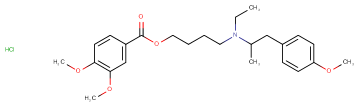
Mebeverine hydrochloride
CAS No. 2753-45-9
Mebeverine hydrochloride( —— )
Catalog No. M13843 CAS No. 2753-45-9
Mebeverine is a drug whose major therapeutic role is in the treatment of irritable bowel syndrome (IBS) and the associated abdominal cramping.
Purity : >98% (HPLC)
 COA
Datasheet
HNMR
HPLC
MSDS
Handing Instructions
COA
Datasheet
HNMR
HPLC
MSDS
Handing Instructions
| Size | Price / USD | Stock | Quantity |
| 1 mL x 10 mM in DMSO | 35 | In Stock |


|
| 25MG | 35 | In Stock |
|
| 50MG | 51 | In Stock |
|
| 100MG | 77 | In Stock |
|
| 200MG | Get Quote | In Stock |
|
| 500MG | 170 | In Stock |
|
| 1G | 269 | In Stock |
|
Biological Information
-
Product NameMebeverine hydrochloride
-
NoteResearch use only, not for human use.
-
Brief DescriptionMebeverine is a drug whose major therapeutic role is in the treatment of irritable bowel syndrome (IBS) and the associated abdominal cramping.
-
DescriptionMebeverine is a drug whose major therapeutic role is in the treatment of irritable bowel syndrome (IBS) and the associated abdominal cramping. It works by relaxing the muscles in and around the gut. It is a musculotropic antispasmodic drug without anticholinergic side-effects. The drug is also indicated for treatment of gastrointestinal spasm secondary to organic disorder.(In Vitro):Mebeverine hydrochloride inhibits the α1 action by limiting the amount of available calcium mobilized on receptor stimulation of the smooth muscle cells of guinea-pig taenia caeci. Mebeverine (6×10⁻⁶ M) hydrochloride shows atropine-like properties by shifting to the right the concentration-response curve obtained with carbachol. The α1-receptor-induced hyperpolarization caused by adrenaline (3×10⁻⁶ M) in the presence of mebeverine declines after reaching an initial maximum. Mebeverine (6×10⁻⁵ M) hydrochloride causes a small hyperpolarization of the muscle cells (2.1 + 0.5 mV) and suppression of spike activity.
-
In VitroMebeverine hydrochloride inhibits the α1 action by limiting the amount of available calcium mobilized on receptor stimulation of the smooth muscle cells of guinea-pig taenia caeci. Mebeverine (6×10⁻⁶ M) hydrochloride shows atropine-like properties by shifting to the right the concentration-response curve obtained with carbachol. The α1-receptor-induced hyperpolarization caused by adrenaline (3×10⁻⁶ M) in the presence of mebeverine declines after reaching an initial maximum. Mebeverine (6×10⁻⁵ M) hydrochloride causes a small hyperpolarization of the muscle cells (2.1 + 0.5 mV) and suppression of spike activity.
-
In Vivo——
-
Synonyms——
-
PathwayOthers
-
TargetOther Targets
-
RecptorOthers
-
Research Area——
-
Indication——
Chemical Information
-
CAS Number2753-45-9
-
Formula Weight466.01
-
Molecular FormulaC25H36ClNO5
-
Purity>98% (HPLC)
-
SolubilityDMSO: 10 mM
-
SMILESCl.CCN(CCCCOC(=O)C1=CC(OC)=C(OC)C=C1)C(C)CC1=CC=C(OC)C=C1
-
Chemical Name——
Shipping & Storage Information
-
Storage(-20℃)
-
ShippingWith Ice Pack
-
Stability≥ 2 years
Reference
1.Rahman MZ, et al. Mymensingh Med J. 2014 Jan;23(1):105-13.
molnova catalog



related products
-
Foliachinenoside C
The seeds of Datura metel.
-
N-Methylflindersine
N-Methylflindersine shows strong toxicity towards brine shrimp larvae, with an LD(50) value of 1.39 microg/ml.
-
AGRP (25-51)
AGRP (25-51)
