


 Cart
Cart
 sales@molnova.com


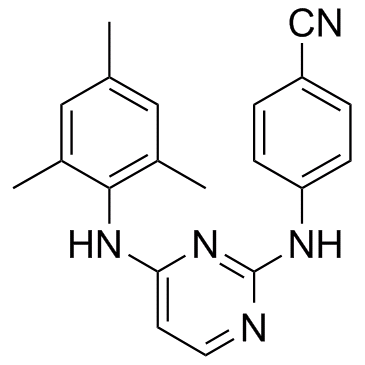
Dapivirine
CAS No. 244767-67-7
Dapivirine( TMC120 )
Catalog No. M13709 CAS No. 244767-67-7
Dapivirine (TMC120) is a non-nucleoside inhibitor for HIV reverse transcriptase with IC50 of 24 nM.
Purity : >98% (HPLC)
 COA
Datasheet
HNMR
HPLC
MSDS
Handing Instructions
COA
Datasheet
HNMR
HPLC
MSDS
Handing Instructions
| Size | Price / USD | Stock | Quantity |
| 1 mL x 10 mM in DMSO | 28 | In Stock |


|
| 10MG | 29 | In Stock |
|
| 25MG | 57 | In Stock |
|
| 50MG | 85 | In Stock |
|
| 100MG | 128 | In Stock |
|
| 200MG | 184 | In Stock |
|
| 500MG | Get Quote | In Stock |
|
| 1G | Get Quote | In Stock |
|
Biological Information
-
Product NameDapivirine
-
NoteResearch use only, not for human use.
-
Brief DescriptionDapivirine (TMC120) is a non-nucleoside inhibitor for HIV reverse transcriptase with IC50 of 24 nM.
-
DescriptionDapivirine (TMC120) is a non-nucleoside inhibitor for HIV reverse transcriptase with IC50 of 24 nM, inhibits a broad panel of HIV-1 isolates from different classes, inclucing a wide range of NNRTI-resistant isolates. Phase 3.(In Vitro):Dapivirine (4-64 μM, 24, 48, 72, 96 and 120 hours) inhibits proliferation of glioma cells and induces apoptosis (16 μM, 12-48 h).Dapivirine (8 and 16 μM, 12 h) enhances invasion of glioma cells.Dapivirine (16 μM, 12 h, 24 h and 48 h) promotes autophagy in U87 cells.Dapivirine (TMC120-R147681) apparently blocks infection in the primary cultures at a 10 nM concentration, but secondary cultures revealed that a 100 nM concentration was needed to completely prevent proviral integration.(In Vivo):Dapivirine (16 mg/kg, once every 3 days for 12 days) exhibits potent antitumor activity in human glioblastoma models in mice.Dapivirine has been shown to have a half-life in the range of 65 to 90 h.
-
In VitroDapivirine (4-64 μM, 24, 48, 72, 96 and 120 hours) inhibits proliferation of glioma cells and induces apoptosis (16 μM, 12-48 h).Dapivirine (8 and 16 μM, 12 h) enhances invasion of glioma cells.Dapivirine (16 μM, 12 h, 24 h and 48 h) promotes autophagy in U87 cells.Dapivirine(TMC120-R147681) apparently blocks infection in the primary cultures at a 10 nM concentration, but secondary cultures revealed that a 100 nM concentration was needed to completely prevent proviral integration. Cell Proliferation AssayCell Line:U87 glioblastoma cells.Concentration:4, 8, 16 μM.Incubation Time:24, 48, 72, 96 and 120 hours.Result:Inhibited proliferation of glioma cells.IC50 was 10.73 μM.Apoptosis Analysis Cell Line:U87 glioblastoma cells.Concentration:16 μM.Incubation Time:12h, 24h and 48h.Result:Induced apoptosis.
-
In VivoDapivirine (16 mg/kg, once every 3 days for 12 days) exhibits potent antitumor activity in human glioblastoma models in mice.Dapivirine has been shown to have a half-life in the range of 65 to 90 h. Animal Model:U87 cells were subcutaneously injected into the nude mice.Dosage:16 mg/kg.Administration:Once every 3 days for 12 days.Result:Significantly decreased the tumor volumes.A significant decrease in Ki67 (a marker for proliferating cells that is overexpressed in many cancers) staining in sections of dapivirine-treated tumors compared to tumors from vehicle-treated mice.
-
SynonymsTMC120
-
PathwayMicrobiology/Virology
-
TargetHIV
-
RecptorHIV reverse transcriptase
-
Research AreaInfection
-
Indication——
Chemical Information
-
CAS Number244767-67-7
-
Formula Weight329.4
-
Molecular FormulaC20H19N5
-
Purity>98% (HPLC)
-
SolubilityDMSO: 34 mg/mL (103.21 mM)
-
SMILESN#CC1=CC=C(NC2=NC=CC(NC3=C(C)C=C(C)C=C3C)=N2)C=C1
-
Chemical Name4-[[4-[(2,4,6-Trimethylphenyl)amino]-2-pyrimidinyl]amino]benzonitrile
Shipping & Storage Information
-
Storage(-20℃)
-
ShippingWith Ice Pack
-
Stability≥ 2 years
Reference
1.Van Herrewege Y, et al. Antimicrob Agents ChemOthers, 2004, 48(1), 337-339.
molnova catalog



related products
-
GS-9822
GS-9822 is a potent, non-catalytic site HIV integrase inhibitor with wild type EC50 of 3 nM.
-
ABX464
ABX464 (ABX-464, ABX 464) is a novel class of anti-HIV small molecule targeting Rev-mediated viral RNA biogenesis.
-
HIV-1 Integrase Inhi...
HIV-1 Integrase Inhibitor 7 is an allosteric HIV-1 integrase inhibitor that inhibits the LEDGF/p75-integrase interaction.
