


 Cart
Cart
 sales@molnova.com


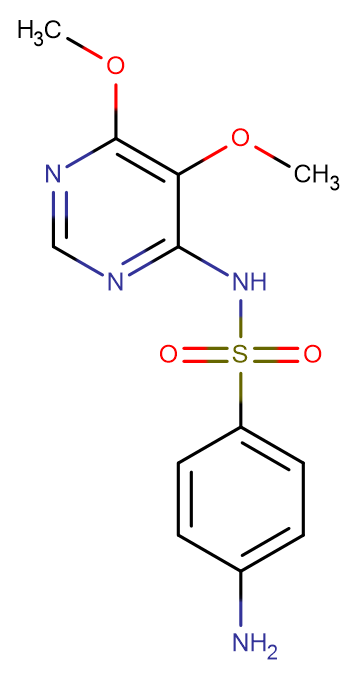
Sulfadoxine
CAS No. 2447-57-6
Sulfadoxine( Ro 4-4393 )
Catalog No. M13708 CAS No. 2447-57-6
Sulfadoxine(Sulphadoxine) is a long acting sulfonamide that is used, usually in combination with other drugs, for respiratory, urinary tract and malarial infections.
Purity : >98% (HPLC)
 COA
Datasheet
HNMR
HPLC
MSDS
Handing Instructions
COA
Datasheet
HNMR
HPLC
MSDS
Handing Instructions
| Size | Price / USD | Stock | Quantity |
| 1 mL x 10 mM in DMSO | 28 | In Stock |


|
| 100MG | Get Quote | In Stock |
|
| 200MG | Get Quote | In Stock |
|
| 500MG | 27 | In Stock |
|
| 1G | Get Quote | In Stock |
|
Biological Information
-
Product NameSulfadoxine
-
NoteResearch use only, not for human use.
-
Brief DescriptionSulfadoxine(Sulphadoxine) is a long acting sulfonamide that is used, usually in combination with other drugs, for respiratory, urinary tract and malarial infections.
-
DescriptionSulfadoxine(Sulphadoxine) is a long acting sulfonamide that is used, usually in combination with other drugs, for respiratory, urinary tract and malarial infections.(In Vitro):Sulfadoxine(Sulphadoxine) is an ultra-long-lasting sulfonamide. Sulfadoxine is often used in combination with pyrimethamine to treat or prevent malaria. Both drugs are antifolates; they inhibit the production of enzymes involved in the synthesis of folic acid within the parasites. Either drug by itself is only moderately effective in treating malaria, because the parasite Plasmodium falciparum may be able to use exogenous folic acid, i.e. folic acid which is present in the parasite's environment, while in combination, the two substances have a synergistic effect which outbalances that ability.
-
In VitroSulfadoxine(Sulphadoxine) is an ultra-long-lasting sulfonamide. Sulfadoxine is often used in combination with pyrimethamine to treat or prevent malaria. Both drugs are antifolates; they inhibit the production of enzymes involved in the synthesis of folic acid within the parasites. Either drug by itself is only moderately effective in treating malaria, because the parasite Plasmodium falciparum may be able to use exogenous folic acid, i.e. folic acid which is present in the parasite's environment, while in combination, the two substances have a synergistic effect which outbalances that ability.
-
In Vivo——
-
SynonymsRo 4-4393
-
PathwayAutophagy
-
TargetAutophagy
-
RecptorDHPS| DHFR
-
Research AreaInfection
-
Indication——
Chemical Information
-
CAS Number2447-57-6
-
Formula Weight310.33
-
Molecular FormulaC12H14N4O4S
-
Purity>98% (HPLC)
-
SolubilityWater: 62 mg/mL (199.78 mM)
-
SMILESO=S(C1=CC=C(N)C=C1)(NC2=NC=NC(OC)=C2OC)=O
-
Chemical Name4-amino-N-(5,6-dimethoxypyrimidin-4-yl)benzenesulfonamide
Shipping & Storage Information
-
Storage(-20℃)
-
ShippingWith Ice Pack
-
Stability≥ 2 years
Reference
1. Raman J, et al. Am J Trop Med Hyg. 2010, 82(5):788-94.
molnova catalog



related products
-
Sulfaguanidine
Sulfaguanidine is a sulfonamide used as an anti-infective agent.
-
NL-1
NL-1 is a mitoNEET inhibitor with antileukemic effect.
-
Indophagolin
Indophagolin is a potent, indoline-containing autophagy inhibitor with IC50 of 140 nM.?
