


 Cart
Cart
 sales@molnova.com


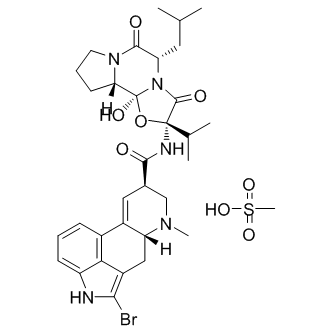
Bromocriptine mesylate
CAS No. 22260-51-1
Bromocriptine mesylate( CB-154 )
Catalog No. M13556 CAS No. 22260-51-1
Bromocriptine (CB-154) is a dopamine D2 receptor agonist (Ki=3 nM) and and various serotonin receptors, also inhibits the release of glutamate by reversing the glutamate GLT1 transporter.
Purity : >98% (HPLC)
 COA
Datasheet
HNMR
HPLC
MSDS
Handing Instructions
COA
Datasheet
HNMR
HPLC
MSDS
Handing Instructions
| Size | Price / USD | Stock | Quantity |
| 1 mL x 10 mM in DMSO | 28 | In Stock |


|
| 25MG | 30 | In Stock |
|
| 50MG | 40 | In Stock |
|
| 100MG | 55 | In Stock |
|
| 200MG | Get Quote | In Stock |
|
| 500MG | Get Quote | In Stock |
|
| 1G | Get Quote | In Stock |
|
Biological Information
-
Product NameBromocriptine mesylate
-
NoteResearch use only, not for human use.
-
Brief DescriptionBromocriptine (CB-154) is a dopamine D2 receptor agonist (Ki=3 nM) and and various serotonin receptors, also inhibits the release of glutamate by reversing the glutamate GLT1 transporter.
-
DescriptionBromocriptine (CB-154) is a dopamine D2 receptor agonist (Ki=3 nM) and and various serotonin receptors, also inhibits the release of glutamate by reversing the glutamate GLT1 transporter; decreases body fat in animal and human models and increases lean muscle mass, improves glucose intolerance and insulin resistance, and reduces triglycerides and free fatty acids; also induces apoptosis and decreases colony formation in AML cells, shows synergy with standard agents and selectivity for the leukemic cell; reduces hyperphagia and adiposity in rats with diet-induced obesity.Diabetes Approved(In Vitro):Bromocriptine stimulates [35S]-GTPγS binding at D2 dopamine receptor expressed in CHO cells with pEC50 of 8.15±0.05. Bromocriptine also is a strong inhibitor of brain nitric oxide synthase. The ergot alkaloid Bromocriptine (BKT) is found to act as a strong inhibitor of purified neuronal nitric oxide synthase (NOS) (IC50=10±2 μM) whereas it is poorly active towards inducible macrophage NOS (IC50>100 μM) . Bromocriptine is found to inhibit the activity of at least one human cytochrome P450 enzyme. Bromocriptine is a potent inhibitor of CYP3A4 with a calculated IC50 value for the interaction of 1.69 μM. (In Vivo):Bromocriptine mesylate (2 mg/kg, i.p.) is administered for 7 days in groups of mice in forced swimming test (FST) and tail suspension test (TST). Bromocriptine group shows significant anti-immobility action as compared to control. When Bromocriptine administered 30 min after the last dose of 7 days MPE treatment and subjected to FST, this dopaminergic agonist produces significant and dose dependent potentiation of anti-immobility action of MPE (200 mg/kg, p.o.) as compared to MPE treatment alone. Bromocriptine treatment group shows a significant reduction of immobility time as compared to control. Bromocriptine administration after 7 days pretreatment with MPE (100 and 200 mg/kg, p.o.) shows significant and dose dependent potentiation of anti-immobility action of MPE as compared to MPE treatment alone. Intracisternal administration of Bromocriptine decreases significantly the static mechanical allodynia (SMA) score compared to that of sham (saline-injected rats) and its effect lasted for 30 min. Intraperitoneal administration of Bromocriptine induces a significant, dose dependent (0.1 mg and 1 mg/kg) decrease in pain scores in CCI-IoN group when compared to sham and its effect lasted for 6 h. The highest dose induces the highest score decrease (P<0.01). Bromocriptine effect lasts for 20 min. Intraperitoneal administration of Bromocriptine induces a significant dose dependent decrease in SMA score in CCI-IoN+6-OHDA lesioned group compared to that of sham. Its effect lasts for 6 h.
-
In VitroBromocriptine stimulates [35S]-GTPγS binding at D2 dopamine receptor expressed in CHO cells with pEC50 of 8.15±0.05. Bromocriptine also is a strong inhibitor of brain nitric oxide synthase. The ergot alkaloid Bromocriptine (BKT) is found to act as a strong inhibitor of purified neuronal nitric oxide synthase (NOS) (IC50=10±2 μM) whereas it is poorly active towards inducible macrophage NOS (IC50>100 μM) . Bromocriptine is found to inhibit the activity of at least one human cytochrome P450 enzyme. Bromocriptine is a potent inhibitor of CYP3A4 with a calculated IC50 value for the interaction of 1.69 μM.
-
In VivoBromocriptine mesylate (2 mg/kg, i.p.) is administered for 7 days in groups of mice in forced swimming test (FST) and tail suspension test (TST). Bromocriptine group shows significant anti-immobility action as compared to control. When Bromocriptine administered 30 min after the last dose of 7 days MPE treatment and subjected to FST, this dopaminergic agonist produces significant and dose dependent potentiation of anti-immobility action of MPE (200 mg/kg, p.o.) as compared to MPE treatment alone. Bromocriptine treatment group shows a significant reduction of immobility time as compared to control. Bromocriptine administration after 7 days pretreatment with MPE (100 and 200 mg/kg, p.o.) shows significant and dose dependent potentiation of anti-immobility action of MPE as compared to MPE treatment alone. Intracisternal administration of Bromocriptine decreases significantly the static mechanical allodynia (SMA) score compared to that of sham (saline-injected rats) and its effect lasted for 30 min. Intraperitoneal administration of Bromocriptine induces a significant, dose dependent (0.1 mg and 1 mg/kg) decrease in pain scores in CCI-IoN group when compared to sham and its effect lasted for 6 h. The highest dose induces the highest score decrease (P<0.01). Bromocriptine effect lasts for 20 min. Intraperitoneal administration of Bromocriptine induces a significant dose dependent decrease in SMA score in CCI-IoN+6-OHDA lesioned group compared to that of sham. Its effect lasts for 6 h.
-
SynonymsCB-154
-
PathwayGPCR/G Protein
-
TargetDopamine Receptor
-
RecptorDopamine Receptor
-
Research AreaMetabolic Disease
-
IndicationDiabetes
Chemical Information
-
CAS Number22260-51-1
-
Formula Weight750.7001
-
Molecular FormulaC33H44BrN5O8S
-
Purity>98% (HPLC)
-
SolubilityDMSO: ≥ 30 mg/mL
-
SMILESO=C([C@H](C=C12)CN(C)[C@]2([H])CC3=C(Br)NC4=C3C1=CC=C4)N[C@@](O5)(C(C)C)C(N6[C@]5(O)[C@@](CCC7)([H])N7C([C@@H]6CC(C)C)=O)=O.CS(=O)(O)=O
-
Chemical NameErgotaman-3',6',18-trione, 2-bromo-12'-hydroxy-2'-(1-methylethyl)-5'-(2-methylpropyl)-, (5α)-, methanesulfonate (1:1)
Shipping & Storage Information
-
Storage(-20℃)
-
ShippingWith Ice Pack
-
Stability≥ 2 years
Reference
1. Shirasaki Y, et al. Eur J Pharmacol. 2010 Sep 15;643(1):48-57.
2. Oda T, et al. Eur J Pharmacol. 2008 Nov 19;598(1-3):27-31.
3. Wacker J, et al. Psychophysiology. 2006 Jul;43(4):372-81.
4. Liberante FG, et al. Oncotarget. 2016 Feb 9;7(6):6609-19.
molnova catalog



related products
-
Trazpiroben
Trazpiroben (TAK-906) is a selective dopamine D2/D3 receptor antagonist utilized in gastroparesis research.
-
Benztropine mesylate
Benzatropine is an anticholinergic drug used in patients to reduce the side effects of antipsychotic treatment.
-
Fluphenazine decanoa...
Fluphenazine decanoate is dopamine D2 receptor blockeand is a long-acting phenothiazine neuroleptic that used to treat schizophrenia.
