


 Cart
Cart
 sales@molnova.com


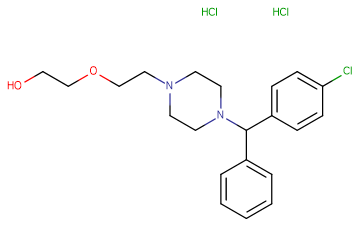
Hydroxyzine dihydrochloride
CAS No. 2192-20-3
Hydroxyzine dihydrochloride( —— )
Catalog No. M13496 CAS No. 2192-20-3
Hydroxyzine Dihydrochloride is a histamine H1-receptor antagonist.
Purity : >98% (HPLC)
 COA
Datasheet
HNMR
HPLC
MSDS
Handing Instructions
COA
Datasheet
HNMR
HPLC
MSDS
Handing Instructions
| Size | Price / USD | Stock | Quantity |
| 1 mL x 10 mM in DMSO | 37 | In Stock |


|
| 100MG | Get Quote | In Stock |
|
| 200MG | 27 | In Stock |
|
| 500MG | 33 | In Stock |
|
| 1G | 45 | In Stock |
|
Biological Information
-
Product NameHydroxyzine dihydrochloride
-
NoteResearch use only, not for human use.
-
Brief DescriptionHydroxyzine Dihydrochloride is a histamine H1-receptor antagonist.
-
DescriptionHydroxyzine Dihydrochloride is a histamine H1-receptor antagonist.(In Vitro):Hydroxyzine dihydrochloride inhibits carbachol (10 μM)-induced serotonin release by 34% at 10 μM, by 25% 1 μM and by 17% 0.1 μM in pretreated bladder slices for 60 min.(In Vivo):Hydroxyzine dihydrochloride (12.5 mg/kg, 25 mg/kg and 50 mg/kg i.p.) shows little direct analgesic activity but markedly potentiates only the effect of morphine on the vocalization after-discharge which represents the affective component of pain in rats. Hydroxyzine dihydrochloride (50 mg/kg i.p.) potentiates morphine on the tail-flick test, while Hydroxyzine (12.5 mg/kg i.p.) decreases morphine antinociception in rats.
-
In VitroHydroxyzine dihydrochloride inhibits carbachol (10 μM)-induced serotonin release by 34% at 10 μM, by 25% 1 μM and by 17% 0.1 μM in pretreated bladder slices for 60 min.
-
In VivoHydroxyzine dihydrochloride (12.5 mg/kg, 25 mg/kg and 50 mg/kg i.p.) shows little direct analgesic activity but markedly potentiates only the effect of morphine on the vocalization after-discharge which represents the affective component of pain in rats. Hydroxyzine dihydrochloride (50 mg/kg i.p.) potentiates morphine on the tail-flick test, while Hydroxyzine (12.5 mg/kg i.p.) decreases morphine antinociception in rats.
-
Synonyms——
-
PathwayGPCR/G Protein
-
TargetHistamine Receptor
-
RecptorH1 receptor
-
Research AreaInflammation/Immunology
-
Indication——
Chemical Information
-
CAS Number2192-20-3
-
Formula Weight447.83
-
Molecular FormulaC21H27ClN2O2·2HCl
-
Purity>98% (HPLC)
-
SolubilityEthanol: 15 mg/mL (33.49 mM); Water: 90 mg/mL (200.96 mM); DMSO: 90 mg/mL (200.96 mM)
-
SMILESCl.Cl.OCCOCCN1CCN(CC1)C(C1=CC=CC=C1)C1=CC=C(Cl)C=C1
-
Chemical Name——
Shipping & Storage Information
-
Storage(-20℃)
-
ShippingWith Ice Pack
-
Stability≥ 2 years
Reference
1.Anthes JC, et al. Eur J Pharmacol, 2002, 449(3), 229-237.
molnova catalog



related products
-
S 38093 HCl
S 38093 is a novel brain-penetrant antagonist/inverse agonist of H3 receptors.
-
Bicyclol
Bicyclol(SY 801) is an anti-hepatitis drug. Oral administration of bicyclol normalizes the elevated serum transaminases (ALT, AST) by 50% in chronic viral hepatitis B and C, and also has a certain level of inhibiting HBV and HCV replication.
-
JNJ 39220675
JNJ 39220675 is potent and selective, brain penetrant H3 antagonist with Ki of 1.4 nM, pA2 of 9.42 for hH3.
