


 Cart
Cart
 sales@molnova.com


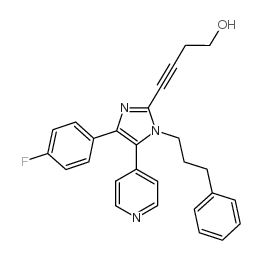
RWJ 67657
CAS No. 215303-72-3
RWJ 67657( RWJ67657 | RWJ-67657 )
Catalog No. M13438 CAS No. 215303-72-3
A potent, selective, orally active p38 MAPK inhibitor that inhibits the production of TNF-α and IL-1β by LPS-stimulated human PBMCs with IC50 of 3 and 11 nM, respectively.
Purity : >98% (HPLC)
 COA
Datasheet
HNMR
HPLC
MSDS
Handing Instructions
COA
Datasheet
HNMR
HPLC
MSDS
Handing Instructions
| Size | Price / USD | Stock | Quantity |
| 1 mL x 10 mM in DMSO | 67 | In Stock |


|
| 2MG | 37 | In Stock |
|
| 5MG | 61 | In Stock |
|
| 10MG | 92 | In Stock |
|
| 25MG | 217 | In Stock |
|
| 50MG | 342 | In Stock |
|
| 100MG | 551 | In Stock |
|
| 200MG | Get Quote | In Stock |
|
| 500MG | 1163 | In Stock |
|
| 1G | Get Quote | In Stock |
|
Biological Information
-
Product NameRWJ 67657
-
NoteResearch use only, not for human use.
-
Brief DescriptionA potent, selective, orally active p38 MAPK inhibitor that inhibits the production of TNF-α and IL-1β by LPS-stimulated human PBMCs with IC50 of 3 and 11 nM, respectively.
-
DescriptionA potent, selective, orally active p38 MAPK inhibitor that inhibits the production of TNF-α and IL-1β by LPS-stimulated human PBMCs with IC50 of 3 and 11 nM, respectively; inhibits p38α from purified LPS-activated human monocytes with IC50 of 30 nM, less potent for p38β; also inhibits Src (IC50=5 uM), p65 Lck and no activity against other MAPKs and serine-threonine kinases; inhibits TNF-alpha production in LPS-injected mice.
-
In VitroRWJ-67657 inhibits the release of TNF-α by lipopolysaccharide (LPS)-treated human peripheral blood mononuclear cells with an IC50 of 3 nM, as well as the release of TNF-α from peripheral blood mononuclear cells treated with the superantigen staphylococcal enterotoxin B, with an IC50 value of 13 nM. RWJ67657 (10 μM; 24 hours) decreases colony formation in MCF-7 cells.Cell Proliferation AssayCell Line:MCF-7 breast carcinoma cells Concentration:10 μM Incubation Time:24 hours Result:Decreased colony formation.
-
In VivoRWJ-67657 inhibits TNF-alpha production in lipopolysaccharide-injected mice (87% inhibition at 50 mg/kg) and in rats (91% inhibition at 25 mg/kg) after oral administration. RWJ-67657 (50 mg/kg; administered orally; once per day for 7 consecutive days) displays a potent anti-inflammatory effect. By both improving the functioning of endothelial progenitor cells (EPCs) and reducing inflammation, EPC transplantation plus RWJ-67657 administration synergistically promotes angiogenesis and neurogenesis after diabetic stroke. Animal Model:The db/db mice (male, 8 weeks old) with EPCs Dosage:50 mg/kg Administration:Administered orally; once per day for 7 consecutive days Result:Increased angiogenesis and neurogenesis of diabetic mice after cotreatment with EPCs transplantation.
-
SynonymsRWJ67657 | RWJ-67657
-
PathwayMAPK/ERK Signaling
-
Targetp38 MAPK
-
Recptorp38 MAPK
-
Research Area——
-
Indication——
Chemical Information
-
CAS Number215303-72-3
-
Formula Weight425.5
-
Molecular FormulaC27H24FN3O
-
Purity>98% (HPLC)
-
SolubilityIn Vitro:?DMSO : 125 mg/mL (293.77 mM)
-
SMILESFC(C=C1)=CC=C1C2=C(C3=CC=NC=C3)N(CCCC4=CC=CC=C4)C(C#CCCO)=N2
-
Chemical Name4-[4-(4-fluorophenyl)-1-(3-phenylpropyl)-5-(4-pyridinyl)-1H-imidazol -2-yl]-3-butyn-1-ol
Shipping & Storage Information
-
Storage(-20℃)
-
ShippingWith Ice Pack
-
Stability≥ 2 years
Reference
1. Wadsworth SA, et al. J Pharmacol Exp Ther. 1999 Nov;291(2):680-7.
2. Schafer PH, et al. J Immunol. 1999 Jun 15;162(12):7110-9.
3. Fijen JW, et al. Clin Exp Immunol. 2001 Apr;124(1):16-20.
4. Faas MM, et al. Clin Exp Immunol. 2002 Feb;127(2):337-43.
molnova catalog



related products
-
MK2-IN-3
MK2-IN-3 is a potent, cell-permeable inhibitor of mitogen-activated protein kinase-activated protein kinase 2 (MAPKAP-K2 or MK-2) and can be used for the treatment of rheumatoid arthritis
-
HS220
HS220 is an inhibitor of TAK1 which plays a key role in the signaling pathways of inflammation and cell survival.
-
Eudesmin
Eudesmin shows antiinflammatory neuritogenic anticonvulsant and sedative effects the mechanism of eudesmin may be related to up-regulation of GABAA and GAD65 expressions and anti-apoptosis of neuron the in brain.50 microM (+)-eudesmin can induce neurite outgrowth and enhance nerve growth factor (NGF)-mediated neurite outgrowth from PC12 cells by stimulating up-stream MAPK PKC and PKA pathways.
