


 Cart
 sales@molnova.com


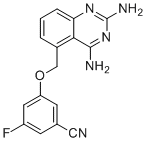
PF-DcpSi
CAS No. 2092917-19-4
PF-DcpSi( —— )
Catalog No. M13280 CAS No. 2092917-19-4
A potent inhibitor of the mRNA decapping scavenger enzyme (DcpS) with IC50 of 0.11 nM; shows no significant activity for DHFR (IC50>30 uM).
Purity : >98% (HPLC)
 COA
Datasheet
HNMR
HPLC
MSDS
Handing Instructions
| Size | Price / USD | Stock | Quantity |
| 100MG | Get Quote | Get Quote |


|
| 200MG | Get Quote | Get Quote |
|
| 500MG | Get Quote | Get Quote |
|
| 1G | Get Quote | Get Quote |
|
Biological Information
-
Product NamePF-DcpSi
-
NoteResearch use only, not for human use.
-
Brief DescriptionA potent inhibitor of the mRNA decapping scavenger enzyme (DcpS) with IC50 of 0.11 nM; shows no significant activity for DHFR (IC50>30 uM).
-
DescriptionA potent inhibitor of the mRNA decapping scavenger enzyme (DcpS) with IC50 of 0.11 nM; shows no significant activity for DHFR (IC50>30 uM); has in vivo mouse CNS PK profile, shows activity in SMA mouse model by prolonging survival and improving function thereby ruling out lysosomotropism.Spinal Muscular Atrophy (SMA)Preclinical.
-
In Vitro——
-
In Vivo——
-
Synonyms——
-
PathwayOthers
-
TargetOther Targets
-
RecptorOther Targets
-
Research AreaNeurological Disease
-
IndicationSpinal Muscular Atrophy(SMA)
Chemical Information
-
CAS Number2092917-19-4
-
Formula Weight309.304
-
Molecular FormulaC16H12FN5O
-
Purity>98% (HPLC)
-
Solubility——
-
SMILESC1=CC(=C2C(=C1)N=C(N=C2N)N)COC3=CC(=CC(=C3)C#N)F
-
Chemical Name3-((2,4-diaminoquinazolin-5-yl)methoxy)-5-fluorobenzonitrile
Shipping & Storage Information
-
Storage(-20℃)
-
ShippingWith Ice Pack
-
Stability≥ 2 years
Reference
1. J Med Chem. 2017 Apr 13;60(7):3094-3108.
molnova catalog



related products
-
Lauric Acid
Lauric Acid,which is found naturally in various plant and animal fats and oils, is a saturated medium-chain fatty acid with a 12-carbon backbone.
-
8-Epiloganin
The fruits of Cornus officinalis Sieb. et Zucc.
-
Glycerol Tridecanoat...
Glycerol Tridecanoate is also known as triacylglycerols or triacylglycerides. The triglycerides are rebuilt in the blood from their fragments and become constituents of lipoproteins which deliver the fatty acids to and from fat cells among other functions. Various tissues can release free fatty acids and take them up as a source of energy.
