


 Cart
Cart
 sales@molnova.com


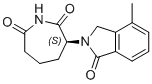
BTX161
CAS No. 2052301-24-1
BTX161( BTX-161 )
Catalog No. M13185 CAS No. 2052301-24-1
BTX161 is a thalidomide analog that mediates degradation of CKIα better than lenalidomide in human AML cells and activates DDR and p53.
Purity : >98% (HPLC)
 COA
Datasheet
HNMR
HPLC
MSDS
Handing Instructions
COA
Datasheet
HNMR
HPLC
MSDS
Handing Instructions
| Size | Price / USD | Stock | Quantity |
| 50MG | 1341 | In Stock |


|
| 100MG | 2124 | In Stock |
|
| 200MG | Get Quote | In Stock |
|
| 500MG | Get Quote | In Stock |
|
| 1G | Get Quote | In Stock |
|
Biological Information
-
Product NameBTX161
-
NoteResearch use only, not for human use.
-
Brief DescriptionBTX161 is a thalidomide analog that mediates degradation of CKIα better than lenalidomide in human AML cells and activates DDR and p53.
-
DescriptionBTX161 is a thalidomide analog that mediates degradation of CKIα better than lenalidomide in human AML cells and activates DDR and p53, while stabilizing the p53 antagonist MDM2; upregulates all the Wnt targets including MYC and does not affect MDM2 mRNA expression.
-
In Vitro——
-
In Vivo——
-
SynonymsBTX-161
-
PathwayMetabolic Enzyme/Protease
-
TargetCasein Kinase
-
RecptorCasein Kinase
-
Research Area——
-
Indication——
Chemical Information
-
CAS Number2052301-24-1
-
Formula Weight272.304
-
Molecular FormulaC15H16N2O3
-
Purity>98% (HPLC)
-
SolubilityIn Vitro:?DMSO : 25 mg/mL (91.81 mM)
-
SMILESCC1=C2CN(C(=O)C2=CC=C1)C3CCCC(=O)NC3=O
-
Chemical Name(S)-3-(4-methyl-1-oxoisoindolin-2-yl)azepane-2,7-dione
Shipping & Storage Information
-
Storage(-20℃)
-
ShippingWith Ice Pack
-
Stability≥ 2 years
Reference
1. Minzel W, et al. Cell. 2018 Aug 20. pii: S0092-8674(18)30973-5. doi: 10.1016/j.cell.2018.07.045.
molnova catalog



related products
-
LH-846
LH846 is a selective inhibitor of CK1δ (IC50 values are 290 nM, 1.3 uM and 2.5 uM for CK1δ, ε and α); displays no inhibitory activity at CK2.
-
PF4800567
PF-4800567 is a selective inhibitor of casein kinase 1ε (CK1ε; IC50 = 32 nM) with greater than 20-fold selectivity over CK1δ.
-
Ellagic Acid hydrate
Ellagic acid hydrate is a natural antioxidant and acts as a potent and ATP-competitive CK2 inhibitor (IC50:40 nM Ki: 20 nM).
