


 Cart
Cart
 sales@molnova.com


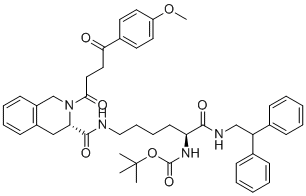
FAUC 1104
CAS No. 1869983-86-7
FAUC 1104( FAUC1104 | FAUC-1104 )
Catalog No. M12894 CAS No. 1869983-86-7
A potent, biased allosteric agonist of CXCR3 (pEC50=5.22) that activates solely G proteins.
Purity : >98% (HPLC)
 COA
Datasheet
HNMR
HPLC
MSDS
Handing Instructions
COA
Datasheet
HNMR
HPLC
MSDS
Handing Instructions
| Size | Price / USD | Stock | Quantity |
| 100MG | Get Quote | Get Quote |


|
| 200MG | Get Quote | Get Quote |
|
| 500MG | Get Quote | Get Quote |
|
| 1G | Get Quote | Get Quote |
|
Biological Information
-
Product NameFAUC 1104
-
NoteResearch use only, not for human use.
-
Brief DescriptionA potent, biased allosteric agonist of CXCR3 (pEC50=5.22) that activates solely G proteins.
-
DescriptionA potent, biased allosteric agonist of CXCR3 (pEC50=5.22) that activates solely G proteins, induces chemotaxis, but fails to induce receptor internalization or β-arrestin 2 recruitment.
-
In Vitro——
-
In Vivo——
-
SynonymsFAUC1104 | FAUC-1104
-
PathwayGPCR/G Protein
-
TargetChemokine Receptor
-
RecptorChemokine Receptor
-
Research Area——
-
Indication——
Chemical Information
-
CAS Number1869983-86-7
-
Formula Weight774.959
-
Molecular FormulaC46H54N4O7
-
Purity>98% (HPLC)
-
Solubility——
-
SMILES——
-
Chemical Nametert-Butyl {(S)-1-[(2,2-diphenylethyl)amino]-6-[(S)-2-(4-(4-methoxyphenyl)-4-oxobutanoyl)-1,2,3,4-tetrahydroisoquinoline-3-carboxamido]-1-oxohexan-2-yl}carbamate
Shipping & Storage Information
-
Storage(-20℃)
-
ShippingWith Ice Pack
-
Stability≥ 2 years
Reference
1. Milanos L, et al. J Med Chem. 2016 Mar 10;59(5):2222-43.
molnova catalog



related products
-
VUF11207 fumarate (b...
A potent CXCR7 (ACKR3) agonist with EC50 of 1.6 nM; inducse recruitment of β-arrestin2 and subsequent internalization of CXCR7 in cells.
-
AF-399 42016530
A potent CCR4 antagonist that blocked CCL22- and CCL17-mediated migration of human peripheral blood CD4+CD25+ Treg and Th2 cells ex-vivo and murine Tregs in-vivo.
-
SCH-563705
A potent, orally bioavailable dual CXCR2/CXCR1 receptor antagonist with IC50 of 1.3 nM and 7.3 nM, respectively.
