


 Cart
Cart
 sales@molnova.com


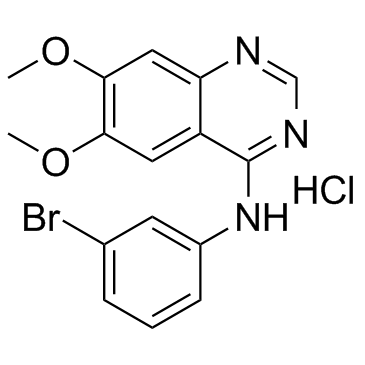
PD153035 hydrochloride
CAS No. 183322-45-4
PD153035 hydrochloride( AG-1517 )
Catalog No. M12831 CAS No. 183322-45-4
PD153035 hydrochloride (ZM 252868; AG 1517) is a potent and specific inhibitor of EGFR with Ki and IC50 of 5.2 pM and 29 pM; little effect against PGDFR, FGFR, CSF-1, InsR and Src.
Purity : >98% (HPLC)
 COA
Datasheet
HNMR
HPLC
MSDS
Handing Instructions
COA
Datasheet
HNMR
HPLC
MSDS
Handing Instructions
| Size | Price / USD | Stock | Quantity |
| 1 mL x 10 mM in DMSO | 29 | In Stock |


|
| 5MG | 29 | In Stock |
|
| 10MG | 35 | In Stock |
|
| 25MG | 71 | In Stock |
|
| 50MG | 124 | In Stock |
|
| 100MG | 197 | In Stock |
|
| 200MG | 293 | In Stock |
|
| 500MG | Get Quote | In Stock |
|
| 1G | Get Quote | In Stock |
|
Biological Information
-
Product NamePD153035 hydrochloride
-
NoteResearch use only, not for human use.
-
Brief DescriptionPD153035 hydrochloride (ZM 252868; AG 1517) is a potent and specific inhibitor of EGFR with Ki and IC50 of 5.2 pM and 29 pM; little effect against PGDFR, FGFR, CSF-1, InsR and Src.
-
DescriptionPD153035 hydrochloride (ZM 252868; AG 1517) is a potent and specific inhibitor of EGFR with Ki and IC50 of 5.2 pM and 29 pM; little effect against PGDFR, FGFR, CSF-1, InsR and Src.
-
In VitroPD153035 inhibits EGF-stimulated receptor autophosphorylation in A431 human epidermoid carcinoma cells, with an IC50 of 14 nM. PD153035 has little effect on PDGFR, FGFR, CSF-1 receptor, the insulin receptor, or on src tyrosine kinases at concentrations as high as 50 μM. PD153035 rapidly suppresses autophosphorylation of the EGF receptor at low nanomolar concentrations in fibroblasts or in human epidermoid carcinoma cells and selectively blocks EGF-mediated cellular processes including mitogenesis, early gene expression, and oncogenic transformation. PD153035 causes a dose-dependent growth inhibition of EGF receptor-positive cell lines, beginning at less than micromolar concentrations, and the IC50 is less than 1 pM in most cases.
-
In VivoPD153035 levels in the plasma and tumor rise to 50 and 22 μM within 15 minutes following a single i.p. dose of 80 mg/kg. While the plasma levels of PD 153035 falls below 1 μM by 3 hours, in the tumors it remains at micromolar concentrations for at least 12 hours. The tyrosine phosphorylation of the EGF receptor is rapidly suppressed by 80-90% in the tumors.
-
SynonymsAG-1517
-
PathwayAngiogenesis
-
TargetEGFR
-
RecptorEGFR| EGFR
-
Research AreaCancer
-
Indication——
Chemical Information
-
CAS Number183322-45-4
-
Formula Weight396.67
-
Molecular FormulaC16H15BrClN3O2
-
Purity>98% (HPLC)
-
SolubilityDMSO: 0.5 mg/mL (1.26 mM)
-
SMILESCOc(c1)c(OC)cc2c1ncnc2Nc3cc(Br)ccc3.Cl
-
Chemical NameN-(3-bromophenyl)-6,7-dimethoxyquinazolin-4-amine hydrochloride
Shipping & Storage Information
-
Storage(-20℃)
-
ShippingWith Ice Pack
-
Stability≥ 2 years
Reference



-
SU5402
SU5402 is a potent multi-targeted receptor tyrosine kinase inhibitor with IC50 of 20 nM, 30 nM, and 510 nM for VEGFR2, FGFR1, and PDGF-Rβ, respectively.
-
EGFR-IN-7
EGFR-IN-7 is a selective and potent EGFR kinase inhibitor.TQB3804 displayed potent enzymatic activities for EGFRd746-750/T790M/C797S, EGFRL858R/T790M/C797S, EGFRd746-750/T790M, and EGFRL858R/T790M with IC50 of 0.46, 0.13, 0.26, and 0.19 nM respectively, and has similar enzymatic activity for EGFRWT (IC50 = 1.07) to Osimertinib.
-
PD 089828
PD 089828 is a competitive inhibitor of the receptor tyrosine kinases FGFR1, PDGFRβ, and EGFR (IC50s = 0.15, 1.76, and 5.47 μM, respectively) and a noncompetitive inhibitor of the nonreceptor tyrosine kinase c-Src (IC50 = 0.18 μM)
