


 Cart
Cart
 sales@molnova.com


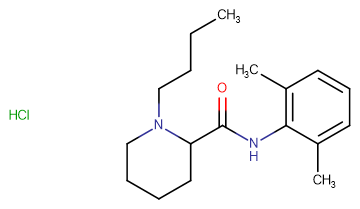
Bupivacaine hydrochloride
CAS No. 18010-40-7
Bupivacaine hydrochloride( —— )
Catalog No. M12740 CAS No. 18010-40-7
Bupivacaine hydrochloride binds to the intracellular portion of voltage-gated sodium channels and blocks sodium influx into nerve cells.
Purity : >98% (HPLC)
 COA
Datasheet
HNMR
HPLC
MSDS
Handing Instructions
COA
Datasheet
HNMR
HPLC
MSDS
Handing Instructions
| Size | Price / USD | Stock | Quantity |
| 1 mL x 10 mM in DMSO | 28 | In Stock |


|
| 100MG | 33 | In Stock |
|
| 200MG | 36 | In Stock |
|
| 500MG | 49 | In Stock |
|
| 1G | 72 | In Stock |
|
Biological Information
-
Product NameBupivacaine hydrochloride
-
NoteResearch use only, not for human use.
-
Brief DescriptionBupivacaine hydrochloride binds to the intracellular portion of voltage-gated sodium channels and blocks sodium influx into nerve cells.
-
DescriptionBupivacaine hydrochloride binds to the intracellular portion of voltage-gated sodium channels and blocks sodium influx into nerve cells, used for treating cardiac arrhythmias. Bupivacaine Hydrochloride is a local anaesthetic drug belonging to the amino amide group.(In Vitro):Bupivacaine hydrochloride inhibits NMDA receptor-mediated synaptic transmission in the dorsal horn of the spinal cord, an area critically involved in central sensitization.Bupivacaine hydrochloride influences the voltage dependency of channel activation and steady-state inactivation by shifting the membrane potential of half-maximal activation/inactivation toward somewhat more negative membrane potentials. In their inactivated state, SCN5A channels are slightly sensitive toward Bupivacaine hydrochloride IC50=2.18±0.16 μM.Bupivacaine hydrochloride reversibly inhibits the SK2 channel in a dose-dependent manner with the IC 50 of 16.5 μM.
-
In Vitro——
-
In Vivo——
-
Synonyms——
-
PathwayGPCR/G Protein
-
TargetProstaglandin Receptor
-
RecptorPGE2| Sodium Channel
-
Research AreaNeurological Disease
-
Indication——
Chemical Information
-
CAS Number18010-40-7
-
Formula Weight324.89
-
Molecular FormulaC18H28N2O·HCl
-
Purity>98% (HPLC)
-
SolubilityEthanol: 65 mg/mL (200.06 mM); Water: 23 mg/mL (70.79 mM); DMSO: 65 mg/mL (200.06 mM)
-
SMILESCl.CCCCN1CCCCC1C(=O)NC1=C(C)C=CC=C1C
-
Chemical Name——
Shipping & Storage Information
-
Storage(-20℃)
-
ShippingWith Ice Pack
-
Stability≥ 2 years
Reference
1.Sheets MF, et al. Trends Cardiovasc Med. 2010 Jan;20(1):16-2
molnova catalog



related products
-
Dazoxiben
Dazoxiben is a potent inhibitor of thromboxane (TX) synthase.
-
Pranoprofen
Pranoprofen is a PGE2 inhibitor with IC50 of 7.5 μM.
-
Aligeron
Aligeron, a non-selective prostaglandin (PG) antagonist, inhibits PGF2α- and PGE2-induced blood pressure decreases in cats and can prevent PGF2α-induced diarrhea in mice and PGE2-induced paw edema in rats.
