


 Cart
Cart
 sales@molnova.com


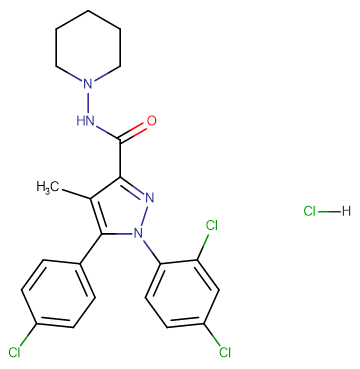
Rimonabant hydrochloride
CAS No. 158681-13-1
Rimonabant hydrochloride( Acomplia )
Catalog No. M12264 CAS No. 158681-13-1
Rimonabant Hcl(SR141716A) is a selective central cannabinoid (CB1) receptor inverse agonist with Ki of 1.8 nM.
Purity : >98% (HPLC)
 COA
Datasheet
HNMR
HPLC
MSDS
Handing Instructions
COA
Datasheet
HNMR
HPLC
MSDS
Handing Instructions
| Size | Price / USD | Stock | Quantity |
| 1 mL x 10 mM in DMSO | 65 | In Stock |


|
| 5MG | 36 | In Stock |
|
| 10MG | 58 | In Stock |
|
| 25MG | 112 | In Stock |
|
| 50MG | 202 | In Stock |
|
| 100MG | 304 | In Stock |
|
| 200MG | Get Quote | In Stock |
|
| 500MG | 728 | In Stock |
|
| 1G | Get Quote | In Stock |
|
Biological Information
-
Product NameRimonabant hydrochloride
-
NoteResearch use only, not for human use.
-
Brief DescriptionRimonabant Hcl(SR141716A) is a selective central cannabinoid (CB1) receptor inverse agonist with Ki of 1.8 nM.
-
DescriptionRimonabant Hcl(SR141716A) is a selective central cannabinoid (CB1) receptor inverse agonist with Ki of 1.8 nM.(In Vitro):Rimonabant could inhibit the growth of Mtb with an MIC of 54 μM. MmpL3, an anti-TB target, is the direct target of rimonabant.Rimonabant itself (10-12-10-3 M, 12 concentrations) inhibits the basal binding of [35S]GTPgS to human cortical membranes in a concentration dependent manner, with a -log IC50 of 4.7±0.2 (IC50 = 20 μM) and a maximal inhibition of 48±2%.(In Vivo):Rimonabant (10 mg/kg by gavage) is fed for 2 weeks to 3-month-old male obese Zucker rats as an impaired glucose tolerance model and for 10 weeks to 6-month-old male obese Zucker rats as a model of the metabolic syndrome. RANTES and MCP-1 serum levels are increased in obese vs lean Zucker rats and significantly reduced by long-term treatment with Rimonabant, which slowes weight gain in rats with the metabolic syndrome. Neutrophils and monocytes are significantly increased in young and old obese vs lean Zucker rats and lowered by Rimonabant. Platelet-bound fibrinogen is significantly enhanced in obese vs lean Zucker rats of both age, and is reduced by Rimonabant .Rimonabant (20 mg daily) exhibits a significant reduction in many cardiometabolic risk factors.
-
In Vitro——
-
In Vivo——
-
SynonymsAcomplia
-
PathwayGPCR/G Protein
-
TargetCannabinoid Receptor
-
RecptorCB1
-
Research AreaMetabolic Disease
-
Indication——
Chemical Information
-
CAS Number158681-13-1
-
Formula Weight500.25
-
Molecular FormulaC22H22Cl4N4O
-
Purity>98% (HPLC)
-
SolubilitySoluble in DMSO
-
SMILESO=C(C1=NN(C2=CC=C(Cl)C=C2Cl)C(C3=CC=C(Cl)C=C3)=C1C)NN4CCCCC4.[H]Cl
-
Chemical Name1H-Pyrazole-3-carboxamide, 5-(4-chlorophenyl)-1-(2,4-dichlorophenyl)-4-methyl-N-1-piperidinyl-, monohydrochloride
Shipping & Storage Information
-
Storage(-20℃)
-
ShippingWith Ice Pack
-
Stability≥ 2 years
Reference
1.Shire D, et al. J Biol Chem. 1996 Mar 22;271(12):6941-6.
molnova catalog



related products
-
SCH-336
SCH-336 is a CB2 receptor agonist (Ki-1.8 nM, EC50-2 nM) with effective, selective, and oral activity. SCH-336 is also bioactive against CB1 receptor, and is 100 times more selective to CB2 receptor than CB1.
-
Bronze Red
Bronze Red
-
CB1/2 agonist 3
CB1/2 agonist 3 is a competitive and potent CB1/CB2 agonist with high affinity for hCB1 and hCB2 and can be used to study neurological disorders.
