


 Cart
Cart
 sales@molnova.com


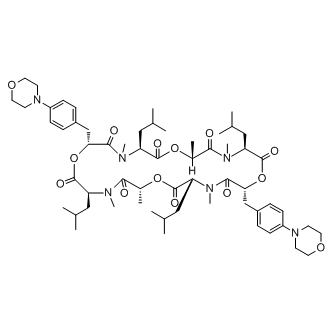
Emodepside
CAS No. 155030-63-0
Emodepside( PF 1022-221 | PF1022-221 | BAY 44-4400 | BAY44-4400 )
Catalog No. M12201 CAS No. 155030-63-0
A semisynthetic derivative of PF1022A, and novel cyclo-depsipeptide anthelmintic which is efficacious against a variety of gastrointestinal nematodes.
Purity : >98% (HPLC)
 COA
Datasheet
HNMR
HPLC
MSDS
Handing Instructions
COA
Datasheet
HNMR
HPLC
MSDS
Handing Instructions
| Size | Price / USD | Stock | Quantity |
| 1 mL x 10 mM in DMSO | 173 | In Stock |


|
| 2MG | 56 | In Stock |
|
| 5MG | 93 | In Stock |
|
| 10MG | 140 | In Stock |
|
| 25MG | 297 | In Stock |
|
| 50MG | 461 | In Stock |
|
| 100MG | 724 | In Stock |
|
| 200MG | 995 | In Stock |
|
| 500MG | Get Quote | In Stock |
|
| 1G | Get Quote | In Stock |
|
Biological Information
-
Product NameEmodepside
-
NoteResearch use only, not for human use.
-
Brief DescriptionA semisynthetic derivative of PF1022A, and novel cyclo-depsipeptide anthelmintic which is efficacious against a variety of gastrointestinal nematodes.
-
DescriptionA semisynthetic derivative of PF1022A, and novel cyclo-depsipeptide anthelmintic which is efficacious against a variety of gastrointestinal nematodes; causes parasitic nematode muscle relaxation, inhibition of muscle contraction elicited by either ACh or the neuropeptide AF2; elicits a Ca(++)-dependent hyperpolarization of muscle cells.Parasite Infection Phase 1 Clinical.
-
In VitroEmodepside is a semisynthetic derivative of PF1022A, which contains a morpholine attached in para position at each of both D-phenyllactic acids. Emodepside is efficacious against a variety of gastrointestinal nematodes. Emodepside binds to a presynaptic latrophilin receptor in nematodes. Emodepside produces a slow time-dependent (20 min), 4-aminopyridine sensitive, concentration-dependent hyperpolarization and increase in voltage-activated K currents. Emodepside has an inhibitory effect on spiking. Emodepside significantly inhibits the ryanodine increase in spike frequency between the 20 and 35 min period by 9.8 spikes/min. In the presence of emodepside, highly increased currents are observed without depolarization up to a threshold of 0 mV and without any additional stimuli to artificially increase [Ca 2+]i levels. These novel findings confirm that Slo-1 is a direct target of emodepside.
-
In VivoEmodepside interferes with signaling at the neuromuscular junction on the body-wall muscles, pharynx and egg-laying muscles and thus inhibits three important physiological functions: locomotion, feeding and reproduction.
-
SynonymsPF 1022-221 | PF1022-221 | BAY 44-4400 | BAY44-4400
-
PathwayMicrobiology/Virology
-
TargetParasite
-
RecptorParasite
-
Research AreaInfection
-
IndicationParasite Infection
Chemical Information
-
CAS Number155030-63-0
-
Formula Weight1119.3884
-
Molecular FormulaC60H90N6O14
-
Purity>98% (HPLC)
-
SolubilityDMSO: ≥ 31 mg/mL
-
SMILESO=C([C@H](CC(C)C)N(C)C([C@@H](C)OC([C@H](CC(C)C)N(C)C([C@@H](CC1=CC=C(N2CCOCC2)C=C1)OC([C@H](CC(C)C)N(C)C([C@@H](C)OC([C@H](CC(C)C)N3C)=O)=O)=O)=O)=O)=O)O[C@H](CC4=CC=C(N5CCOCC5)C=C4)C3=O
-
Chemical NameCyclo[(αR)-α-hydroxy-4-(4-morpholinyl)benzenepropanoyl-N-methyl-L-leucyl-(2R)-2-hydroxypropanoyl-N-methyl-L-leucyl-(αR)-α-hydroxy-4-(4-morpholinyl)benzenepropanoyl-N-methyl-L-leucyl-(2R)-2-hydroxypropanoyl-N-methyl-L-leucyl]
Shipping & Storage Information
-
Storage(-20℃)
-
ShippingWith Ice Pack
-
Stability≥ 2 years
Reference
1. Harder A, Parasitol Res. 2001 Nov;87(11):924-8.
2. Harder A, et al. Parasitol Res. 2002 Jun;88(6):481-8.
3. Willson J, et al. Parasitology. 2003 Jan;126(Pt 1):79-86.
4. Harder A, et al. Int J Antimicrob Agents. 2003 Sep;22(3):318-31.
molnova catalog



related products
-
Diloxanide furoate
Diloxanide furoate (Dichlofurazol) is an antiprotozoal compound with oral activity that can be used in the study of amoebas in tissues and several other protozoal infections.
-
Antimalarial agent 1...
N2-(3-chlorophenyl)-N4-(furan-2-ylmethyl)quinazoline-2,4-diamine (antimalarial agent 13 ) is a potent antimalarial agent.
-
DDD107498 succinate
DDD107498 has a potent and novel spectrum of antimalarial activity against multiple life-cycle stages of the Plasmodium parasite. It targets translation elongation factor 2 (eEF2).
