


 Cart
Cart
 sales@molnova.com


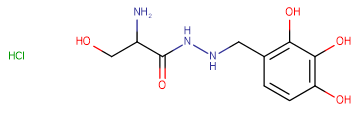
Benserazide hydrochloride
CAS No. 14919-77-8
Benserazide hydrochloride( Ro 4-4602 )
Catalog No. M12064 CAS No. 14919-77-8
Benserazide Hydrochloride is a peripherally-acting aromatic L-amino acid decarboxylase (AAAD) or DOPA decarboxylase inhibitor.
Purity : >98% (HPLC)
 COA
Datasheet
HNMR
HPLC
MSDS
Handing Instructions
COA
Datasheet
HNMR
HPLC
MSDS
Handing Instructions
| Size | Price / USD | Stock | Quantity |
| 100MG | Get Quote | In Stock |


|
| 200MG | Get Quote | In Stock |
|
| 500MG | 43 | In Stock |
|
| 1G | 57 | In Stock |
|
Biological Information
-
Product NameBenserazide hydrochloride
-
NoteResearch use only, not for human use.
-
Brief DescriptionBenserazide Hydrochloride is a peripherally-acting aromatic L-amino acid decarboxylase (AAAD) or DOPA decarboxylase inhibitor.
-
DescriptionBenserazide Hydrochloride is a peripherally-acting aromatic L-amino acid decarboxylase (AAAD) or DOPA decarboxylase inhibitor.(In Vitro):Benserazide hydrochloride (BH) and Levodopa (LD) individually and in combination (Benserazide hydrochloride + LD) (25 μM; 0 hour, 12 hours, 24 hours and 168 hours; SH-SY5Y) treatment inhibit protein aggregation and have the ability to minimise the amyloid-induced cytotoxicity in human neuroblastoma cell line. Benserazide hydrochloride and LD both can act as efficient inhibitors of the formation of cytotoxic HSA aggregates, and the inhibitory effects are more pronounced when both of these drugs are added simultaneously.(In Vivo):Benserazide (5-50 mg/kg; intraperitoneal injection; male Wistar rats) treatment of 6-OHDA-lesioned rats increases exogenous L-DOPA-derived extracellular DA levels, the time to reach the peak DA levels are significantly prolong by Benserazide dose-dependently. The AADC activity in the denervates striatal tissues shows a significant decrease by 10 mg/kg and 50 mg/kg Benserazide. Benserazide reduces the central AADC activity in the striatum of rats with nigrostriatal denervation, which leads to changes in the metabolism of exogenous L-DOPA.
-
In VitroBenserazide hydrochloride (BH) and Levodopa (LD) individually and in combination (Benserazide hydrochloride?+?LD) (25 μM; 0 hour, 12 hours, 24 hours and 168 hours; SH-SY5Y) treatment inhibit protein aggregation and have the ability to minimise the amyloid-induced cytotoxicity in human neuroblastoma cell line. Benserazide hydrochloride and LD both can act as efficient inhibitors of the formation of cytotoxic HSA aggregates, and the inhibitory effects are more pronounced when both of these drugs are added simultaneously. Cell Viability Assay Cell Line:SH-SY5Y cells Concentration:25 μM Incubation Time:0 hour, 12 hours, 24 hours and 168 hours Result:Enhanced cell viability, and inhibited the formation of cytotoxic human serum albumin (HSA) aggregates.
-
In VivoBenserazide (5-50 mg/kg; intraperitoneal injection; male Wistar rats) treatment of 6-OHDA-lesioned ratsincreases exogenous L-DOPA-derived extracellular DA levels, the time to reach the peak DA levels are significantly prolong by Benserazide dose-dependently. The AADC activity in the denervates striatal tissues shows a significant decrease by 10 mg/kg and 50 mg/kg Benserazide. Benserazide reduces the central AADC activity in the striatum of rats with nigrostriatal denervation, which leads to changes in the metabolism of exogenous L-DOPA. Animal Model:Male Wistar rats with 6-hydroxydopamine (6-OHDA) (8 Ag/4 Al)Dosage:5 mg/kg, 10 mg/kg or 50 mg/kg (Pharmacokinetic study)Administration:Intraperitoneal injection Result:Increased in exogenous L-DOPA-derived extracellular DA levels, the time to reach the peak DA levels were significantly prolonged in a dose-dependent fashion. The AADC activity in the denervated striatal tissues showed a significant decreased by 10 mg/kg and 50 mg/kg.
-
SynonymsRo 4-4602
-
PathwayGPCR/G Protein
-
TargetDopamine Receptor
-
RecptorDOPA decarboxylase| Dopamine
-
Research AreaNeurological Disease
-
Indication——
Chemical Information
-
CAS Number14919-77-8
-
Formula Weight293.7
-
Molecular FormulaC10H15N3O5·HCl
-
Purity>98% (HPLC)
-
SolubilityEthanol: 1 mg/mL warmed (3.4 mM); Water: 58 mg/mL (197.48 mM); DMSO: 58 mg/mL (197.48 mM)
-
SMILESCl.NC(CO)C(=O)NNCC1=C(O)C(O)=C(O)C=C1
-
Chemical Name——
Shipping & Storage Information
-
Storage(-20℃)
-
ShippingWith Ice Pack
-
Stability≥ 2 years
Reference
1.Tashkhourian J, et al. Spectrochim Acta A Mol Biomol Spectrosc. 2011 Nov;82(1):25-30.
molnova catalog



related products
-
Mesdopetam hemitartr...
Mesdopetam hemitartrate is an antagonist of dopamine D3 receptor (Ki=90 nM; IC50=9.8 μM for human recombinant D3 receptor).
-
Ro 10-5824 dihydroch...
Ro 10-5824 dihydrochloride is a selective agonist of dopamine D4 receptor partial, (Ki of 5.2 nM).
-
Talquetamab
Talquetamab (JNJ-64407564) is a GPRC5D bispecific antibody for multiple myeloma (MM) that induces T-cell-mediated killing of GPRC5-expressing MM cells through T-cell recruitment and activation, demonstrating antitumor activity.
