


 Cart
Cart
 sales@molnova.com


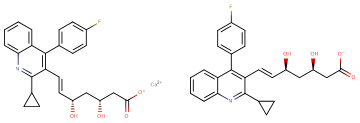
Pitavastatin calcium
CAS No. 147526-32-7
Pitavastatin calcium( Itabastatin | Itavastatin | NK 104 )
Catalog No. M12034 CAS No. 147526-32-7
Pitavastatin calcium is a novel member of the medication class of statins.
Purity : >98% (HPLC)
 COA
Datasheet
HNMR
HPLC
MSDS
Handing Instructions
COA
Datasheet
HNMR
HPLC
MSDS
Handing Instructions
| Size | Price / USD | Stock | Quantity |
| 1 mL x 10 mM in DMSO | 51 | In Stock |


|
| 5MG | 32 | In Stock |
|
| 10MG | 51 | In Stock |
|
| 25MG | 72 | In Stock |
|
| 50MG | 91 | In Stock |
|
| 100MG | 159 | In Stock |
|
| 200MG | 222 | In Stock |
|
| 500MG | Get Quote | In Stock |
|
| 1G | Get Quote | In Stock |
|
Biological Information
-
Product NamePitavastatin calcium
-
NoteResearch use only, not for human use.
-
Brief DescriptionPitavastatin calcium is a novel member of the medication class of statins.
-
DescriptionPitavastatin calcium is a novel member of the medication class of statins. The statins are a family of compounds that inhibit 3-hydroxy-3-methyl glutaryl coenzyme A (HMG-CoA) reductase, a pivotal enzyme in cholesterol biosynthesis. Pitavastatin is a potent inhibitor of HMG-CoA reductase (Ki = 1.7 nM). It lowers both total cholesterol and low density lipoprotein cholesterol in animals and humans. Metabolism of pitavastatin by the cytochrome P450 system is minimal, reducing the risk of drug-drug interactions. Moreover, pitavastatin causes atherosclerosis regression in humans with subclinical carotid atherosclerosis and improves cardiac function and survival in a rat model of hypertensive heart failure.(In Vitro):Pitavastatin Calcium inhibits the growth of a panel of ovarian cancer cells, including those considered most likely to represent HGSOC, grown as a monolayers (IC50 = 0.4-5 μM) or as spheroids (IC50=0.6-4 μM).Pitavastatin Calcium (1 μM; 48 hours ) induces apoptosis, evidenced by the increased activity of executioner caspases-3,7 as well as caspase-8 and caspase-9 in Ovcar-8 cells and Ovcar-3 cells.Pitavastatin (1 μM, 48 hours) causes PARP cleavage in Ovcar-8 cells.(In Vivo):Pitavastatin Calcium (59 mg/kg; p.o.; twice daily for 28 days) causes significant tumour regression.
-
In VitroWestern Blot Analysis Cell Line:Ovcar-8 cells Concentration:1?μM Incubation Time:48 hours Result:Induced PARP cleavage.
-
In VivoAnimal Model:4 week old female NCR Nu/Nu female mice?(bearing Ovcar-4 tumours)Dosage:59?mg/kg Administration:p.o.; twice daily for 28 days Result:Caused significant tumour regression.
-
SynonymsItabastatin | Itavastatin | NK 104
-
PathwayOthers
-
TargetOther Targets
-
Recptorcholesterol esters
-
Research AreaCancer
-
Indication——
Chemical Information
-
CAS Number147526-32-7
-
Formula Weight880.98
-
Molecular FormulaC50H46CaF2N2O8
-
Purity>98% (HPLC)
-
SolubilityDMSO: 51 mg/mL (57.89 mM)
-
SMILESC1C(C1)C2=NC3=CC=CC=C3C(=C2/C=C/[C@@H](O)C[C@@H](O)CC(=O)[O-])C4=CC=C(C=C4)F.C1C(C1)C2=NC3=CC=CC=C3C(=C2/C=C/[C@@H](O)C[C@@H](O)CC(=O)[O-])C4=CC=C(C=C4)F.[Ca+2]
-
Chemical Name——
Shipping & Storage Information
-
Storage(-20℃)
-
ShippingWith Ice Pack
-
Stability≥ 2 years
Reference
1.Ahmad H, et al. Cardiol Rev, 2010, 18(5):264-267.
molnova catalog



related products
-
(25R)-Ruscogenin-3-y...
(25R)-Ruscogenin-3-yl α-L-rhamnopyranosyl-(1→2)-[β-D-xylopyranosyl-(1→4)]-β-D-glucopyranoside (compound 1) is a steroidal saponin , can be isolated from the roots of Ophiopogon japonicus.
-
Odontoside
The herbs of Gastrodia elata BL.
-
Leu-Enkephalin, amid...
Leu-Enkephalin, amide
