


 Cart
Cart
 sales@molnova.com


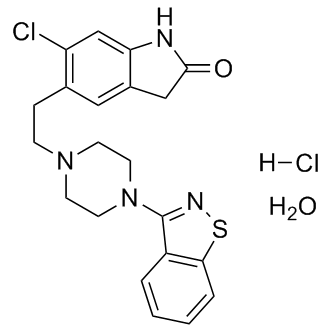
Ziprasidone hydrochloride monohydrate
CAS No. 138982-67-9
Ziprasidone hydrochloride monohydrate( CP-88059 )
Catalog No. M11616 CAS No. 138982-67-9
A full antagonist of D2 and 5-HT2A receptors with Ki of 6.8 and 0.6 nM, respectively; also is a partial agonist of 5-HT1A, and a partial antagonist of 5-HT2C and 5-HT1D receptors.
Purity : >98% (HPLC)
 COA
Datasheet
HNMR
HPLC
MSDS
Handing Instructions
COA
Datasheet
HNMR
HPLC
MSDS
Handing Instructions
| Size | Price / USD | Stock | Quantity |
| 10MG | 48 | In Stock |


|
| 25MG | 77 | In Stock |
|
| 50MG | 106 | In Stock |
|
| 100MG | Get Quote | In Stock |
|
| 200MG | Get Quote | In Stock |
|
| 500MG | Get Quote | In Stock |
|
| 1G | Get Quote | In Stock |
|
Biological Information
-
Product NameZiprasidone hydrochloride monohydrate
-
NoteResearch use only, not for human use.
-
Brief DescriptionA full antagonist of D2 and 5-HT2A receptors with Ki of 6.8 and 0.6 nM, respectively; also is a partial agonist of 5-HT1A, and a partial antagonist of 5-HT2C and 5-HT1D receptors.
-
DescriptionA full antagonist of D2 and 5-HT2A receptors with Ki of 6.8 and 0.6 nM, respectively; also is a partial agonist of 5-HT1A, and a partial antagonist of 5-HT2C and 5-HT1D receptors; exhibits potent antipsychotic activity in vivo.Schizophrenia Approved(In Vitro):Ziprasidone hydrochloride monohydrate (0-500 nM, 150 seconds) blocks wild-type hERG current.(In Vivo):Ziprasidone hydrochloride monohydrate (oral gavage; 20 mg/kg; once daily; 7 weeks) results in weight loss, low level physical activity, high resting energy expenditure and greater capacity for thermogenesis when subjected to cold.
-
In VitroZiprasidone hydrochloride monohydrate (0-500 nM, 150 seconds) blocks wild-type hERG current.Cell Viability Assay Cell Line:HEK-293 cells Concentration:0-500 nM Incubation Time:150 seconds Result:Blocked wild-type hERG current in a voltage- and concentration-dependent manner (IC50 = 120 nm).
-
In VivoZiprasidone hydrochloride monohydrate (oral gavage; 20 mg/kg; once daily; 7 weeks) results in weight loss, low level physical activity, high resting energy expenditure and greater capacity for thermogenesis when subjected to cold. Animal Model:Eight-week-old female Sprague-Dawleyrats weighing 200 to 250 g Dosage:20 mg/kg Administration:Oral gavage; 20 mg/kg; once daily; 7 weeks Result:Gained significantly less weight (P = 0.031), had a lower level of physical activity (P = 0.016), showed a higher resting energy expenditure (P < 0.001), and displayed a greater capacity for thermogenesis when subjected to cold (P < 0.001).
-
SynonymsCP-88059
-
PathwayGPCR/G Protein
-
Target5-HT Receptor
-
Recptor5-HTtransporter|5-HT1A|5-HT1B|5-HT1D|5-HT2A|5-HT2C|5-HT6|5-HT7|D1|D2|D3|H1receptor|norepinephrinetransporter(NET)|α1A-adrenergicreceptor|α2A-adrenergicreceptor
-
Research AreaNeurological Disease
-
IndicationSchizophrenia
Chemical Information
-
CAS Number138982-67-9
-
Formula Weight467.4119
-
Molecular FormulaC21H24Cl2N4O2S
-
Purity>98% (HPLC)
-
Solubility10 mM in DMSO
-
SMILESO=C1CC2=CC(CCN3CCN(C4=NSC5=C4C=CC=C5)CC3)=C(Cl)C=C2N1.Cl.O
-
Chemical Name2H-Indol-2-one, 5-[2-[4-(1,2-benzisothiazol-3-yl)-1-piperazinyl]ethyl]-6-chloro-1,3-dihydro-, hydrochloride, hydrate (1:1:1)
Shipping & Storage Information
-
Storage(-20℃)
-
ShippingWith Ice Pack
-
Stability≥ 2 years
Reference
1. Mattei C, et al. J Cent Nerv Syst Dis. 2011 Feb 15;3:1-16.
2. Seeger TF, et al. J Pharmacol Exp Ther. 1995 Oct;275(1):101-13.
3. Schotte A, et al. Psychopharmacology (Berl). 1996 Mar;124(1-2):57-73.
molnova catalog



related products
-
Lumateperone
Lumateperone (ITI-007) is a potent 5-HT2A antagonist (Ki=0.54 nM), postsynaptic D2 antagonist(Ki=32 nM), and SERT blocker (Ki= 61 nM).
-
Oxatomide
Oxatomide (Oxatomida) is a potent and orally active dual H1 histamine receptor and P2X7 receptor antagonist with antihistamine and antiallergic activity.
-
Repinotan HCl
Repinotan HCl (Bay-x-3702) is an orally active, selective and potent 5-HT1A receptor agonist across the blood-brain barrier and is an aminomethylbenzidine derivative.
