


 Cart
Cart
 sales@molnova.com


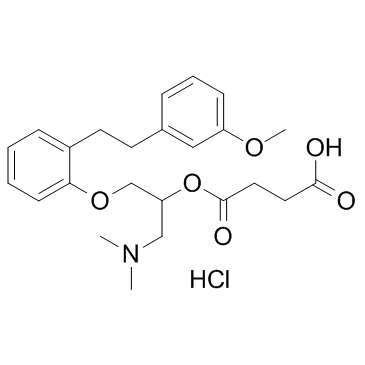
Sarpogrelate hydrochloride
CAS No. 135159-51-2
Sarpogrelate hydrochloride( MCI 9042 | MCI9042 | MCI-9042 )
Catalog No. M11420 CAS No. 135159-51-2
A potent, specific 5HT2 receptor antagonist with Ki of 8.39 nM for 5-HT2A; also shows binding affinity for 5-HT2B.
Purity : >98% (HPLC)
 COA
Datasheet
HNMR
HPLC
MSDS
Handing Instructions
COA
Datasheet
HNMR
HPLC
MSDS
Handing Instructions
| Size | Price / USD | Stock | Quantity |
| 1 mL x 10 mM in DMSO | 45 | In Stock |


|
| 5MG | 39 | In Stock |
|
| 10MG | 63 | In Stock |
|
| 25MG | 116 | In Stock |
|
| 50MG | 181 | In Stock |
|
| 100MG | 268 | In Stock |
|
| 200MG | Get Quote | In Stock |
|
| 500MG | 640 | In Stock |
|
| 1G | Get Quote | In Stock |
|
Biological Information
-
Product NameSarpogrelate hydrochloride
-
NoteResearch use only, not for human use.
-
Brief DescriptionA potent, specific 5HT2 receptor antagonist with Ki of 8.39 nM for 5-HT2A; also shows binding affinity for 5-HT2B.
-
DescriptionA potent, specific 5HT2 receptor antagonist with Ki of 8.39 nM for 5-HT2A; also shows binding affinity for 5-HT2B; displays selectivity over 5-HT1-like, 5-HT3, beta, H1, H2 and M3; blocks serotonin-induced platelet aggregation.Heart Failure Approved(In Vitro):Sarpogrelate is selective for 5-HT2 (pKi=7.54) over 5-HT1 (pKi=4.58), α1-, α2-, and β-adrenergic (pKi=3.17-6.19), and muscarinic receptors (pKi=4.39).Sarpogrelate (10 μM) significantly reduces the number of platelet-rich plasma (PRP)-induced THP-1 cell that adheres to human umbilical vein endothelial cells (HUVECs).Sarpogrelate (10 μM) significantly reduces the expression of PRP-induced E-selectin in HUVECs.(In Vivo):Sarpogrelate (5 mg/kg; i.p. daily for 4 weeks) inhibits HFFD-induced obesity and decreases leukocyte-endothelial interactions in mice.
-
In VitroSarpogrelate is selective for 5-HT2 (pKi=7.54) over 5-HT1 (pKi=4.58), α1-, α2-, and β-adrenergic (pKi=3.17-6.19), and muscarinic receptors (pKi=4.39).Sarpogrelate (10 μM) significantly reduces the number of platelet-rich plasma (PRP)-induced THP-1 cell that adheres to human umbilical vein endothelial cells (HUVECs).Sarpogrelate (10 μM) significantly reduces the expression of PRP-induced E-selectin in HUVECs.
-
In VivoSarpogrelate (5 mg/kg; i.p. daily for 4 weeks) inhibits HFFD-induced obesity and decreases leukocyte-endothelial interactions in mice. Animal Model:Male C57BL/6 mice (7 weeks old) are fed normal chow (NC) or a high-fat diet with 30% fructose in the drinking water (HFFD)Dosage:5 mg/kg Administration:I.p. daily for 4 weeks Result:Prevented the HFFD-induced increases of the body weight, visceral fat weight, and serum monocyte chemoattractant protein-1 levels.Decreased leukocyte-endothelial interactions and serum monocyte chemoattractant protein-1 (MCP-1) level.
-
SynonymsMCI 9042 | MCI9042 | MCI-9042
-
PathwayEndocrinology/Hormones
-
Target5-HT Receptor
-
Recptor5-HT Receptor
-
Research AreaCardiovascular Disease
-
Indication——
Chemical Information
-
CAS Number135159-51-2
-
Formula Weight465.967
-
Molecular FormulaC24H32ClNO6
-
Purity>98% (HPLC)
-
SolubilityDMSO: ≥ 62 mg/mL
-
SMILESCN(C)CC(COC1=CC=CC=C1CCC2=CC(=CC=C2)OC)OC(=O)CCC(=O)O.Cl
-
Chemical NameButanedioic acid, 1-[2-(dimethylamino)-1-[[2-[2-(3-methoxyphenyl)ethyl]phenoxy]methyl]ethyl] ester, hydrochloride (1:1)
Shipping & Storage Information
-
Storage(-20℃)
-
ShippingWith Ice Pack
-
Stability≥ 2 years
Reference
1. Kikumoto R, et al. J Med Chem. 1990 Jun;33(6):1818-23.
2. Pertz H, et al. J Pharm Pharmacol. 1995 Apr;47(4):310-6.
3. Nishio H, et al. Arch Int Pharmacodyn Ther. 1996 Mar-Apr;331(2):189-202.
molnova catalog



related products
-
pCPA methyl ester hy...
pCPA methyl ester hydrochloride is an inhibitor of tryptophan hydroxylase inhibitor and 5-HT synthesis. pCPA methyl ester hydrochloride is permeable across the blood-brain barrier and reduces 5-HT central availability.
-
Amitriptyline
Amitriptyline (MK-230, N-750, Ro41575) is a tricyclic antidepressant (TCA) with analgesic properties.
-
Peptide 401
Peptide 401 is an antimicrobial peptide (AMP) derived from the venom of bees and wasps. Peptide 401 induces mast cell degranulation, activating histamine release from peritoneal mast cells. Additionally, peptide 401 exhibits some anti-inflammatory activity, decreasing paw edema in animal models.
