


 Cart
Cart
 sales@molnova.com


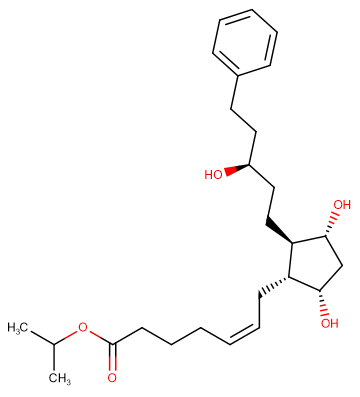
Latanoprost
CAS No. 130209-82-4
Latanoprost( 17-phenyl-13,14-dihydro trinor Prostaglandin F2α isopropyl ester )
Catalog No. M11213 CAS No. 130209-82-4
Latanoprost is a prostaglandin F2a analogue used for controlling the progression of glaucoma or ocular hypertension.
Purity : >98% (HPLC)
 COA
Datasheet
HNMR
HPLC
MSDS
Handing Instructions
COA
Datasheet
HNMR
HPLC
MSDS
Handing Instructions
| Size | Price / USD | Stock | Quantity |
| 1 mL x 10 mM in DMSO | 85 | In Stock |


|
| 2MG | 51 | In Stock |
|
| 5MG | 77 | In Stock |
|
| 10MG | 138 | In Stock |
|
| 25MG | 274 | In Stock |
|
| 50MG | 399 | In Stock |
|
| 100MG | 591 | In Stock |
|
| 200MG | Get Quote | In Stock |
|
| 500MG | 1265 | In Stock |
|
| 1G | Get Quote | In Stock |
|
Biological Information
-
Product NameLatanoprost
-
NoteResearch use only, not for human use.
-
Brief DescriptionLatanoprost is a prostaglandin F2a analogue used for controlling the progression of glaucoma or ocular hypertension.
-
DescriptionLatanoprost is a prostaglandin F2a analogue used for controlling the progression of glaucoma or ocular hypertension.(In Vitro):Benzalkonium chloride latanoprost (BAK-latanoprost) and 0.02% BAK induce significant apoptosis in the apical layers that correlated with the significant decrease of cell viability. Preservative-free latanoprost (PF-latanoprost) slightly decreases cell viability and few apoptotic cells are found in the superficial layers, without reaching statistical significance compared with PBS. Latanoprost (0.1 μM) significantly increases cell viability as compared with control. Meanwhile, 0.1 μM latanoprost results in the obvious promotion of neurite outgrowth similar to ciliary neurotrophic factor (CNTF) and simultaneously increases the levels of p-Akt and p-mTOR expression. Latanoprost can promote neurite outgrowth through an FP receptor-mediated modulation of the PI3K-Akt-mTOR signaling pathway. Latanoprost (0.03 or 0.3 μg/mL) and bimatoprost increase MMP-9 activity by 75% ± 27% and 75% ± 24%, respectively, in human CBSM cells.(In Vivo):A single drop of latanoprost results in marked miosis, anterior bowing of the peripheral iris, narrowing of the iridocorneal angle, and shallowing of the anterior chamber of the beagle dog. Following latanoprost, the pupil diameter, ACA, and AOD (means) decreases 84%, 14%, and 16%, respectively.
-
In VitroBenzalkonium chloride latanoprost (BAK-latanoprost) and 0.02% BAK induce significant apoptosis in the apical layers that correlated with the significant decrease of cell viability. Preservative-free latanoprost (PF-latanoprost) slightly decreases cell viability and few apoptotic cells are found in the superficial layers, without reaching statistical significance compared with PBS. Latanoprost (0.1 μM) significantly increases cell viability as compared with control. Meanwhile, 0.1 μM latanoprost results in the obvious promotion of neurite outgrowth similar to ciliary neurotrophic factor (CNTF) and simultaneously increases the levels of p-Akt and p-mTOR expression. Latanoprost can promote neurite outgrowth through an FP receptor-mediated modulation of the PI3K-Akt-mTOR signaling pathway. Latanoprost (0.03 or 0.3 μg/mL) and bimatoprost increase MMP-9 activity by 75% ± 27% and 75% ± 24%, respectively, in human CBSM cells.
-
In VivoA single drop of latanoprost results in marked miosis, anterior bowing of the peripheral iris, narrowing of the iridocorneal angle, and shallowing of the anterior chamber of the beagle dog. Following latanoprost, the pupil diameter, ACA, and AOD (means) decreases 84%, 14%, and 16%, respectively.
-
Synonyms17-phenyl-13,14-dihydro trinor Prostaglandin F2α isopropyl ester
-
PathwayCell Cycle/DNA Damage
-
TargetGPR
-
Recptorprostanoid selective FP receptor| retinoid X receptor α
-
Research AreaOther Indications
-
Indication——
Chemical Information
-
CAS Number130209-82-4
-
Formula Weight432.59
-
Molecular FormulaC26H40O5
-
Purity>98% (HPLC)
-
SolubilityDMSO: 10 mM
-
SMILESO=C(OC(C)C)CCC/C=C\C[C@@H]1[C@@H](CC[C@@H](O)CCC2=CC=CC=C2)[C@H](O)C[C@@H]1O
-
Chemical Namepropan-2-yl (Z)-7-[(1R,2R,3R,5S)-3,5-dihydroxy-2-[(3R)-3-hydroxy-5-phenylpentyl]cyclopentyl]hept-5-enoate
Shipping & Storage Information
-
Storage(-20℃)
-
ShippingWith Ice Pack
-
Stability≥ 2 years
Reference
1.Patel SS and CM Spencer Latanoprost. Drugs Aging, 1996. 9(5): p. 363-78.
molnova catalog



related products
-
GTPL5846
6-OAU(GTPL5846; 6-n-octylaminouracil) is a surrogate agonist of GPR84; activates human GPR84 in the presence of Gqi5 chimera in HEK293 cells with an EC50 of 105 nM in the PI assay.
-
P2Y2R/GPR17 antagoni...
P2Y2R/GPR17 antagonist 1 (Compound 14m) is a dual antagonist with an IC50 of 3.17 μM for P2Y2R and 1.67 μM for GPR17.
-
APD 668
APD668 is a potent GPR119 agonist with EC50 of 2.7 nM and 33 nM for hGPR119 and ratGPR119 respectively.
