


 Cart
Cart
 sales@molnova.com


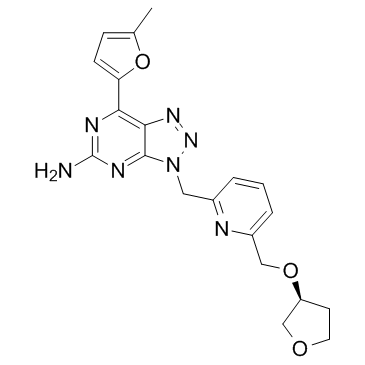
Ciforadenant
CAS No. 1202402-40-1
Ciforadenant( CPD1110 | CPI-444 | V 81444 )
Catalog No. M10733 CAS No. 1202402-40-1
A potent, orally active, adenosine A2A receptor antagonist that is being investigated in solid tumors as a single agent and in combination with the anti-PD-L1 antibody atezolizumab.
Purity : >98% (HPLC)
 COA
Datasheet
HNMR
HPLC
MSDS
Handing Instructions
COA
Datasheet
HNMR
HPLC
MSDS
Handing Instructions
| Size | Price / USD | Stock | Quantity |
| 1 mL x 10 mM in DMSO | 48 | In Stock |


|
| 2MG | 29 | In Stock |
|
| 5MG | 44 | In Stock |
|
| 10MG | 67 | In Stock |
|
| 25MG | 130 | In Stock |
|
| 50MG | 203 | In Stock |
|
| 100MG | 305 | In Stock |
|
| 200MG | 458 | In Stock |
|
| 500MG | Get Quote | In Stock |
|
| 1G | Get Quote | In Stock |
|
Biological Information
-
Product NameCiforadenant
-
NoteResearch use only, not for human use.
-
Brief DescriptionA potent, orally active, adenosine A2A receptor antagonist that is being investigated in solid tumors as a single agent and in combination with the anti-PD-L1 antibody atezolizumab.
-
DescriptionA potent, orally active, adenosine A2A receptor antagonist that is being investigated in solid tumors as a single agent and in combination with the anti-PD-L1 antibody atezolizumab; dose-dependent inhibits tumor growth in mouse model MC38; induces anti-tumor immunity in mouse tumor models and inhibits adenosine signaling in lymphocytes of treated humans.Lung Cancer Phase 2 Clinical(In Vitro):Ciforadenant is a potent, oral, selective A2AR antagonist. CD8+ T cell depletion abrogates the efficacy of Ciforadenant treatment as a single agent as well as in combination with anti-PD-L1, demonstrating a role for CD8+ T cells in mediating primary and secondary immune responses. Anti-tumor efficacy of Ciforadenant±anti-PD-L1 is associated with increased CD8+ cell infiltration and activation in MC38 tumor tissues, and a corresponding rise in PD-1 expression on CD8+ T cells in the spleen. Additionally, levels of immune checkpoints are modulated by treatment with Ciforadenant, including GITR, OX40, and LAG3 on tumor infiltrating lymphocytes and circulating T cells, suggesting a broad role for adenosine mediated immunosuppression. (In Vivo):Daily treatment of the syngeneic mouse model MC38 with Ciforadenant (1, 10, 100 mg/kg) leads to dose-dependent inhibition of tumor growth, leading to tumor elimination in ~30% of treated mice. Combining Ciforadenant (100 mg/kg, qd, 14 days) with anti-PD-L1 (200 μg, 3qw, 4 doses) treatment in MC38 models synergistically inhibits tumor growth and eliminates tumors in 90% of treated mice. When cured mice are later re-challenged with MC38 cells, tumor growth is rejected in 100% of challenged mice, indicating that Ciforadenant induces systemic anti-tumor immune memory.
-
In Vitro——
-
In Vivo——
-
SynonymsCPD1110 | CPI-444 | V 81444
-
PathwayGPCR/G Protein
-
TargetAdenosine Receptor
-
RecptorAdenosine Receptor
-
Research AreaCancer
-
IndicationLung Cancer
Chemical Information
-
CAS Number1202402-40-1
-
Formula Weight407.434
-
Molecular FormulaC20H21N7O3
-
Purity>98% (HPLC)
-
SolubilityDMSO : 67.5 mg/mL 165.67 mM
-
SMILESNC1=NC2=C(N=NN2CC3=NC(CO[C@H]4CCOC4)=CC=C3)C(C5=CC=C(O5)C)=N1
-
Chemical Name7-(5-Methyl-2-furanyl)-3-[[6-[[[(3S)-tetrahydro-3-furanyl]oxy]methyl]-2-pyridinyl]methyl]-3H-1,2,3-triazolo[4,5-d]pyrimidin-5-amine
Shipping & Storage Information
-
Storage(-20℃)
-
ShippingWith Ice Pack
-
Stability≥ 2 years
Reference
1. Stephen Willingham, et al. Abstract PR04: CPI-444: DOI: 10.1158/2326-6066.IMM2016-PR04 Published November 2016
molnova catalog



related products
-
DPTN dihydrochloride
DPTN dihydrochloride is a potent and selective A3AR antagonist with Ki values of 1.65, 9.61 and 8.53 nM in human, mouse and rat, respectively.
-
MRE3008F20
MRE3008F20 is a species-selective and potent adenosine A3 receptor (AA3R) antagonist that inhibits Cl-IB-MECA-induced cAMP production and can be used in glaucoma and asthma studies.CAS ??13483-88-88-9
-
LUF6096
LUF6096 (CF-602) is a potent allosteric enhancer of the adenosine A3 receptor, exhibiting the capability to enhance agonist binding allosterically while demonstrating low orthosteric affinity across adenosine receptors.
