


 Cart
Cart
 sales@molnova.com


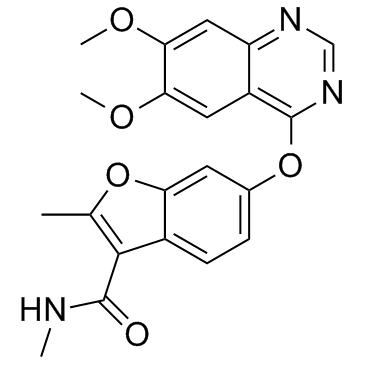
Fruquintinib
CAS No. 1194506-26-7
Fruquintinib( HMPL-013 )
Catalog No. M10681 CAS No. 1194506-26-7
A potent and highly selective small molecule inhibitor of VEGFR1/2/3 with IC50 of 33/3/5/0.5 nM, respectively.
Purity : >98% (HPLC)
 COA
Datasheet
HNMR
HPLC
MSDS
Handing Instructions
COA
Datasheet
HNMR
HPLC
MSDS
Handing Instructions
| Size | Price / USD | Stock | Quantity |
| 1 mL x 10 mM in DMSO | 50 | In Stock |


|
| 2MG | 29 | In Stock |
|
| 5MG | 46 | In Stock |
|
| 10MG | 73 | In Stock |
|
| 25MG | 113 | In Stock |
|
| 50MG | 140 | In Stock |
|
| 100MG | 245 | In Stock |
|
| 200MG | Get Quote | In Stock |
|
| 500MG | 607 | In Stock |
|
| 1G | Get Quote | In Stock |
|
Biological Information
-
Product NameFruquintinib
-
NoteResearch use only, not for human use.
-
Brief DescriptionA potent and highly selective small molecule inhibitor of VEGFR1/2/3 with IC50 of 33/3/5/0.5 nM, respectively.
-
DescriptionA potent and highly selective small molecule inhibitor of VEGFR1/2/3 with IC50 of 33/3/5/0.5 nM, respectively; weakly inhibits RET, FGFR-1 and c-kit kinases; demonstrates potent inhibition on VEGF-A dependent KDR phosphorylation in HEK293-KDR cells and VEGF-A induced proliferation in primary HUVECs with IC50 of 0.6 nM and 1.7 nM, respectively; suppresses tumor growth inhibition in a panel of tumor xenograft and patient derive xenograft models in mouse; orally active.Colon Cancer Phase 3 Clinical(In Vitro):Fruquintinib demonstrates potent inhibition on VEGF-A dependent KDR phosphorylation in HEK293-KDR cells and VEGF-A induced proliferation in primary HUVECs with IC50s of 0.6±0.2 nM and 1.7 nM, respectively. Similarly, potent VEGFR3 attenuation by fruquintinib is observed in primary HLECs, with IC50s of 1.5 nM and 4.2 nM for VEGF-C stimulated VEGFR3 phosphorylation and proliferation, respectively. Fruquintinib suppresses the tube branching, tube length and area in a concentration-dependent manner. The tubule length of primary HUVECs decreased by 74% and 94% at 0.03 and 0.3 μM of fruquintinib, respectively. Fruquintinib inhibits HUVEC tubule growth and CAM angiogenesis. Tube formation is suppressed significantly after treatment with fruquintinib at 0.3 μM for 18 hours. (In Vivo):Gastric cancer BGC-823 model is found to be most sensitive to fruquintinib. In this model, fruquintinib inhibits tumor growth by 62.3% and 95.4~98.6%, at 0.5 and 2 mg/kg once daily dosing, respectively. When the dose is elevated to 5 mg/kg and 20 mg/kg, the tumors regress by 24.1% and 48.6%, respectively. The level of anti-tumor growth activity of fruquintinib varies in different tumor xenograft models. Fruquintinib significantly decreases the micro-vessel density even at the lowest dose of 0.8 mg/kg.
-
In Vitro——
-
In Vivo——
-
SynonymsHMPL-013
-
PathwayAngiogenesis
-
TargetVEGFR
-
RecptorVEGFR
-
Research AreaCancer
-
IndicationColon Cancer
Chemical Information
-
CAS Number1194506-26-7
-
Formula Weight393.3927
-
Molecular FormulaC21H19N3O5
-
Purity>98% (HPLC)
-
SolubilityDMSO: 7.75 mg/mL
-
SMILESO=C(C1=C(C)OC2=CC(OC3=C4C=C(OC)C(OC)=CC4=NC=N3)=CC=C12)NC
-
Chemical Name3-Benzofurancarboxamide, 6-[(6,7-dimethoxy-4-quinazolinyl)oxy]-N,2-dimethyl-
Shipping & Storage Information
-
Storage(-20℃)
-
ShippingWith Ice Pack
-
Stability≥ 2 years
Reference
1. Sun Q, et al. Cancer Biol Ther. 2014;15(12):1635-45.
2. Gu Y, et al. Cancer Chemother Pharmacol. 2014 Jul;74(1):95-115.
3. Cao J, et al. Cancer Chemother Pharmacol. 2016 Aug;78(2):259-69.
molnova catalog



related products
-
GSK269962A
GSK269962 is a selective ROCK(Rho-associated protein kinase) inhibitor with IC50 values of 1.6 and 4 nM for ROCK1 and ROCK2, respectively.
-
BIBF 1202
BIBF 1202 is a VEGFR2 kinase inhibitor (IC50 = 62 nM).
-
FTI 277 hydrochlorid...
FTI 277 hydrochloride is an effective and specific farnesyltransferase (FTase) inhibitor (IC50: 500 pM); this selectivity is about 100-fold than the closely related GGTase I.
