


 Cart
Cart
 sales@molnova.com


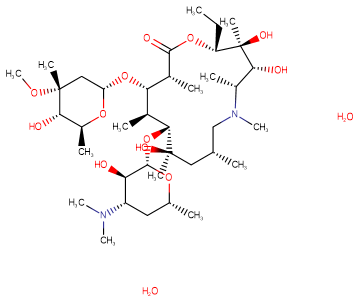
Azithromycin dihydrate
CAS No. 117772-70-0
Azithromycin dihydrate( Azitro | CP 62993 | CP-62993 | CP62993 | Goxal )
Catalog No. M10602 CAS No. 117772-70-0
Azithromycin Dihydrate is an acid stable orally administered macrolide antimicrobial drug, structurally related to erythromycin.
Purity : >98% (HPLC)
 COA
Datasheet
HNMR
HPLC
MSDS
Handing Instructions
COA
Datasheet
HNMR
HPLC
MSDS
Handing Instructions
| Size | Price / USD | Stock | Quantity |
| 1 mL x 10 mM in DMSO | 37 | In Stock |


|
| 25MG | 34 | In Stock |
|
| 50MG | 48 | In Stock |
|
| 100MG | 73 | In Stock |
|
| 200MG | 116 | In Stock |
|
| 500MG | 202 | In Stock |
|
| 1G | Get Quote | In Stock |
|
Biological Information
-
Product NameAzithromycin dihydrate
-
NoteResearch use only, not for human use.
-
Brief DescriptionAzithromycin Dihydrate is an acid stable orally administered macrolide antimicrobial drug, structurally related to erythromycin.
-
DescriptionAzithromycin Dihydrate is an acid stable orally administered macrolide antimicrobial drug, structurally related to erythromycin.(In Vitro):Azithromycin (2 μM) augments rhinovirus-induced IFNβ expression in primary bronchial epithelial cells from asthmatics, which is associated with over-expression of RIG-I like receptors and repression of viral replication. Knockdown of MDA5, but not knockdown of RIG-I, diminishes azithromycin (2 μM)-enhanced viral-induced IFNβ expression in asthmatic primary bronchial epithelial cells. Azithromycin specifically reduces MMP-9 mRNA and protein levels without affecting NF-κB in endotoxin-challenged monocytic THP-1 cells.(In Vivo):Azithromycin (50 mg/kg) has no effect on bronchoalveolar lavage inflammatory parameters and LDH levels in a mouse model of asthma exacerbation. Azithromycin induces neither general inflammatory parameters nor LDH release in a mouse model of asthma exacerbation, and augments expression of interferon-stimulated genes and the pattern recognition receptor MDA5 but not RIG-I in exacerbating mice.
-
In VitroAzithromycin (2 μM) augments rhinovirus-induced IFNβ expression in primary bronchial epithelial cells from asthmatics, which is associated with over-expression of RIG-I like receptors and repression of viral replication. Knockdown of MDA5, but not knockdown of RIG-I, diminishes azithromycin (2 μM)-enhanced viral-induced IFNβ expression in asthmatic primary bronchial epithelial cells. Azithromycin specifically reduces MMP-9 mRNA and protein levels without affecting NF-κB in endotoxin-challenged monocytic THP-1 cells.
-
In VivoAzithromycin (50 mg/kg) has no effect on bronchoalveolar lavage inflammatory parameters and LDH levels in a mouse model of asthma exacerbation. Azithromycin induces neither general inflammatory parameters nor LDH release in a mouse model of asthma exacerbation, and augments expression of interferon-stimulated genes and the pattern recognition receptor MDA5 but not RIG-I in exacerbating mice.
-
SynonymsAzitro | CP 62993 | CP-62993 | CP62993 | Goxal
-
PathwayGPCR/G Protein
-
TargetAntibacterial
-
Recptor23S rRNA| 50S ribosome
-
Research AreaInfection
-
Indication——
Chemical Information
-
CAS Number117772-70-0
-
Formula Weight785.03
-
Molecular FormulaC38H72N2O12·2H2O
-
Purity>98% (HPLC)
-
SolubilityEthanol: 100 mg/mL (127.38 mM); Water: 10 mg/mL (12.73 mM); DMSO: 100 mg/mL (127.38 mM)
-
SMILESCC[C@@H]1[C@@](C)(O)[C@H](O)[C@@H](C)N(C)C[C@H](C)C[C@@](C)(O)[C@H](O[C@H]2[C@H](O)[C@@H](N(C)C)C[C@@H](C)O2)[C@@H](C)[C@H](O[C@H]3C[C@@](C)(OC)[C@@H](O)[C@H](C)O3)[C@@H](C)C(O1)=O.O.O
-
Chemical Name(2R,3S,4R,5R,8R,10R,11R,12S,13S,14R)-11-(((2S,3R,4S,6R)-4-(dimethylamino)-3-hydroxy-6-methyltetrahydro-2H-pyran-2-yl)oxy)-2-ethyl-3,4,10-trihydroxy-13-(((2R,4R,5S,6S)-5-hydroxy-4-methoxy-4,6-dimethyltetrahydro-2H-pyran-2-yl)oxy)-3,5,6,8,10,12,14-heptamethyl-1-oxa-6-azacyclopentadecan-15-one dihydrate
Shipping & Storage Information
-
Storage(-20℃)
-
ShippingWith Ice Pack
-
Stability≥ 2 years
Reference
1.Peters DH, et al. Drugs, 1992, 44(5), 750-799.
molnova catalog



related products
-
Cefonicid sodium
Cefonicid sodium is a broadspectrum cephalosporin antibiotic which inhibits the formation of the bacterial cell wall.
-
Mycaminosyltylonolid...
Mycaminosyltylonolide is a macrolide antibiotic that is tylonolide having a beta-D-mycaminosyl residue attached at position 5.
-
Bicyclomycin benzoat...
A broad spectrum antibiotic active against Gram-negative bacteria and the Gram-positive bacterium.
