


 Cart
Cart
 sales@molnova.com


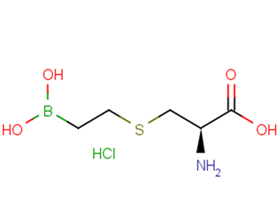
BEC HCl
CAS No. 222638-67-7
BEC HCl( —— )
Catalog No. M17443 CAS No. 222638-67-7
BEC HCl is a competitive arginase inhibitor, which bind slowly. Ki of BEC HCl is 0.31 μM (pH7.5) for Arginase II, and is 0.4-0.6 μM for rat Arginase I.
Purity : >98% (HPLC)
 COA
Datasheet
HNMR
HPLC
MSDS
Handing Instructions
COA
Datasheet
HNMR
HPLC
MSDS
Handing Instructions
| Size | Price / USD | Stock | Quantity |
| 1 mL x 10 mM in DMSO | 77 | In Stock |


|
| 5MG | 77 | In Stock |
|
| 10MG | 147 | In Stock |
|
| 25MG | 282 | In Stock |
|
| 50MG | 454 | In Stock |
|
| 100MG | 649 | In Stock |
|
| 200MG | 899 | In Stock |
|
| 500MG | Get Quote | In Stock |
|
| 1G | Get Quote | In Stock |
|
Biological Information
-
Product NameBEC HCl
-
NoteResearch use only, not for human use.
-
Brief DescriptionBEC HCl is a competitive arginase inhibitor, which bind slowly. Ki of BEC HCl is 0.31 μM (pH7.5) for Arginase II, and is 0.4-0.6 μM for rat Arginase I.
-
DescriptionBEC HCl is a competitive arginase inhibitor, which bind slowly. Ki of BEC HCl is 0.31 μM (pH7.5) for Arginase II, and is 0.4-0.6 μM for rat Arginase I.
-
In VitroThe X-ray crystal structure of the arginase-BEC complex has been determined at 2.3 ? resolution from crystals perfectly twinned by hemihedry. The structure of the complex reveals that the boronic acid moiety undergoes nucleophilic attack by metal-bridging hydroxide ion to yield a tetrahedral boronate anion that bridges the binuclear manganese cluster, thereby mimicking the tetrahedral intermediate (and its flanking transition states) in the arginine hydrolysis reaction.
-
In VivoAdministration of the arginase inhibitor BEC decreases arginase activity and causes alterations in NO homeostasis, which are reflected by increases in S-nitrosylated and nitrated proteins in the lungs from inflamed mice. BEC enhances perivascular and peribronchiolar lung inflammation, mucus metaplasia, NF-κB DNA binding, and mRNA expression of the NF-κB-driven chemokine genes CCL20 and KC, and leads to further increases in airways hyperresponsiveness. Animal Model:C57BL/6J wild-type mice, mice deficient in arginase 2 (Arg2-/-), mice deficient in both arginase 1 and 2 (Arg1-/-Arg2-/-), and mice deficient in NOX2 (NOX2-/-Dosage:20 mg/kg. Administration:I.V., in 0.9% saline, 1 hour before the injection of LPS.Result:BEC robustly reduced VEGF expression in neuroglia (72% reduction) and macrophage/microglia (87% reduction).
-
Synonyms——
-
PathwayGPCR/G Protein
-
TargetAntibacterial
-
RecptorArginase-2| rat Arginase I
-
Research AreaCancer
-
Indication——
Chemical Information
-
CAS Number222638-67-7
-
Formula Weight229.49
-
Molecular FormulaC5H12BNO4S·ClH
-
Purity>98% (HPLC)
-
SolubilityH2O : ≥ 35 mg/mL; 152.51 mM
-
SMILESC(=O)([C@H](CSCCB(O)O)N)O.Cl
-
Chemical Name——
Shipping & Storage Information
-
Storage(-20℃)
-
ShippingWith Ice Pack
-
Stability≥ 2 years
Reference
1.Colleluori DM et al. Classical and slow-binding inhibitors of human type II arginase. Biochemistry. 2001 Aug 7;40(31):9356-62.
molnova catalog



related products
-
Sulbenicillin Sodium
Sulbenicillin Sodium is is a penicillin antibioticis a Penicillin antibiotic with antibacterial activity.
-
Azithromycin
A macrolide antibiotic used for the treatment of a number of bacterial infections.
-
Nourseothricin sulfa...
Nourseothricin sulfate is a broad-spectrum antibiotic,and inhibits protein biosynthesis in prokaryotic cells and strongly inhibits the growth of eukaryotes like fungi .Renal handling of Nourseothricin is characterized in experiments on renal cortical slices under various experimental conditions.?
