


 Cart
Cart
 sales@molnova.com


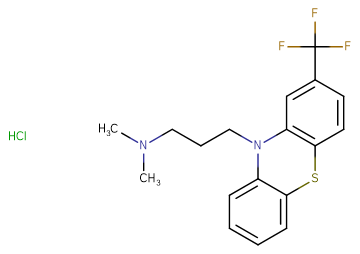
Triflupromazine hydrochloride
CAS No. 1098-60-8
Triflupromazine hydrochloride( —— )
Catalog No. M10378 CAS No. 1098-60-8
Triflupromazine hydrochloride is an antipsychotic medication, which are Dopamine D1/D2 receptor antagonists.
Purity : >98% (HPLC)
 COA
Datasheet
HNMR
HPLC
MSDS
Handing Instructions
COA
Datasheet
HNMR
HPLC
MSDS
Handing Instructions
| Size | Price / USD | Stock | Quantity |
| 100MG | 28 | In Stock |


|
| 200MG | 47 | In Stock |
|
| 500MG | 76 | In Stock |
|
| 1G | 110 | In Stock |
|
Biological Information
-
Product NameTriflupromazine hydrochloride
-
NoteResearch use only, not for human use.
-
Brief DescriptionTriflupromazine hydrochloride is an antipsychotic medication, which are Dopamine D1/D2 receptor antagonists.
-
DescriptionTriflupromazine hydrochloride is an antipsychotic medication, which are Dopamine D1/D2 receptor antagonists.
-
In Vitro——
-
In Vivo——
-
Synonyms——
-
PathwayEndocrinology/Hormones
-
Target5-HT Receptor
-
Recptor5-HT| mAChR| Dopamine
-
Research AreaNeurological Disease
-
Indication——
Chemical Information
-
CAS Number1098-60-8
-
Formula Weight388.88
-
Molecular FormulaC18H20ClF3N2S
-
Purity>98% (HPLC)
-
SolubilityWater: 0.0018 mg/mL
-
SMILESCl.CN(C)CCCN1C2=CC=CC=C2SC2=C1C=C(C=C2)C(F)(F)F
-
Chemical Name——
Shipping & Storage Information
-
Storage(-20℃)
-
ShippingWith Ice Pack
-
Stability≥ 2 years
Reference
1. Snyder S, et al. Arch Gen Psychiatry. 1974 Jul;31(1):58-6
molnova catalog



related products
-
Levodropropizine
Levodropropizine is a histamine receptor inhibitor, Levodropropizine is an effective and very well tolerated peripheral antitussive drug.
-
Buspirone
Buspirone free base is an agonist of serotonin receptor with anxiolytic activity. Buspirone free base has an efficacy comparable to diazepam.
-
Maprotiline hydrochl...
Maprotiline is a tetracyclic antidepressant with similar pharmacological properties to tricyclic antidepressants (TCAs).
