


 Cart
Cart
 sales@molnova.com


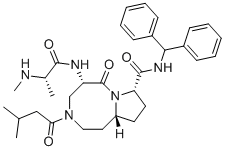
DEBIO 1143
CAS No. 1071992-99-8
DEBIO 1143( AT-406 | DEBIO1143 | SM406 | ARRY-334543 | D1143 )
Catalog No. M10293 CAS No. 1071992-99-8
DEBIO 1143 (AT-406, DEBIO-1143, SM406, ARRY-334543, D1143) is potent, orally active Smac mimetic that antagonizes cIAP1, cIAP2 and XIAP with Ki of 66.4, 1.9 and 5.1 nM, respectively.
Purity : >98% (HPLC)
 COA
Datasheet
HNMR
HPLC
MSDS
Handing Instructions
COA
Datasheet
HNMR
HPLC
MSDS
Handing Instructions
| Size | Price / USD | Stock | Quantity |
| 1 mL x 10 mM in DMSO | 141 | In Stock |


|
| 2MG | 49 | In Stock |
|
| 5MG | 81 | In Stock |
|
| 10MG | 126 | In Stock |
|
| 25MG | 275 | In Stock |
|
| 50MG | 431 | In Stock |
|
| 100MG | 668 | In Stock |
|
| 200MG | 986 | In Stock |
|
| 500MG | Get Quote | In Stock |
|
| 1G | Get Quote | In Stock |
|
Biological Information
-
Product NameDEBIO 1143
-
NoteResearch use only, not for human use.
-
Brief DescriptionDEBIO 1143 (AT-406, DEBIO-1143, SM406, ARRY-334543, D1143) is potent, orally active Smac mimetic that antagonizes cIAP1, cIAP2 and XIAP with Ki of 66.4, 1.9 and 5.1 nM, respectively.
-
DescriptionDEBIO 1143 (AT-406, DEBIO-1143, SM406, ARRY-334543, D1143) is potent, orally active Smac mimetic that antagonizes cIAP1, cIAP2 and XIAP with Ki of 66.4, 1.9 and 5.1 nM, respectively; effectively antagonizes XIAP BIR3 protein in cell-free functional assays, induces rapid degradation of cellular cIAP1 protein, and inhibits cancer cell growth in various human cancer cell lines; effectively induces apoptosis and causes complete inhibition of tumor growth apoptosis in xenograft tumors.Ovarian Cancer Phase 2 Clinical(In Vitro):Xevinapant mimic closely the AVPI peptide in both hydrogen bonding and hydrophobic interactions with XIAP, with additional hydrophobic contacts with W323 of XIAP. Xevinapant is more sensitive to these IAPs than Smac AVPI peptide with 50-100 fold binding affinities. Xevinapant (1 μM) completely restores the activity of caspase-9, which is suppressed by 500 nM XIAP BIR3 in a cell-free system. In MDA-MB-231 cell, Xevinapant induces rapid cellular cIAP1 degradation and also pulls down the cellular XIAP protein. Xevinapant effectively inhibits lots of human cancer cell lines and shows IC50 of 144 and 142 nM in MDA-MB-231 cell and SK-OV-3 ovarian cell, with low toxicity against normal-like human breast epithelial MCF-12F cells and primary human normal prostate epithelial cells. Xevinapant induces apoptosis in MDA-MB-231 cell by inducing activation of caspase-3 and cleavage of PARP. Xevinapant displays single agent activity in ovarian cancer cell lines. The IC50 values of AT-406 in these ovarian cancer cells range from 0.05-0.5 μg/mL. Xevinapant exhibits anti-ovarian cancer efficacy both as a single agent and in combination with carboplatin. Xevinapant (30 μg/mL) induced degradation of XIAP in the drug sensitive ovarian cancer cell lines.(In Vivo):Xevinapant (AT-406) is very effective in inhibition of tumor growth in the MDA-MB-231 xenograft model, and has minimal toxicity to animals. Xevinapant is evaluated for its pharmacokinetic (PK) properties in mice, rats, non-human primates and dogs.
-
In VitroXevinapant mimic closely the AVPI peptide in both hydrogen bonding and hydrophobic interactions with XIAP, with additional hydrophobic contacts with W323 of XIAP. Xevinapant is more sensitive to these IAPs than Smac AVPI peptide with 50-100 fold binding affinities. Xevinapant (1 μM) completely restores the activity of caspase-9, which is suppressed by 500 nM XIAP BIR3 in a cell-free system. In MDA-MB-231 cell, Xevinapant induces rapid cellular cIAP1 degradation and also pulls down the cellular XIAP protein. Xevinapant effectively inhibits lots of human cancer cell lines and shows IC50 of 144 and 142 nM in MDA-MB-231 cell and SK-OV-3 ovarian cell, with low toxicity against normal-like human breast epithelial MCF-12F cells and primary human normal prostate epithelial cells. Xevinapant induces apoptosis in MDA-MB-231 cell by inducing activation of caspase-3 and cleavage of PARP. Xevinapant displays single agent activity in ovarian cancer cell lines. The IC50 values of AT-406 in these ovarian cancer cells range from 0.05-0.5 μg/mL. Xevinapant exhibits anti-ovarian cancer efficacy both as a single agent and in combination with carboplatin. Xevinapant (30 μg/mL) induced degradation of XIAP in the drug sensitive ovarian cancer cell lines.
-
In VivoXevinapant (AT-406) is very effective in inhibition of tumor growth in the MDA-MB-231 xenograft model, and has minimal toxicity to animals. Xevinapant is evaluated for its pharmacokinetic (PK) properties in mice, rats, non-human primates and dogs. Animal Model:SCID mice bearing MDA-MB-231 xenograft tumors Dosage:30 and 100 mg/kg Administration:p.o.; 5 days a week for 2 weeks Result:Strongly inhibits tumor growth at 30 and 100 mg/kg and completely inhibits tumor growth during the treatment with 100 mg/kg.
-
SynonymsAT-406 | DEBIO1143 | SM406 | ARRY-334543 | D1143
-
PathwayOthers
-
TargetOther Targets
-
RecptorcIAP1-BIR3|cIAP2-BIR3|XIAP-BIR3
-
Research AreaCancer
-
IndicationOvarian Cancer
Chemical Information
-
CAS Number1071992-99-8
-
Formula Weight561.727
-
Molecular FormulaC32H43N5O4
-
Purity>98% (HPLC)
-
SolubilityDMSO: 93 mg/mL (165.6 mM); Ethanol: 93 mg/mL (165.6 mM); Water: <1 mg/mL ( < 1 mg/ml refers to the product slightly soluble or insoluble )
-
SMILESCC(C)CC(=O)N1CCC2CCC(N2C(=O)C(C1)NC(=O)C(C)NC)C(=O)NC(C3=CC=CC=C3)C4=CC=CC=C4
-
Chemical Name(5S,8S,10aR)-N-benzhydryl-5-((S)-2-(methylamino)propanamido)-3-(3-methylbutanoyl)-6-oxodecahydropyrrolo[1,2-a][1,5]diazocine-8-carboxamide
Shipping & Storage Information
-
Storage(-20℃)
-
ShippingWith Ice Pack
-
Stability≥ 2 years
Reference
1. Cai Q, et al. J Med Chem. 2011 Apr 28;54(8):2714-26.
2. Langdon CG, et al. Oncotarget. 2015 Nov 10;6(35):37410-25.
3. Tao Z, et al. Clin Cancer Res. 2018 Oct 23. doi: 10.1158/1078-0432.
4. Thibault B, et al. Sci Rep. 2018 Dec 14;8(1):17862.
molnova catalog



related products
-
ProcyanidinB13-O-gal...
ProcyanidinB13-O-gallate
-
TAK-448 acetate
TAK-448 is a KISS1R protein agonist as a oligopeptide analog of kisspeptin,TAK-448 acetate (MVT-602 acetate) is a potent and full KISS1R agonist with an IC50 of 460 pM and an EC50 of 632 pM.
-
Tirzepatide hydrochl...
Tirzepatide hydrochloride (LY3298176 hydrochloride) is a dual glucose-dependent insulinotropic polypeptide (GIP) and glucagon-like peptide-1 (GLP-1) receptor agonist.
