


 Cart
Cart
 sales@molnova.com


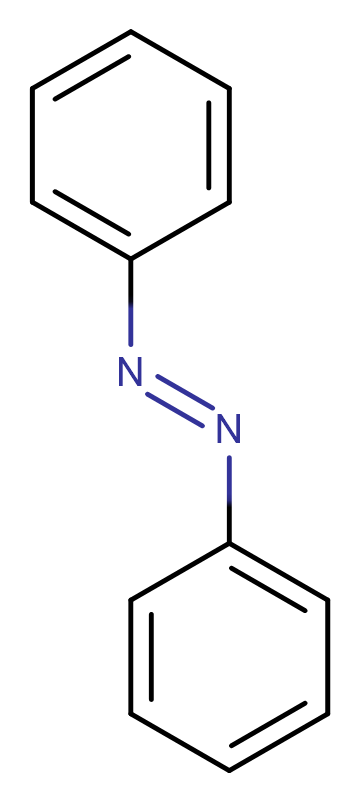
Azobenzene
CAS No. 103-33-3
Azobenzene( NSC 2102 | NSC-2102 | NSC2102 | Azobenzene )
Catalog No. M10162 CAS No. 103-33-3
Azobenzene is a chemical compound composed of two phenyl rings linked by a N=N double bond.
Purity : >98% (HPLC)
 COA
Datasheet
HNMR
HPLC
MSDS
Handing Instructions
COA
Datasheet
HNMR
HPLC
MSDS
Handing Instructions
| Size | Price / USD | Stock | Quantity |
| 1 mL x 10 mM in DMSO | 28 | In Stock |


|
| 100MG | Get Quote | In Stock |
|
| 200MG | Get Quote | In Stock |
|
| 500MG | Get Quote | In Stock |
|
| 1G | 27 | In Stock |
|
Biological Information
-
Product NameAzobenzene
-
NoteResearch use only, not for human use.
-
Brief DescriptionAzobenzene is a chemical compound composed of two phenyl rings linked by a N=N double bond.
-
DescriptionAzobenzene is a chemical compound composed of two phenyl rings linked by a N=N double bond. It is the simplest example of an aryl azo compound. The term 'azobenzene' or simply 'azo' is often used to refer to a wide class of molecules that share the core azobenzene structure, with different chemical functional groups extending from the phenyl rings.
-
In VitroPhotochromic compounds that undergo large conformational changes when exposed to light of appropriate wavelength are particularly attractive as molecular switch elements. Azobenzene is a popular choice among the chromophores. The thermodynamically favored trans isomer is rapidly converted to the cis isomer by irradiation at the wavelength of the π-π* transition, whereas the reverse process is achieved either (slowly) by thermal relaxation in the dark or (quickly) by irradiation at the wavelength of the n-π* transition. The azobenzene amino acid (aa) can be used as a photo-inducible conformational switch in polypeptides. A reversible conformational change of the peptide backbone is induced by switching between the cis and trans configurations of the azobenzene moiety by irradiation with light of suitable wavelength. Azobenzene has been the most widely used optical trigger for the synthesis of photoresponsive systems ranging from poly-a-amino acids to innovative materials with light-controlled mechanical and optical properties. Its use in form of appropriate derivatives allow to generate cyclic peptide structures of constraint conformational space and thus to exploit its reversible photoisomerization to induce well defined transitions between different conformational states. Azobenzene photoswitches can be used to drive functional changes in peptides, proteins, nucleic acids, lipids, and carbohydrates.
-
In Vivo——
-
SynonymsNSC 2102 | NSC-2102 | NSC2102 | Azobenzene
-
PathwayOthers
-
TargetOther Targets
-
RecptorOthers
-
Research Area——
-
Indication——
Chemical Information
-
CAS Number103-33-3
-
Formula Weight182.22
-
Molecular FormulaC12H10N2
-
Purity>98% (HPLC)
-
SolubilityWater: 6.4 mg/L
-
SMILESC1(/N=N/C2=CC=CC=C2)=CC=CC=C1
-
Chemical NameDiazene, 1,2-diphenyl-
Shipping & Storage Information
-
Storage(-20℃)
-
ShippingWith Ice Pack
-
Stability≥ 2 years
Reference
1.Wu L, et al. Bioconjug Chem. 2015 Jun 17;26(6):1070-9.
molnova catalog



related products
-
Retinol palmitate
Vitamin A palmitate is a more stable, synthetic version of the essential nutrient vitamin A joined to palmitic acid.
-
Alopecurone A
Alopecurone A exhibits potent inhibitory activity on MRP1.
-
Delphinidin3-O-(6-co...
Delphinidin3-O-(6''-coumaroylglucoside)
