


 Cart
Cart
 sales@molnova.com


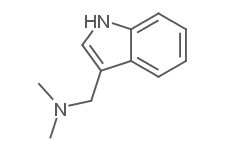
Gramine
CAS No. 87-52-5
Gramine( Donaxine | Gramine | NSC 16892 | NSC-16892 )
Catalog No. M19210 CAS No. 87-52-5
Gramine, a natural indole alkaloid, can be present in several plant species.
Purity : >98% (HPLC)
 COA
Datasheet
HNMR
HPLC
MSDS
Handing Instructions
COA
Datasheet
HNMR
HPLC
MSDS
Handing Instructions
| Size | Price / USD | Stock | Quantity |
| 25MG | 34 | In Stock |


|
| 50MG | 50 | In Stock |
|
| 100MG | 71 | In Stock |
|
| 200MG | Get Quote | In Stock |
|
| 500MG | Get Quote | In Stock |
|
| 1G | Get Quote | In Stock |
|
Biological Information
-
Product NameGramine
-
NoteResearch use only, not for human use.
-
Brief DescriptionGramine, a natural indole alkaloid, can be present in several plant species.
-
DescriptionGramine, also known as Donaxine, is a naturally occurring indole alkaloid present in several plant species. Gramine may play a defensive role in these plants, since it is toxic to many organisms. Gramine inhibits angiogenesis and induces apoptosis via modulation of TGF-β signalling in 7,12 dimethylbenz[a]anthracene (DMBA) induced hamster buccal pouch carcinoma.
-
In Vitro——
-
In Vivo——
-
SynonymsDonaxine | Gramine | NSC 16892 | NSC-16892
-
PathwayOthers
-
TargetAntioxidant
-
RecptorOthers
-
Research AreaOthers-Field
-
Indication——
Chemical Information
-
CAS Number87-52-5
-
Formula Weight174.24
-
Molecular FormulaC11H14N2
-
Purity>98% (HPLC)
-
SolubilityDMSO : ≥ 125 mg/mL; 717.40 mM
-
SMILESCN(C)Cc1c[nH]c2ccccc12
-
Chemical Name3-(Dimethylaminomethyl)indole
Shipping & Storage Information
-
Storage(-20℃)
-
ShippingWith Ice Pack
-
Stability≥ 2 years
Reference
1.Liu SL, Wang WW, Liu F, Li HY, Liu JS, Yang WD.Bull Environ Contam Toxicol. 2016 Apr;96(4):540-3.
molnova catalog



related products
-
Theaflavin 33'-digal...
8-Gingerol (TFDG) a major polyphenol found in black tea is an inducer of oxidative stress which has anti-inflammatory and cancer chemopreventive actions it reduces tumor angiogenesis by downregulating HIF-1αand VEGF.
-
BMY 7378 dihydrochlo...
BMY-7378, α1D-adrenergic receptor antagonist, is a weak partial agonist/antagonist of 5-HT1A receptor.
-
Hydroquinone diaceta...
Hydroquinone diacetate is an OH? inibitor with IC50 of 7.59 μM.
