


 Cart
Cart
 sales@molnova.com


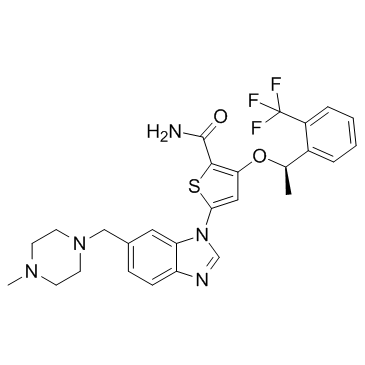
GSK-461364
CAS No. 929095-18-1
GSK-461364( GSK-461364A )
Catalog No. M16654 CAS No. 929095-18-1
A potent, selective, and reversible ATP-competitive PLK1 inhibitor with Ki of 2.2 nM.
Purity : >98% (HPLC)
 COA
Datasheet
HNMR
HPLC
MSDS
Handing Instructions
COA
Datasheet
HNMR
HPLC
MSDS
Handing Instructions
| Size | Price / USD | Stock | Quantity |
| 2MG | 42 | In Stock |


|
| 5MG | 65 | In Stock |
|
| 10MG | 120 | In Stock |
|
| 25MG | 206 | In Stock |
|
| 50MG | 365 | In Stock |
|
| 100MG | 546 | In Stock |
|
| 200MG | 780 | In Stock |
|
| 500MG | 1190 | In Stock |
|
| 1G | Get Quote | In Stock |
|
Biological Information
-
Product NameGSK-461364
-
NoteResearch use only, not for human use.
-
Brief DescriptionA potent, selective, and reversible ATP-competitive PLK1 inhibitor with Ki of 2.2 nM.
-
DescriptionA potent, selective, and reversible ATP-competitive PLK1 inhibitor with Ki of 2.2 nM; >390-fold greater selectivity for Plk1 than for Plk2 and Plk3 and 1,000-fold greater selectivity than for a panel of 48 other kinases; shows antiproliferative activity against >120 tumor cell lines and potently inhibits the proliferation with IC50s of <100 nM; shows clear antitumor activity in human tumor xenograft models.Blood Cancer Phase 1 Clinical(In Vitro):GSK461364 is a potent, selective, and reversible ATP-competitive Plk1 inhibitor (Ki, 2.2 nM) with at least 390-fold greater selectivity for Plk1 than for Plk2 and Plk3 and 1,000-fold greater selectivity than for a panel of 48 other kinases. GSK461364 (GSK461364A, 250 nM) inhibiting plk1 causes prolonged mitotic delay, aberrant mitotic exit, and p53 activation in A549 and PL45 cells. Knockdown of p53 significantly enhances the sensitivity of the cells to GSK461364A (30 or 300 nM) in preventing outgrowth in A549 and NCI-H460 cells, compared with cells with nonsilencing control siRNA. GSK461364 can inhibits cell growth of most proliferating cancer cell lines, and suppresses 89% of cancer cell line (66 of 74 lines) proliferation, with a GI50 (concentration required to inhibit 50% cell growth) of ≤100 nM. GSK461364 (GSK461364A, >20 nM) blocks cells in G2-M phase with reduction of cells in G1 phase of A549 lung carcinoma line. GSK461364 (10-250 nM) blocks cells in G2 and M phases of the cell cycle and causes M-phase caspase-3/caspase-7 activation in cancer cells. GSK461364 (0.5-2 μM) decreases level of PLK1 and pCDC25C, and cuases a dose- and time-dependent increase in pHisH3, an indicator of mitotic arrest in OS cell lines.(In Vivo):GSK461364 (50 mg/kg) exhibits various degrees of tumor growth delay (TGD) in multiple xenograft tumor models by i.p. one dose every 2 days repeated twelve times (q2d×12).
-
In VitroGSK461364 is a potent, selective, and reversible ATP-competitive Plk1 inhibitor (Ki, 2.2 nM) with at least 390-fold greater selectivity for Plk1 than for Plk2 and Plk3 and 1,000-fold greater selectivity than for a panel of 48 other kinases. GSK461364 (GSK461364A, 250 nM) inhibiting plk1 causes prolonged mitotic delay, aberrant mitotic exit, and p53 activation in A549 and PL45 cells. Knockdown of p53 significantly enhances the sensitivity of the cells to GSK461364A (30 or 300 nM) in preventing outgrowth in A549 and NCI-H460 cells, compared with cells with nonsilencing control siRNA. GSK461364 can inhibits cell growth of most proliferating cancer cell lines, and suppresses 89% of cancer cell line (66 of 74 lines) proliferation, with a GI50 (concentration required to inhibit 50% cell growth) of ≤100 nM. GSK461364 (GSK461364A, >20 nM) blocks cells in G2-M phase with reduction of cells in G1 phase of A549 lung carcinoma line. GSK461364 (10-250 nM) blocks cells in G2 and M phases of the cell cycle and causes M-phase caspase-3/caspase-7 activation in cancer cells. GSK461364 (0.5-2 μM) decreases level of PLK1 and pCDC25C, and cuases a dose- and time-dependent increase in pHisH3, an indicator of mitotic arrest in OS cell lines.
-
In VivoGSK461364 (50 mg/kg) exhibits various degrees of tumor growth delay (TGD) in multiple xenograft tumor models by i.p. one dose every 2 days repeated twelve times (q2d×12).
-
SynonymsGSK-461364A
-
PathwayCell Cycle/DNA Damage
-
TargetPLK
-
RecptorPLK1
-
Research AreaCancer
-
IndicationBlood cancer
Chemical Information
-
CAS Number929095-18-1
-
Formula Weight543.6038
-
Molecular FormulaC27H28F3N5O2S
-
Purity>98% (HPLC)
-
Solubility10 mM in DMSO
-
SMILESO=C(C1=C(O[C@@H](C2=CC=CC=C2C(F)(F)F)C)C=C(N3C=NC4=CC=C(CN5CCN(C)CC5)C=C34)S1)N
-
Chemical Name2-Thiophenecarboxamide, 5-[6-[(4-methyl-1-piperazinyl)methyl]-1H-benzimidazol-1-yl]-3-[(1R)-1-[2-(trifluoromethyl)phenyl]ethoxy]-
Shipping & Storage Information
-
Storage(-20℃)
-
ShippingWith Ice Pack
-
Stability≥ 2 years
Reference
1. Olmos D, et al. Clin Cancer Res. 2011 May 15;17(10):3420-30.
2. Gilmartin AG, et al. Cancer Res. 2009 Sep 1;69(17):6969-77.
3. Degenhardt Y, et al. Mol Cancer Ther. 2010 Jul;9(7):2079-89.
molnova catalog



related products
-
Ilexsaponin A1
Ilexsaponin A shows protective effects on ischemia-reperfusion-induced myocardial injury through anti-apoptotic pathway.
-
TC-S 7005
TC-S 7005 is an inhibitor of Polo-like kinases (IC50s: 4 nM, 24 nM and 214 nM for Plk2, Plk3, and Plk1, respectively).
-
Dihydrobaicalein
Dihydrobaicalein is a natural product from Scutellaria baicalensis, a PLK1 inhibitor (IC50:6.3 μM).Dihydrobaicalein inhibits VRK2 and PLK2.
