


 Cart
Cart
 sales@molnova.com


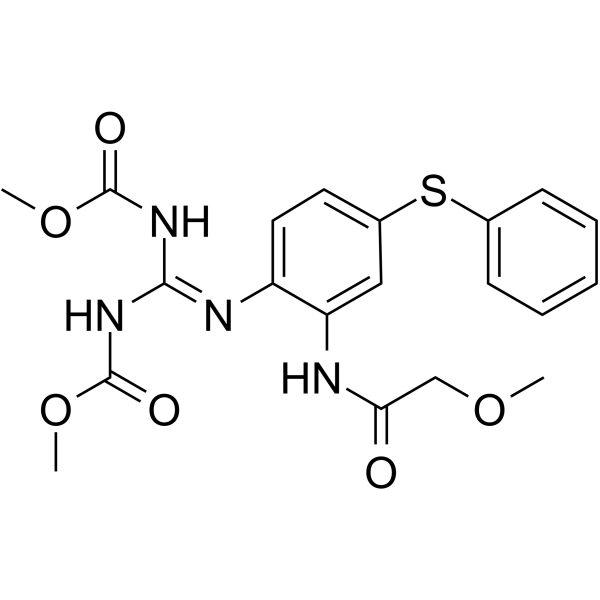
Febantel
CAS No. 58306-30-2
Febantel( —— )
Catalog No. M26685 CAS No. 58306-30-2
Febantel is an anthelmintic. It is used for veterinary use on dogs, cats, cattle, sheep, goats, pig, and poultry against roundworms and tapeworms.
Purity : >98% (HPLC)
 COA
Datasheet
HNMR
HPLC
MSDS
Handing Instructions
COA
Datasheet
HNMR
HPLC
MSDS
Handing Instructions
| Size | Price / USD | Stock | Quantity |
| 500MG | 35 | In Stock |


|
| 1G | Get Quote | In Stock |
|
Biological Information
-
Product NameFebantel
-
NoteResearch use only, not for human use.
-
Brief DescriptionFebantel is an anthelmintic. It is used for veterinary use on dogs, cats, cattle, sheep, goats, pig, and poultry against roundworms and tapeworms.
-
DescriptionFebantel is an anthelmintic. It is used for veterinary use on dogs, cats, cattle, sheep, goats, pig, and poultry against roundworms and tapeworms.(In Vitro):Febantel is a veteran anthelmintic (wormer) compound. Febantel is transformed into fenbendazole in the stomach and the intestine of the host, shortly after ingestion. Once transformed its behavior is comparable to the one of fenbendazole.
-
In Vitro——
-
In Vivo——
-
Synonyms——
-
PathwayMicrobiology/Virology
-
TargetParasite
-
Recptor——
-
Research Area——
-
Indication——
Chemical Information
-
CAS Number58306-30-2
-
Formula Weight446.48
-
Molecular FormulaC20H22N4O6S
-
Purity>98% (HPLC)
-
SolubilityIn Vitro:?DMSO : 100 mg/mL (223.97 mM)
-
SMILESCOCC(=O)Nc1cc(Sc2ccccc2)ccc1N=C(NC(=O)OC)NC(=O)OC
-
Chemical Name——
Shipping & Storage Information
-
Storage(-20℃)
-
ShippingWith Ice Pack
-
Stability≥ 2 years
Reference
1.Sanglier JJ, et al. Isolation of (4R)-4-[(E)-2-butenyl]-4-methyl-L-threonine, the characteristic structural element of cyclosporins, from a blocked mutant of Tolypocladium inflatum. J Antibiot (Tokyo). 1990 Jun;43(6):707-14.
molnova catalog



related products
-
DDD107498 succinate
DDD107498 has a potent and novel spectrum of antimalarial activity against multiple life-cycle stages of the Plasmodium parasite. It targets translation elongation factor 2 (eEF2).
-
Propargite
Propargite is a pesticide used to kill mites. Propargite induces β-cell necrosis preceded by DNA damage. Propargite induces MIN6 cell death with an IC 50 of 1 μM.
-
Spirodiclofen
Spirodiclofen is a selective, non-systemic acaricide from the new chemical class of tetronic acid derivatives,with no cross resistance to currently available acaricides and with additional insecticidal properties.
