


 Cart
Cart
 sales@molnova.com


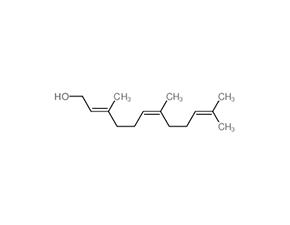
Farnesol
CAS No. 4602-84-0
Farnesol( —— )
Catalog No. M21112 CAS No. 4602-84-0
Farnesol is a natural product has the activity in inhibiting bacteria.
Purity : >98% (HPLC)
 COA
Datasheet
HNMR
HPLC
MSDS
Handing Instructions
COA
Datasheet
HNMR
HPLC
MSDS
Handing Instructions
| Size | Price / USD | Stock | Quantity |
| 500MG | 45 | Get Quote |


|
| 1G | Get Quote | Get Quote |
|
Biological Information
-
Product NameFarnesol
-
NoteResearch use only, not for human use.
-
Brief DescriptionFarnesol is a natural product has the activity in inhibiting bacteria.
-
DescriptionFarnesol is a natural product has the activity in inhibiting bacteria.
-
In VitroFarnesol is a sesquiterpene alcohol that modulates cell-to-cell communication in Candida albicans. It is also shown that this molecule presents inhibitory effects against non-albicans Candida species, Paracoccidioides brasiliensis and bacteria. The minimum inhibitory concentrations (MICs) are determined in accordance with the M27-A3 protocol as described and Farnesol is tested at a concentration range of 0.29-150 μM. It is observed that Farnesol presents an inhibitory activity against C. neoformans and C. gattii (MIC range: 0.29-75.0 μM). Although Farnesol does not significantly alter phospholipase activity, a tendency to decrease this activity is observed.
-
In Vivo——
-
Synonyms——
-
PathwayProteasome/Ubiquitin
-
TargetEndogenous Metabolite
-
RecptorHuman Endogenous Metabolite
-
Research Area——
-
Indication——
Chemical Information
-
CAS Number4602-84-0
-
Formula Weight222.37
-
Molecular FormulaC15H26O
-
Purity>98% (HPLC)
-
SolubilityIn Vitro:?DMSO : 100 mg/mL (449.70 mM)
-
SMILESCC(C)=CCC/C(C)=C/CC/C(C)=C/CO
-
Chemical Name(2E6E)-3711-trimethyldodeca-2610-trien-1-ol
Shipping & Storage Information
-
Storage(-20℃)
-
ShippingWith Ice Pack
-
Stability≥ 2 years
Reference
1.Young Yun Jung et al. Potential Anti-Inflammatory and Anti-Cancer Properties of Farnesol.[J]. Molecules 2018.
molnova catalog



related products
-
L-(+)-Arabinose
L-(+)-Arabinose inhibits intestinal sucrase activity, thereby reducing sucrose utilization, and consequently decreasing lipogenesis.
-
Aniline
Aniline has been reported to be toxic to the spleen via iron overload and induction of oxidative stress via Heme Oxygenase 1 up-regulation.
-
Epoprostenol sodium
Epoprostenol sodium (Prostaglandin I2 sodium salt) is a short-acting vasodilator, a synthetic prostacyclin, and can be used to study pulmonary hypertension and congestive heart failure.
