


 Cart
Cart
 sales@molnova.com


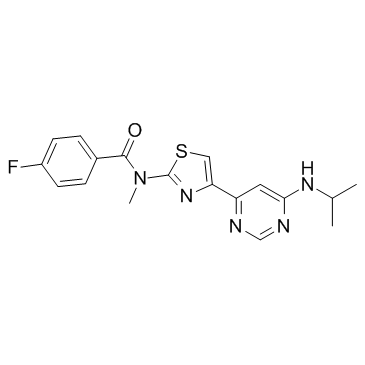
FITM
CAS No. 932737-65-0
FITM( —— )
Catalog No. M20702 CAS No. 932737-65-0
FITM is a potent negative allosteric modulator of mGlu1 receptor(Ki : 2.5 nM).
Purity : >98% (HPLC)
 COA
Datasheet
HNMR
HPLC
MSDS
Handing Instructions
COA
Datasheet
HNMR
HPLC
MSDS
Handing Instructions
| Size | Price / USD | Stock | Quantity |
| 2MG | 35 | In Stock |


|
| 5MG | 65 | In Stock |
|
| 10MG | 110 | In Stock |
|
| 25MG | 222 | In Stock |
|
| 50MG | 368 | In Stock |
|
| 100MG | 536 | In Stock |
|
| 200MG | Get Quote | In Stock |
|
| 500MG | Get Quote | In Stock |
|
| 1G | Get Quote | In Stock |
|
Biological Information
-
Product NameFITM
-
NoteResearch use only, not for human use.
-
Brief DescriptionFITM is a potent negative allosteric modulator of mGlu1 receptor(Ki : 2.5 nM).
-
DescriptionFITM is a potent negative allosteric modulator of mGlu1 receptor(Ki : 2.5 nM).
-
In VitroFITM fits tightly into the long and narrow pocket. Most of the ligand-receptor interactions are hydrophobic with the exception of the contacts of the pyrimidine-amine group with the T815 7.38 side chain. The mGlu1 binding pocket for FITM largely corresponds to mutagenic data for the common allosteric site in mGlus and likely extends to other class C GPCRs. FITM which shows high affinity and selectivity for mGlu1 over mGlu5. FITM has the high hydrogen bonds occupancy with Thr815 and Tyr805 in dimer A and B of mGlu1 during molecular dynamics simulations. The nitrogen and hydrogen atoms of FITM form the dynamical hydrogen bonds with the hydrogen atom of Tyr805 and oxygen atom of Thr815, respectively. It indicates that there is a strong attraction interaction between FITM and allosteric sites.
-
In VivoThe pretreatment of rats with unlabeled FITM (1 mg/kg) occupies an mGluR1 binding site of 18F-FITM by more than 99% and does not affect the input function. The Kd (nM) and Bmax (pmol/mL) obtained by the Scatchard analyses with the multidose ligand assays are 2.1 and 36.3, respectively, for the thalamus; 2.1 and 27.5, respectively, for the hippocampus; 1.5 and 22.2, respectively, for the striatum; and 1.5 and 20.5, respectively, for the cingulate cortex with a high confidence. 18F-FITM shows excellent pharmacokinetics, namely the dense and specific accumulation in mGlu1-positive melanomas versus mGlu1-negative hepatoma and normal tissues. Furthermore, the accumulation levels of radioactivity corresponded to the extent of tumor and to levels of mGlu1 protein expression in melanomas and melanoma metastasis.
-
Synonyms——
-
PathwayNeuroscience
-
TargetGluR
-
RecptormGluR1
-
Research Area——
-
Indication——
Chemical Information
-
CAS Number932737-65-0
-
Formula Weight371.43
-
Molecular FormulaC18H18FN5OS
-
Purity>98% (HPLC)
-
SolubilityDMSO:150 mg/mL (403.84 mM)
-
SMILESCC(C)Nc1cc(ncn1)-c1csc(n1)N(C)C(=O)c1ccc(F)cc1
-
Chemical Name4-Fluoro-N-[4-[6-(isopropylamino)pyrimidin-4-yl]-13-thiazol-2-yl]-N-methylbenzamide
Shipping & Storage Information
-
Storage(-20℃)
-
ShippingWith Ice Pack
-
Stability≥ 2 years
Reference
1.Hayes M Choudhary V Ojha N et al. Fat storage-inducing transmembrane (FIT or FITM) proteins are related to lipid phosphatase/phosphotransferase enzymes[J]. Microbial cell (Graz Austria) 2017 5(2):88.
molnova catalog



related products
-
SIB-1757
SIB-1757 is a selective antagonist of mGlu5 metabotropic glutamate receptor subtype (hmGlu5, IC50 : 0.4 μM),SIB-1757 was given by either intrathecal (i.th.), subcutaneous (s.c.) or intraplantar (i.pl.) injection.?
-
KM02894
KM02894 is a glutamate release inhibitor. Cancer cells release high levels of glutamate that can disrupt normal bone turnover, which can lead to cancer-induced bone pain.KM02894 may be used in the study of tumor-related diseases.
-
gamma-DGG acetate(67...
gamma-DGG acetate(6729-55-1 free base) (γ-D-Glutamylglycine) is a competitive blocker of AMPA receptor.
