


 Cart
Cart
 sales@molnova.com


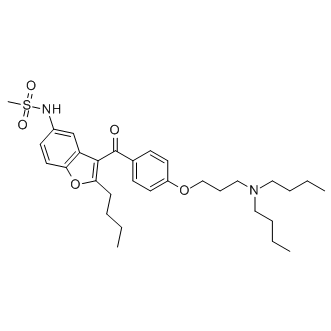
Dronedarone
CAS No. 141626-36-0
Dronedarone( SR-33589 )
Catalog No. M11734 CAS No. 141626-36-0
A multichannel blocker agent that has antiarrhythmic activity; reduces the late sustained K(+) current, I(K) (or Isus) with EC50 of 0.85 uM in postmyocardial infarcted (PMI) rats.
Purity : >98% (HPLC)
 COA
Datasheet
HNMR
HPLC
MSDS
Handing Instructions
COA
Datasheet
HNMR
HPLC
MSDS
Handing Instructions
| Size | Price / USD | Stock | Quantity |
| 10MG | 42 | In Stock |


|
| 50MG | 124 | In Stock |
|
| 100MG | Get Quote | In Stock |
|
| 200MG | Get Quote | In Stock |
|
| 500MG | Get Quote | In Stock |
|
| 1G | Get Quote | In Stock |
|
Biological Information
-
Product NameDronedarone
-
NoteResearch use only, not for human use.
-
Brief DescriptionA multichannel blocker agent that has antiarrhythmic activity; reduces the late sustained K(+) current, I(K) (or Isus) with EC50 of 0.85 uM in postmyocardial infarcted (PMI) rats.
-
DescriptionA multichannel blocker agent that has antiarrhythmic activity; reduces the late sustained K(+) current, I(K) (or Isus) with EC50 of 0.85 uM in postmyocardial infarcted (PMI) rats; reduces significantly the incidence of ventricular fibrillation (VF) in rats; mainly used for treatment of cardiac arrhythmias.Heart Arrhythmia Approved(In Vitro):In patch clamp experiments using human atrial myocytes, Dronedarone produces potent blockade of peak sodium current, resulting in a 97% block at 3 μM.In guinea pig ventricular myocytes, Dronedarone inhibits the rapidly activating delayed-rectifier potassium current (IC50<3 μM), the slowly activating delayed-rectifier potassium current (IC50=10 μM), the inward rectifier potassium current (IC50>30 μM), and L-type calcium current (IC50=0.18 μM).Dronedarone exhibits strong inhibitory effects on the acetylcholine-activated potassium current (IK-Ach) in rabbit inoatrial nodal cells (IC50=63 nM) and guinea pig atrial cells (IC50=10 nM). Blockade of IK-Ach by dronedarone is 100 times more potent than that of amiodarone.Dronedarone exerts its antiadrenergic effects by noncompetitive binding to β-adrenergic receptors (IC50=1.8 μM) and inhibition of agonist-induced increases in adenylate cyclase activity.Dronedarone (0.01-1 μM) induces a concentration-dependent reduction of coronary perfusion pressure in isolated guinea pig hearts, effects that are independent of the nitric oxide synthase pathway and possibly related to its calcium current blockade.(In Vivo):Dronedarone (intraperitoneal injection; 25-100 mg/kg) exhibits anticonvulsant effects in a dose-dependent manner and increases the threshold for electroconvulsions in mice.
-
In VitroIn patch clamp experiments using human atrial myocytes, Dronedarone produces potent blockade of peak sodium current, resulting in a 97% block at 3 μM.In guinea pig ventricular myocytes, Dronedarone inhibits the rapidly activating delayed-rectifier potassium current (IC50<3 μM), the slowly activating delayed-rectifier potassium current (IC50=10 μM), the inward rectifier potassium current (IC50>30 μM), and L-type calcium current (IC50=0.18 μM).Dronedarone exhibits strong inhibitory effects on the acetylcholine-activated potassium current (IK-Ach) in rabbit inoatrial nodal cells (IC50=63 nM) and guinea pig atrial cells (IC50=10 nM). Blockade of IK-Ach by dronedarone is 100 times more potent than that of amiodarone.Dronedarone exerts its antiadrenergic effects by noncompetitive binding to β-adrenergic receptors (IC50=1.8 μM) and inhibition of agonist-induced increases in adenylate cyclase activity.Dronedarone (0.01-1 μM) induces a concentration-dependent reduction of coronary perfusion pressure in isolated guinea pig hearts, effects that are independent of the nitric oxide synthase pathway and possibly related to its calcium current blockade.
-
In VivoDronedarone (intraperitoneal injection; 25-100 mg/kg) exhibits anticonvulsant effects in a dose-dependent manner and increases the threshold for electroconvulsions in mice. Animal Model:Tonic-clonic seizures in male albino Swiss outbred mice Dosage:25?mg/kg; 50 mg/kg; 75?mg/kg; 100?mg/kg Administration:Intraperitoneal injection Result:Showed significant anticonvulsant effects.
-
SynonymsSR-33589
-
PathwayCell Cycle/DNA Damage
-
TargetPotassium Channel
-
RecptorPotassium Channel|Sodium channel|Calcium channel
-
Research AreaCardiovascular Disease
-
IndicationHeart Arrhythmia
Chemical Information
-
CAS Number141626-36-0
-
Formula Weight556.7565
-
Molecular FormulaC31H44N2O5S
-
Purity>98% (HPLC)
-
Solubility10 mM in DMSO
-
SMILESCS(=O)(NC1=CC2=C(OC(CCCC)=C2C(C3=CC=C(OCCCN(CCCC)CCCC)C=C3)=O)C=C1)=O
-
Chemical NameMethanesulfonamide, N-[2-butyl-3-[4-[3-(dibutylamino)propoxy]benzoyl]-5-benzofuranyl]-
Shipping & Storage Information
-
Storage(-20℃)
-
ShippingWith Ice Pack
-
Stability≥ 2 years
Reference
1. Aimond F, et al. J Pharmacol Exp Ther. 2000 Jan;292(1):415-24.
2. Sun W, et al. Circulation. 1999 Nov 30;100(22):2276-81.
3. Manakshe G, et al. Indian Heart J. 2012 Mar-Apr;64(2):182-6.
molnova catalog



related products
-
TWIK-1/TREK-1-IN-3
TWIK-1/TREK-1-IN-3 is a selective and potent inhibitor of the potassium channel TREK-1, effectively inhibiting TREK-1 homodimers and TWIK-1/TREK-1 heterodimers containing two-pore-domain potassium (K2p) channels.
-
ASP 2905
A novel potent, selective, orally bioavailable inhibitor of voltage-gated potassium channel KCNH3 with IC50 of 9.0 nM.
-
Hexachlorophene
Hexachlorophene(Hexachlorofen) is a potent KCNQ1/KCNE1 potassium channel activator with EC50 of 4.61 ± 1.29 μM; also is an inhibitor of Wnt/beta-catenin signaling.
