


 Cart
Cart
 sales@molnova.com


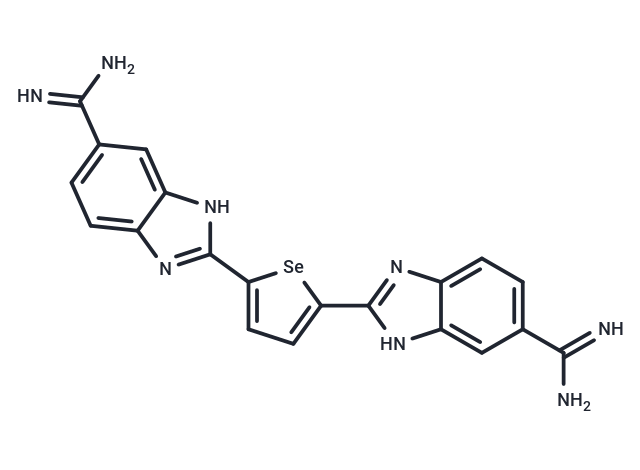
DB1976
CAS No. 1557397-51-9
DB1976( —— )
Catalog No. M32877 CAS No. 1557397-51-9
DB1976 is a selenophene analog of DB270 and a highly potent, cell-permeable, fully efficacious transcription factor PU.1 inhibitor.
Purity : >98% (HPLC)
 COA
Datasheet
HNMR
HPLC
MSDS
Handing Instructions
COA
Datasheet
HNMR
HPLC
MSDS
Handing Instructions
| Size | Price / USD | Stock | Quantity |
| 2MG | 179 | Get Quote |


|
| 5MG | 226 | Get Quote |
|
| 10MG | 335 | Get Quote |
|
| 25MG | 522 | Get Quote |
|
| 50MG | 707 | Get Quote |
|
| 100MG | 888 | Get Quote |
|
| 200MG | 1251 | Get Quote |
|
| 500MG | Get Quote | Get Quote |
|
| 1G | Get Quote | Get Quote |
|
Biological Information
-
Product NameDB1976
-
NoteResearch use only, not for human use.
-
Brief DescriptionDB1976 is a selenophene analog of DB270 and a highly potent, cell-permeable, fully efficacious transcription factor PU.1 inhibitor.
-
DescriptionDB1976 is a selenophene analog of DB270 and a potent and cell-permeable fully efficacious transcription factor PU.1 inhibitor. DB1976 potently inhibits PU.1 binding (IC50 of 10 nM) and strongly inhibits the PU.1/DNA complex (with high DB1976-λB affinity, KD of 12 nM) in vitro. DB1976 has apoptosis-inducing effect.
-
In VitroDB1976 is a classic heterocyclic dication (a single heteroatom) with strong affinity and selectivity for AT-rich sequences commonly found in cognate DNA binding sites for PU.1. DB1976 inhibits PU.1-dependent transactivation of the reporter in a dose-dependent manner with an IC50 value of 2.4 μM in PU.1-negative HEK293 cells.DB1976 treatment leads to a profound decrease in the growth of PU.1 URE–/– AML cells (IC50 of 105 μM), while showing little effect on normal hematopoietic cells at similar concentrations (IC50 of 334 μM). DB1976 treatment leads to a 1.6-fold increase in apoptotic cells in murine PU.1 URE–/– AML cells, and observed similar effects in human MOLM13 cells.DB1976 treatment leads to a significant decrease in the number of viable cells (primary human AML cells) (mean decrease of 81%) and clonogenic capacity (mean decrease of 36%) compared with vehicle-treated cells. The apoptotic cell fraction increased on average by 1.5-fold with DB1976.
-
In Vivo——
-
Synonyms——
-
PathwayApoptosis
-
TargetApoptosis
-
RecptorApoptosis
-
Research Area——
-
Indication——
Chemical Information
-
CAS Number1557397-51-9
-
Formula Weight447.35
-
Molecular FormulaC20H16N8Se
-
Purity>98% (HPLC)
-
Solubility——
-
SMILESC(=N)(N)C=1C=C2NC(=NC2=CC1)C=3[Se]C(=CC3)C=4NC=5C(N4)=CC=C(C(=N)N)C5
-
Chemical Name——
Shipping & Storage Information
-
Storage(-20℃)
-
ShippingWith Ice Pack
-
Stability≥ 2 years
Reference
1. Munde M, et al. Structure-dependent inhibition of the ETS-family transcription factor PU.1 by novel heterocyclic diamidines. Nucleic Acids Res. 2014 Jan;42(2):1379-90.?
molnova catalog



related products
-
KS106
KS106 is a selective and potent ALDH inhibitor with antiproliferative and anticancer activity, inhibits ALDH1A1, ALDH2, and ALDH3A1 with IC50 of 334, 2137, and 360 nM, respectively.
-
1-(4-Chloro-3-(trifl...
SC-1 is a a derivative of the multiple tyrosine kinase inhibitor sorafenib. SC-1 potently inhibits the phosphorylation of STAT3 by blocking STAT3 phosphorylation and activation, and induces apoptosis in hepatocellular carcinoma cell lines.
-
BTM-3528
BTM-3528 is an activator of the mitochondrial protease OMA1 with anticancer activity.BTM-3528 activates the ISR via the mitochondrial protease OMA1, inducing OMA1-dependent cleavage of DELE1 and OPA1 and mitochondrial fragmentation.
