


 Cart
Cart
 sales@molnova.com


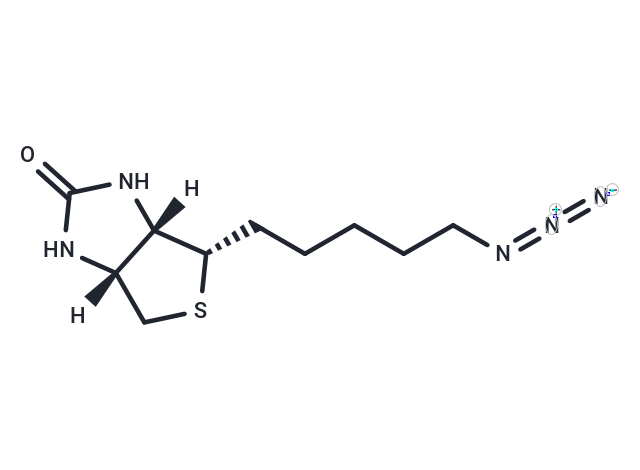
Biotin-C5-Azide
CAS No. 1260586-88-6
Biotin-C5-Azide( —— )
Catalog No. M37184 CAS No. 1260586-88-6
Biotin-C5-Azide (DecarboxyBiotin-N3) is an azide derivative with a biotin tag attached.
Purity : >98% (HPLC)
 COA
Datasheet
HNMR
HPLC
MSDS
Handing Instructions
COA
Datasheet
HNMR
HPLC
MSDS
Handing Instructions
| Size | Price / USD | Stock | Quantity |
| 5MG | 38 | In Stock |


|
| 10MG | 53 | In Stock |
|
| 25MG | 101 | In Stock |
|
| 50MG | 160 | In Stock |
|
| 100MG | 237 | In Stock |
|
| 200MG | 352 | In Stock |
|
| 500MG | Get Quote | In Stock |
|
| 1G | Get Quote | In Stock |
|
Biological Information
-
Product NameBiotin-C5-Azide
-
NoteResearch use only, not for human use.
-
Brief DescriptionBiotin-C5-Azide (DecarboxyBiotin-N3) is an azide derivative with a biotin tag attached.
-
DescriptionBiotin-C5-Azide (DecarboxyBiotin-N3) is a biotin reagent and can be used to prepare biotinylated conjugates. Biotin-C5-Azide is a click chemistry reagent, it contains an Azide group and can undergo copper-catalyzed azide-alkyne cycloaddition reaction (CuAAc) with molecules containing Alkyne groups. Strain-promoted alkyne-azide cycloaddition (SPAAC) can also occur with molecules containing DBCO or BCN groups.
-
In Vitro——
-
In Vivo——
-
Synonyms——
-
PathwayOthers
-
TargetOther Targets
-
RecptorOthers
-
Research Area——
-
Indication——
Chemical Information
-
CAS Number1260586-88-6
-
Formula Weight255.34
-
Molecular FormulaC10H17N5OS
-
Purity>98% (HPLC)
-
SolubilityIn Vitro:?DMSO : 100 mg/mL (391.63 mM; Ultrasonic )
-
SMILESC(CCCCN=[N+]=[N-])[C@H]1[C@@]2([C@@](NC(=O)N2)(CS1)[H])[H]
-
Chemical Name——
Shipping & Storage Information
-
Storage(-20℃)
-
ShippingWith Ice Pack
-
Stability≥ 2 years
Reference
1. Pfaff P, et al. Azoacetylenes for the Synthesis of Arylazotriazole Photoswitches. J Am Chem Soc. 2021 Sep 15;143(36):14495-14501.?
molnova catalog



related products
-
WDR5-0102
WDR5-0102 is a compound that inhibits the WDR5-MLL1 interface (K dis = 7 μM, K d = 4 μM), selectively reducing MLL1 HMT activity without affecting the human H3K4 methyltransferase SETD7 or other HMTs, including G9a, EHMT1, SUV39H2, SETD8, PRMT3, and PRMT5.
-
Pomalidomide 4-PEG3-...
Pomalidomide 4'-PEG3-azide is a chemically synthesized E3 ligase ligand-linker conjugate that incorporates the cereblon ligand derived from Pomalidomide, along with a linker.
-
beta-Oxoacteoside
The herbs of Cistanche deserticola.
