


 Cart
Cart
 sales@molnova.com


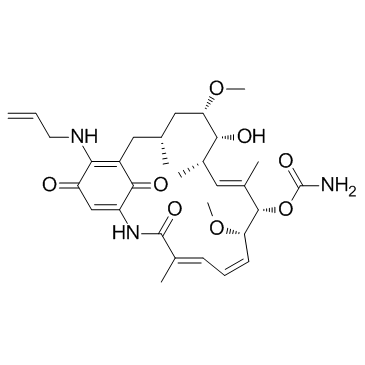
17-AAG
CAS No. 75747-14-7
17-AAG( Tanespimycin | NSC 330507 | CP 127374 | 17AAG | 17 AAG )
Catalog No. M15881 CAS No. 75747-14-7
A potent Hsp90 inhibitor with IC50 of 5 nM in cell-free assays.
Purity : >98% (HPLC)
 COA
Datasheet
HNMR
HPLC
MSDS
Handing Instructions
COA
Datasheet
HNMR
HPLC
MSDS
Handing Instructions
| Size | Price / USD | Stock | Quantity |
| 5MG | 34 | In Stock |


|
| 10MG | 53 | In Stock |
|
| 25MG | 87 | In Stock |
|
| 100MG | Get Quote | In Stock |
|
| 200MG | Get Quote | In Stock |
|
| 500MG | Get Quote | In Stock |
|
| 1G | Get Quote | In Stock |
|
Biological Information
-
Product Name17-AAG
-
NoteResearch use only, not for human use.
-
Brief DescriptionA potent Hsp90 inhibitor with IC50 of 5 nM in cell-free assays.
-
DescriptionA potent Hsp90 inhibitor with IC50 of 5 nM in cell-free assays; induces cytosolic accumulation of cytochrome c and cleavage and activities of caspase-9 and caspase-3, triggering apoptosis of HL-60/Bcr-Abl and K562 cells; causes the degradation of HER2, HER3, Akt, and both mutant and wild-type androgen receptor; inhibits prostate cancer xenografts growth in mice.Skin Cancer Phase 2 Discontinued(In Vitro):Tanespimycin causes the degradation of HER2, Akt, and both mutant and wild-type AR and the retinoblastoma-dependent G1 growth arrest of prostate cancer cells. Tanespimycin inhibits prostate cancer cell lines with IC50s ranged from 25-45 nM (LNCaP, 25 nM; LAPC-4, 40 nM; DU-145, 45 nM; and PC-3, 25 nM).Tanespimycin (0.1-1 μM) induces a nearly complete loss of ErbB2 on ErbB2-overexpressing breast cancer cells. Tanespimycin inhibits cell growth and induces G2/M cell cycle arrest and apoptosis in CCA cells together with the down-regulation of Bcl-2, Survivin and Cyclin B1, and the up-regulation of cleaved PARP.(In Vivo):Tanespimycin (25-200 mg/kg, i.p.) causes a dose-dependent decline in AR, HER2, and Akt expression in prostate cancer xenografts. Tanespimycin treatment at doses sufficient to induce AR, HER2, and Akt degradation results in the dose-dependent inhibition of androgen-dependent and -independent prostate cancer xenograft growth without toxicity.Tanespimycin (60 mg/kg) with Rapamycin (30 mg/kg) inhibits A549 and MDA-MB-231 tumor growth and effects tumor cures in MDA-MB-231 tumor-bearing animals by tail vein injection.
-
In Vitro——
-
In Vivo——
-
SynonymsTanespimycin | NSC 330507 | CP 127374 | 17AAG | 17 AAG
-
PathwayCytoskeleton/Cell Adhesion Molecules
-
TargetHSP
-
RecptorHSP90
-
Research AreaCancer
-
IndicationSkin Cancer
Chemical Information
-
CAS Number75747-14-7
-
Formula Weight585.6884
-
Molecular FormulaC31H43N3O8
-
Purity>98% (HPLC)
-
SolubilityDMSO: ≥ 55 mg/mL
-
SMILESNC(O[C@@H](/C(C)=C/[C@H](C)[C@@H](O)[C@@H](OC)C[C@H](C)CC1=C2NCC=C)[C@@H](OC)/C=C/C=C(C)/C(NC(C1=O)=CC2=O)=O)=O
-
Chemical NameGeldanamycin, 17-demethoxy-17-(2-propenylamino)-
Shipping & Storage Information
-
Storage(-20℃)
-
ShippingWith Ice Pack
-
Stability≥ 2 years
Reference
1. Kamal A, et al. Nature. 2003 Sep 25;425(6956):407-10.
2. Solit DB, et al. Clin Cancer Res. 2002 May;8(5):986-93.
3. Nimmanapalli R, et al.Cancer Res. 2001 Mar 1;61(5):1799-804.
molnova catalog



related products
-
Col 003
Col 003 is a small-molecule compound that inhibits the interaction of Hsp47 with collagen with IC50 of 1.8 uM.
-
SNX 2112
SNX 2112 (PF 04928473) is a potent, selective Hsp90 inhibitor with binding IC50 of 30 nM for both HSP90α and HSP90β.
-
AT-533
AT-533 is a potent inhibitor of Hsp90 and HSV. AT-533 blocks the HIF-1α/VEGF/VEGFR-2 signaling pathway, leading to suppress tumor growth and angiogenesis.
