


 Cart
Cart
 sales@molnova.com


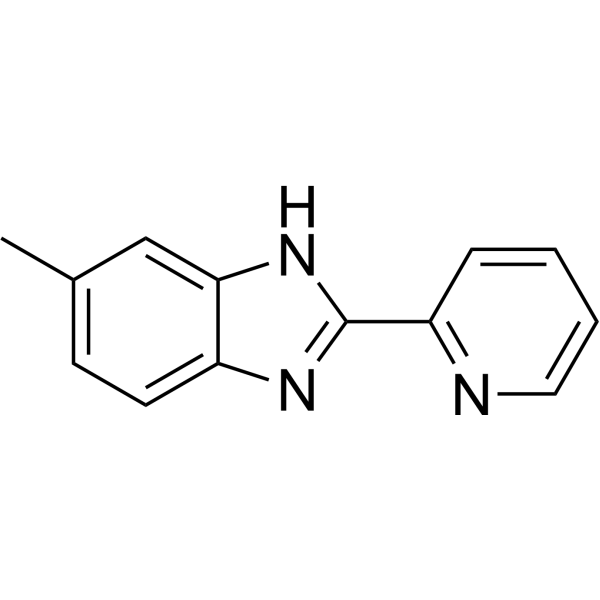
ecMetAP-IN-1
CAS No. 7471-12-7
ecMetAP-IN-1( —— )
Catalog No. M35307 CAS No. 7471-12-7
ecMetAP-IN-1 can be used as a QSAR model to study methionine aminopeptidase inhibitor as an anticancer agent using multiple linear regression.
Purity : >98% (HPLC)
 COA
Datasheet
HNMR
HPLC
MSDS
Handing Instructions
COA
Datasheet
HNMR
HPLC
MSDS
Handing Instructions
| Size | Price / USD | Stock | Quantity |
| 5MG | 39 | Get Quote |


|
| 10MG | 54 | Get Quote |
|
| 25MG | 82 | Get Quote |
|
| 50MG | 121 | Get Quote |
|
| 100MG | 172 | Get Quote |
|
| 200MG | 255 | Get Quote |
|
| 500MG | Get Quote | Get Quote |
|
| 1G | Get Quote | Get Quote |
|
Biological Information
-
Product NameecMetAP-IN-1
-
NoteResearch use only, not for human use.
-
Brief DescriptionecMetAP-IN-1 can be used as a QSAR model to study methionine aminopeptidase inhibitor as an anticancer agent using multiple linear regression.
-
DescriptionecMetAP-IN-1 (compound 17) is a potent ecMetAP inhibitor with an IC50 value of 2.086 μM.
-
In Vitro——
-
In Vivo——
-
Synonyms——
-
PathwayOthers
-
TargetOther Targets
-
RecptorOthers
-
Research Area——
-
Indication——
Chemical Information
-
CAS Number7471-12-7
-
Formula Weight209.25
-
Molecular FormulaC13H11N3
-
Purity>98% (HPLC)
-
Solubility——
-
SMILESCC=1C=C2N=C(NC2=CC1)C3=CC=CC=N3
-
Chemical Name——
Shipping & Storage Information
-
Storage(-20℃)
-
ShippingWith Ice Pack
-
Stability≥ 2 years
Reference
1. Schiffmann R, et al. Metal-mediated inhibition of Escherichia coli methionine aminopeptidase: structure-activity relationships and development of a novel scoring function for metal-ligand interactions. J Med Chem. 2006 Jan 26;49(2):511-22.?
molnova catalog



related products
-
Cdk4/6 Inhibitor IV
Cdk4/6 inhibitor IV is a cell-permeable triaminopyrimidine that reversibly blocks Cdk4/cyclin D1 and Cdk6/cyclin D1 activity with IC50 values of 1.5 and 5.6 μM, respectively.
-
Reynoutrin
Reynoutrin with antioxidant and radical-scavenging activity.
-
BR-1
BR-1 is a phosphatase of regenerating liver 3 (PRL-3) inhibitor which blocks the migration and invasion of metastatic cancer cells.
