


 Cart
Cart
 sales@molnova.com


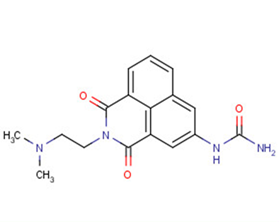
UNBS-5162
CAS No. 956590-23-1
UNBS-5162( UNBS-5162, UNBS 5162, UNBS5162 )
Catalog No. M17690 CAS No. 956590-23-1
UNBS-5162 is a novel naphthalimide that decreases CXCL chemokine expression in experimental prostate cancers.
Purity : >98% (HPLC)
 COA
Datasheet
HNMR
HPLC
MSDS
Handing Instructions
COA
Datasheet
HNMR
HPLC
MSDS
Handing Instructions
| Size | Price / USD | Stock | Quantity |
| 2MG | 45 | In Stock |


|
| 5MG | 65 | In Stock |
|
| 10MG | 122 | In Stock |
|
| 25MG | 240 | In Stock |
|
| 50MG | 402 | In Stock |
|
| 100MG | 593 | In Stock |
|
| 500MG | 1251 | In Stock |
|
| 1G | Get Quote | In Stock |
|
Biological Information
-
Product NameUNBS-5162
-
NoteResearch use only, not for human use.
-
Brief DescriptionUNBS-5162 is a novel naphthalimide that decreases CXCL chemokine expression in experimental prostate cancers.
-
DescriptionUNBS5162 is a novel naphthalimide that binds to DNA by intercalation and suppresses CXCL chemokine elaboration. In vivo UNBS5162 after repeat administration significantly increased survival in orthotopic human prostate cancer models. Results obtained by the National Cancer Institute (NCI) using UNBS3157 and UNBS5162 against the NCI 60 cell line panel did not show a correlation with any other compound present in the NCI database, including amonafide, thereby suggesting a unique mechanism of action for these two novel naphthalimides.(In Vitro):UNBS5162 is a pan-antagonist of CXCL chemokine expression and exhibits weak antiproliferative activity against human cancer cell lines with mean IC50 of 17.9 μM. UNBS5162 markedly impairs PC-3 tumor cell growth kinetics, without inducing senescence, whereas the reverse feature is observed with respect to DU-145 cells. UNBS5162 is cytotoxic to a range of human cancer cell lines including glioblastoma (Hs683 and U373MG), colorectal (HCT-15 and LoVo), non-small-cell lung (A549) and breast (MCF-7), with IC50s of 0.5-5 μM. UNBS5162 also markedly increases the levels of expression of LC3-I and LC3-II in human cancer cells. UNBS5162 displays no anti-topoisomerase II activity. Moreover, UNBS5162 induces cancer cell death through lysosomal membrane permeabilization (LMP) in PC3 prostate cancer cells but not in U373 glioblastoma cells, with this LMP process occurring as an UNBS5162-induced decrease in Hsp70 expression. UNBS5162 inhibits the proliferation of esophageal cancer squamous cells via the PI3K/AKT signaling pathway. UNBS5162 downregulates the protein expression of proteins associated with the PI3K/AKT signaling pathway, including the levels of phosphorylated (p)-AKT, p-mechanistic target of rapamycin kinase, ribosomal protein S6 kinase β1 and cyclin D1.(In Vivo):UNBS5162 (20 mg/kg, i.v.) increases the therapeutic benefits of taxol in vivo in the orthotopic human PC-3 prostate cancer model.
-
In VitroUNBS5162 is a pan-antagonist of CXCL chemokine expression and exhibits weak antiproliferative activity against human cancer cell lines with mean IC50 of 17.9 μM. UNBS5162 markedly impairs PC-3 tumor cell growth kinetics, without inducing senescence, whereas the reverse feature is observed with respect to DU-145 cells. UNBS5162 is cytotoxic to a range of human cancer cell lines including glioblastoma (Hs683 and U373MG), colorectal (HCT-15 and LoVo), non-small-cell lung (A549) and breast (MCF-7), with IC50s of 0.5-5 μM. UNBS5162 also markedly increases the levels of expression of LC3-I and LC3-II in human cancer cells. UNBS5162 displays no anti-topoisomerase II activity. Moreover, UNBS5162 induces cancer cell death through lysosomal membrane permeabilization (LMP) in PC3 prostate cancer cells but not in U373 glioblastoma cells, with this LMP process occurring as an UNBS5162-induced decrease in Hsp70 expression. UNBS5162 inhibits the proliferation of esophageal cancer squamous cells via the PI3K/AKT signaling pathway. UNBS5162 downregulates the protein expression of proteins associated with the PI3K/AKT signaling pathway, including the levels of phosphorylated (p)-AKT, p-mechanistic target of rapamycin kinase, ribosomal protein S6 kinase β1 and cyclin D1.
-
In VivoUNBS5162 (20 mg/kg, i.v.) increases the therapeutic benefits of taxol in vivo in the orthotopic human PC-3 prostate cancer model.
-
SynonymsUNBS-5162, UNBS 5162, UNBS5162
-
PathwayCell Cycle/DNA Damage
-
TargetPARP
-
RecptorCXCL
-
Research AreaCancer
-
Indication——
Chemical Information
-
CAS Number956590-23-1
-
Formula Weight326.35
-
Molecular FormulaC17H18N4O3
-
Purity>98% (HPLC)
-
SolubilityDMSO : 21.5 mg/mL. 65.88 mM;
-
SMILESCN(C)CCn1c(=O)c2cccc3cc(NC(=O)N)cc(c1=O)c23
-
Chemical Name1-(2-(2-(dimethylamino)ethyl)-1,3-dioxo-2,3-dihydro-1H-benzo[de]isoquinolin-5-yl)urea
Shipping & Storage Information
-
Storage(-20℃)
-
ShippingWith Ice Pack
-
Stability≥ 2 years
Reference
1. Mijatovic T, et al. Neoplasia. 2008 Jun;10(6):573-86.
molnova catalog



related products
-
NVP-BVU972
NVP-BVU972 is a selective and potent Met inhibitor with IC50 of 14 nM.
-
PARP10-IN-3
PARP10-IN-3 is a potent and selective mono-Adp-ribotransferase PARP10 inhibitor that inhibits human PARP10 (IC50:480 nM). PARP10-IN-3 also inhibited human PARP2 and human PARP15 with IC50 values of 1.7 μM.
-
2-CHLORO-5-CYANOPYRA...
2-CHLORO-5-CYANOPYRAZINE is an active biochemical.
