


 Cart
Cart
 sales@molnova.com


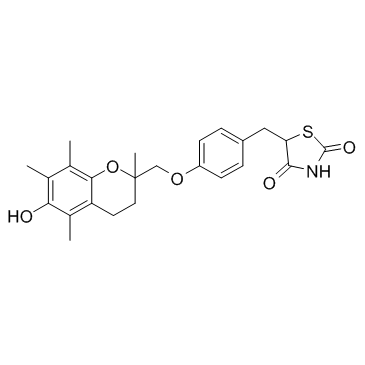
Troglitazone
CAS No. 97322-87-7
Troglitazone( CS-045 )
Catalog No. M16880 CAS No. 97322-87-7
A PPARγ activator that has antidiabetic, anti-tumor and anti-inflammatory activities.
Purity : >98% (HPLC)
 COA
Datasheet
HNMR
HPLC
MSDS
Handing Instructions
COA
Datasheet
HNMR
HPLC
MSDS
Handing Instructions
| Size | Price / USD | Stock | Quantity |
| 2MG | 32 | In Stock |


|
| 5MG | 50 | In Stock |
|
| 10MG | 81 | In Stock |
|
| 25MG | 158 | In Stock |
|
| 50MG | 290 | In Stock |
|
| 100MG | 529 | In Stock |
|
| 500MG | 1107 | In Stock |
|
| 1G | Get Quote | In Stock |
|
Biological Information
-
Product NameTroglitazone
-
NoteResearch use only, not for human use.
-
Brief DescriptionA PPARγ activator that has antidiabetic, anti-tumor and anti-inflammatory activities.
-
DescriptionA PPARγ activator that has antidiabetic, anti-tumor and anti-inflammatory activities; binds to PPARγ and selectively induces the early growth response-1 gene expression; inhibits biosynthesis of cholesterol in CHO cell (IC50=8 ug/ml); enhances human lung cancer cells to TRAIL-induced apoptosis via autophagy flux.Diabetes Approved(In Vitro):Troglitazone is a PPARγ agonist, with EC50s of 550 nM and 780 nM for human and murine?PPARγ receptor, respectively. Troglitazone (2-200 μM) is cytotoxic to the pancreatic cancer cell lines (MIA Paca2 and PANC-1 cells), with IC50s of 49.9?±?1.2 and 51.3?±?5.3 μM, respectively. Troglitazone (50 μM) increases chromatin condensation in MIA Paca2 and PANC-1 cells, enhances the activity of caspase-3 and decreases Bcl-2 expression. Troglitazone (0, 1, 2, and 4 μM) sensitizes TRAIL-mediated apoptosis in human lung adenocarcinoma cells. Troglitazone enhancement of TRAIL-induced apoptosis is blocked by inhibition of autophagy, via activation of autophagy flux. In addition, the effects of troglitazone are induced by PPARγ activation in A549 cells.(In Vivo):Troglitazone (200 mg/kg, p.o.) shows inhibitory effects on the growth of tumor in the MIA Paca2 xenograft model.
-
In VitroTroglitazone is a PPARγ agonist, with EC50s of 550 nM and 780 nM for human and murine?PPARγ receptor, respectively. Troglitazone (2-200 μM) is cytotoxic to the pancreatic cancer cell lines (MIA Paca2 and PANC-1 cells), with IC50s of 49.9?±?1.2 and 51.3?±?5.3 μM, respectively. Troglitazone (50 μM) increases chromatin condensation in MIA Paca2 and PANC-1 cells, enhances the activity of caspase-3 and decreases Bcl-2 expression. Troglitazone (0, 1, 2, and 4 μM) sensitizes TRAIL-mediated apoptosis in human lung adenocarcinoma cells. Troglitazone enhancement of TRAIL-induced apoptosis is blocked by inhibition of autophagy. In addition, the effects of troglitazone are induced by PPARγ activation in A549 cells.
-
In VivoTroglitazone (200 mg/kg, p.o.) shows inhibitory effects on the growth of tumor in the MIA Paca2 xenograft model.
-
SynonymsCS-045
-
PathwayMetabolic Enzyme/Protease
-
TargetPPAR
-
RecptorPPARγ
-
Research AreaMetabolic Disease
-
IndicationDiabetes
Chemical Information
-
CAS Number97322-87-7
-
Formula Weight441.5399
-
Molecular FormulaC24H27NO5S
-
Purity>98% (HPLC)
-
Solubility10 mM in DMSO
-
SMILESO=C(N1)SC(CC2=CC=C(OCC3(C)CCC4=C(C)C(O)=C(C)C(C)=C4O3)C=C2)C1=O
-
Chemical Name2,4-Thiazolidinedione, 5-[[4-[(3,4-dihydro-6-hydroxy-2,5,7,8-tetramethyl-2H-1-benzopyran-2-yl)methoxy]phenyl]methyl]-
Shipping & Storage Information
-
Storage(-20℃)
-
ShippingWith Ice Pack
-
Stability≥ 2 years
Reference
1. Baek SJ, et al. J Biol Chem. 2003 Feb 21;278(8):5845-53.
2. Nazim UM, et al. Oncotarget. 2017 Apr 18;8(16):26819-26831.
3. Wang M, et al. Diabetes. 1999 Feb;48(2):254-60.
molnova catalog



related products
-
L-165041
L-165041 is a potent and selective agonist of the nuclear receptor PPARβ and PPARδ(Ki = 9 nM EC50 = ~500 nM respectively).
-
Fucosterol
Fucosterol is isolated from E. stolonifera with anti-diabetic anti-adipogenic and anti-cancer activities. It regulates adipogenesis via modulation of PPARα and C/EBPα expression.
-
1-Deoxynojirimycin
1-Deoxynojirimycin is a potent α-glucosidase inhibitor, suppressing postprandial blood glucose, thereby possibly preventing diabetes mellitus.
