


 Cart
Cart
 sales@molnova.com


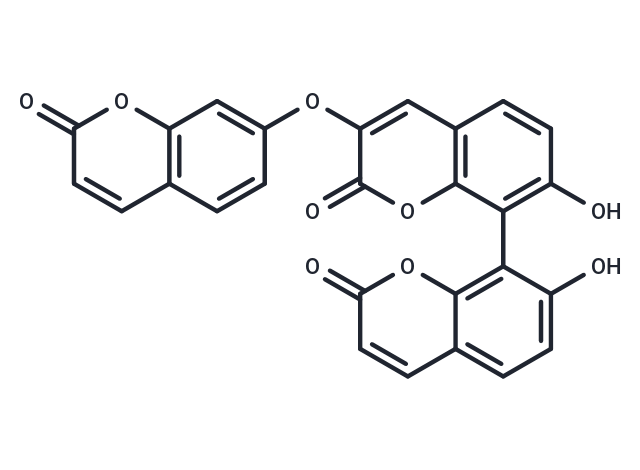
Triumbelletin
CAS No. 131559-54-1
Triumbelletin( —— )
Catalog No. M37722 CAS No. 131559-54-1
Triumbelletin is a tricoumarin rhamnopyranoside obtained from Wikstroemia indica with antitumour activity for the study of tumours.
Purity : >98% (HPLC)
 COA
Datasheet
HNMR
HPLC
MSDS
Handing Instructions
COA
Datasheet
HNMR
HPLC
MSDS
Handing Instructions
| Size | Price / USD | Stock | Quantity |
| 2MG | 728 | Get Quote |


|
| 500MG | Get Quote | Get Quote |
|
| 1G | Get Quote | Get Quote |
|
Biological Information
-
Product NameTriumbelletin
-
NoteResearch use only, not for human use.
-
Brief DescriptionTriumbelletin is a tricoumarin rhamnopyranoside obtained from Wikstroemia indica with antitumour activity for the study of tumours.
-
DescriptionTriumbelletin is a tricoumarin rhamnopyranoside that can be found in Daphne mezereum.
-
In Vitro——
-
In Vivo——
-
Synonyms——
-
PathwayOthers
-
TargetOther Targets
-
RecptorOthers
-
Research Area——
-
Indication——
Chemical Information
-
CAS Number131559-54-1
-
Formula Weight482.39
-
Molecular FormulaC27H14O9
-
Purity>98% (HPLC)
-
Solubility——
-
SMILESO=C1OC=2C=C(OC3=CC=4C=CC(O)=C(C4OC3=O)C=5C(O)=CC=C6C=CC(=O)OC65)C=CC2C=C1
-
Chemical Name——
Shipping & Storage Information
-
Storage(-20℃)
-
ShippingWith Ice Pack
-
Stability≥ 2 years
Reference
1. Bernhard Kreher, et al. Triumbellin, A tricoumarin rhamnopyranoside from Daphne mezereum. Phytochemistry, 1990, 29 (11): 3633-3637.
molnova catalog



related products
-
K-975
K-975 is a highly selective, orally active TEAD inhibitor, effectively inhibiting protein-protein interactions between TEAD and YAP1/TAZ.
-
m-PEG3-SH
m-PEG3-SH is a PEG-based PROTAC linker that can be used in the synthesis of PROTACs.
-
Nor-rubrofusarin gen...
Nor-rubrofusarin gentiobioside is a natural product found in the leguminous plant Cassia vulgaris.
