


 Cart
Cart
 sales@molnova.com


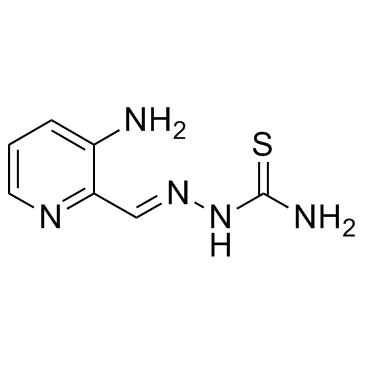
Triapine
CAS No. 143621-35-6
Triapine( 3-AP | PAN-811 | OCX191 | NSC663249 )
Catalog No. M11854 CAS No. 143621-35-6
Triapine (3-AP, PAN-811, OCX191, NSC 663249) is a potent ribonucleotide reductase inhibitor with broad spectrum antitumor activity.
Purity : >98% (HPLC)
 COA
Datasheet
HNMR
HPLC
MSDS
Handing Instructions
COA
Datasheet
HNMR
HPLC
MSDS
Handing Instructions
| Size | Price / USD | Stock | Quantity |
| 5MG | 47 | In Stock |


|
| 10MG | 57 | In Stock |
|
| 25MG | 138 | In Stock |
|
| 50MG | 249 | In Stock |
|
| 100MG | 380 | In Stock |
|
| 200MG | Get Quote | In Stock |
|
| 500MG | Get Quote | In Stock |
|
| 1G | Get Quote | In Stock |
|
Biological Information
-
Product NameTriapine
-
NoteResearch use only, not for human use.
-
Brief DescriptionTriapine (3-AP, PAN-811, OCX191, NSC 663249) is a potent ribonucleotide reductase inhibitor with broad spectrum antitumor activity.
-
DescriptionTriapine (3-AP, PAN-811, OCX191, NSC 663249) is a potent ribonucleotide reductase inhibitor with broad spectrum antitumor activity.Ovarian Cancer Phase 2 Clinical(In Vitro):3-AP (Triapine) is a potent derivative of α-heterocyclic carboxaldehyde thiosemicarbazone (HCT) that inhibits hRRM2 and p53R2 isoforms of the M2 subunit. 3-AP (Triapine) is thought to inhibit ribonucleotide reductase through its preformed iron chelate, rather than directly by removing iron from the active site. In cells containing less topoisomerase IIα fewer DNA strand breaks will be produced, and thus topoisomerase II poisons will be less inhibitory in the K/VP.5 cell line. The IC50s for Dp44mT growth inhibition are 48±9 nM and 60±12 nM, for K562 and K/VP.5 cells, respectively. The IC50s for 3-AP growth inhibition are 476±39 nM and 661±69 nM for K562 and K/VP.5 cells, respectively. PKIH and DpT Fe chelators show high antiproliferative activity against a range of tumor cell lines. Dp44mT shows the greatest antitumor efficacy with an IC50 that ranged from 0.005 to 0.4 μM. The average IC50 of Dp44mT over 28 cell types is 0.03±0.01 μM, which is significantly lower than that of 3-AP (Triapine; average IC50: 1.41±0.37 μM).(In Vivo):3-AP (Triapine) causes a significant increase (1.7-fold) in splenic weight when expressed as a percentage of total body weight (1.02±0.06%; n=25) compared with control mice (0.6±0.03%; n=27). In the long-term group, a significant increase in heart weight is observed after Dp44mT (0.4 mg/kg per day) (0.8±0.06%; n=4) compared with control mice (0.5±0.01%; n=6). A significant decrease in the expression of Ndrg1, TfR1, and VEGF1 in the liver is noted for Dp44mT- and 3-AP (12 mg/kg per day)-treated animals. The decreased expression could be related to the increased liver Fe in both Dp44mT- and 3-AP-treated mice.
-
In VitroTriapine (3-AP; PAN-811) is a potent derivative of α-heterocyclic carboxaldehyde thiosemicarbazone (HCT) that inhibits hRRM2 and p53R2 isoforms of the M2 subunit. Triapine (3-AP; PAN-811) is thought to inhibit ribonucleotide reductase through its preformed iron chelate, rather than directly by removing iron from the active site. In cells containing less topoisomerase IIα fewer DNA strand breaks will be produced, and thus topoisomerase II poisons will be less inhibitory in the K/VP.5 cell line. The IC50s for Dp44mT growth inhibition are 48±9 nM and 60±12 nM, for K562 and K/VP.5 cells, respectively. The IC50s for Triapine growth inhibition are 476±39 nM and 661±69 nM for K562 and K/VP.5 cells, respectively. PKIH and DpT Fe chelators show high antiproliferative activity against a range of tumor cell lines. Dp44mT shows the greatest antitumor efficacy with an IC50 that ranged from 0.005 to 0.4 μM. The average IC50 of Dp44mT over 28 cell types is 0.03±0.01 μM, which is significantly lower than that of Triapine (3-AP; PAN-811; average IC50: 1.41±0.37 μM).
-
In VivoTriapine (3-AP; PAN-811) causes a significant increase (1.7-fold) in splenic weight when expressed as a percentage of total body weight (1.02±0.06%; n=25) compared with control mice (0.6±0.03%; n=27). In the long-term group, a significant increase in heart weight is observed after Dp44mT (0.4 mg/kg per day) (0.8±0.06%; n=4) compared with control mice (0.5±0.01%; n=6). A significant decrease in the expression of Ndrg1, TfR1, and VEGF1 in the liver is noted for Dp44mT- and Triapine (12 mg/kg per day)-treated animals. The decreased expression could be related to the increased liver Fe in both Dp44mT- and Triapine-treated mice.
-
Synonyms3-AP | PAN-811 | OCX191 | NSC663249
-
PathwayCell Cycle/DNA Damage
-
TargetNucleoside Antimetabolite/Analog
-
RecptorRR
-
Research AreaCancer
-
IndicationOvarian Cancer
Chemical Information
-
CAS Number143621-35-6
-
Formula Weight195.2449
-
Molecular FormulaC7H9N5S
-
Purity>98% (HPLC)
-
SolubilityDMSO: ≥ 47 mg/mL
-
SMILESNC1=CC=CN=C1/C=N/NC(N)=S
-
Chemical NameHydrazinecarbothioamide, 2-[(3-amino-2-pyridinyl)methylene]-
Shipping & Storage Information
-
Storage(-20℃)
-
ShippingWith Ice Pack
-
Stability≥ 2 years
Reference
1. Liu MC, et al. J Med Chem. 1992 Oct 2;35(20):3672-7.
2. Cory JG, et al. Biochem Pharmacol. 1994 Jul 19;48(2):335-44.
3. Chen RW, et al. Neuroscience. 2005;135(1):191-201.
4. Finch RA, et al. Biochem Pharmacol. 2000 Apr 15;59(8):983-91.
molnova catalog



related products
-
N2-Methylguanosine
N2-methylguanosine is a modified nucleoside of tRNA that occurs at several specific locations in many tRNA's.
-
6-?Thioinosine
6-?Thioinosine (6TI) is a purine antimetabolite acts as an anti-adipogenesis agent.
-
Tegafur
A chemotherapeutic prodrug of 5-flourouracil (5-FU) used in the treatment of cancers; a thymidylate synthase inhibitor.
