


 Cart
Cart
 sales@molnova.com


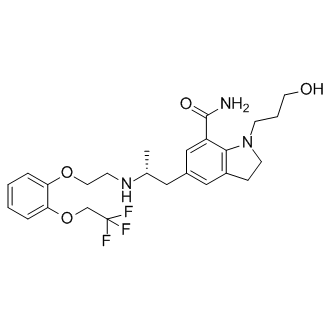
Silodosin
CAS No. 160970-54-7
Silodosin( KAD 3213 | KMD 3213 )
Catalog No. M12319 CAS No. 160970-54-7
A highly potent, uroselective α1a-adrenoceptor antagonist with Ki of 36 pM; displays 583- and 56-fold lower potency against α1b and α1d respectors, respectively.
Purity : >98% (HPLC)
 COA
Datasheet
HNMR
HPLC
MSDS
Handing Instructions
COA
Datasheet
HNMR
HPLC
MSDS
Handing Instructions
| Size | Price / USD | Stock | Quantity |
| 5MG | 29 | In Stock |


|
| 10MG | 47 | In Stock |
|
| 25MG | 68 | In Stock |
|
| 50MG | 82 | In Stock |
|
| 100MG | 97 | In Stock |
|
| 200MG | 122 | In Stock |
|
| 500MG | Get Quote | In Stock |
|
| 1G | Get Quote | In Stock |
|
Biological Information
-
Product NameSilodosin
-
NoteResearch use only, not for human use.
-
Brief DescriptionA highly potent, uroselective α1a-adrenoceptor antagonist with Ki of 36 pM; displays 583- and 56-fold lower potency against α1b and α1d respectors, respectively.
-
DescriptionA highly potent, uroselective α1a-adrenoceptor antagonist with Ki of 36 pM; displays 583- and 56-fold lower potency against α1b and α1d respectors, respectively; inhibits norepinephrine-induced increases intracellular Ca2+ concentrations in CHO cells with IC50 of 0.32 nM; inhibits intraurethral pressure (IUP) response in vivo.Other Indication Approved(In Vitro):Silodosin (KAD 3213; KMD 3213) inhibits norepinephrine-induced increases in intracellular Ca2+ concentrations in alpha 1a-AR-expressing Chinese hamster ovary cells with an IC50 of 0.32 nM but had a much weaker inhibitory effect on the alpha 1b- and alpha 1d-ARs.Silodosin potently inhibits 2-[2-(4-hydroxy-3-[125I]iodophenyl)ethylaminomethyl]-alpha-tetralone binding to the cloned human alpha 1a-AR, with a Ki value of 0.036 nM, but has 583- and 56-fold lower potency at the alpha 1b- and alpha 1d-ARs, respectively.Silodosin (0-10 μM; 24 hours) decreases ELK1 gene expression as a dose-dependent manner in all the bladder cancer cell lines.Silodosin (0-10 μM; 24 hours) decreases ELK1 protein expression as a as a dose-dependent manner.Silodosin (0-10 μM; 96 hours) insignificantly changes cell viability of AR-positive UMUC3 or TCCSUP cultured in an androgen-depleted condition or that of AR-negative 647V. In contrast, silodosin reduced the growth of UMUC3 cells cultured with normal FBS containing androgens (58% decrease at 10 μM).(In Vivo):Silodosin (intravenous injection; 0.1-0.3mg/kg) reduces the obstruction-induced increases in MinP by 27.7 % (0.1 mg/kg) and 20.8 %(0.3 mg/kg). It improves detrusor overactivity and reduces the grade of obstruction, and thus may be effective for both storage and voiding dysfunction for the treatment of LUTS/BPH.
-
In VitroSilodosin (KAD 3213; KMD 3213) inhibits norepinephrine-induced increases in intracellular Ca2+ concentrations in alpha 1a-AR-expressing Chinese hamster ovary cells with an IC50 of 0.32 nM but had a much weaker inhibitory effect on the alpha 1b- and alpha 1d-ARs.Silodosin potently inhibits 2-[2-(4-hydroxy-3-[125I]iodophenyl)ethylaminomethyl]-alpha-tetralone binding to the cloned human alpha 1a-AR, with a Ki value of 0.036 nM, but has 583- and 56-fold lower potency at the alpha 1b- and alpha 1d-ARs, respectively.Silodosin (0-10 μM; 24 hours) decreases?ELK1 gene expression as a dose-dependent manner in all the bladder cancer cell lines. Silodosin (0-10 μM; 24 hours) decreases ELK1 protein expression as a as a dose-dependent manner.Silodosin (0-10 μM; 96 hours) insignificantly changes cell viability of AR-positive UMUC3or TCCSUP cultured in an androgen-depleted condition or that of AR-negative 647V.In contrast, silodosin reduced the growth of UMUC3 cells cultured with normal FBS containing androgens (58% decrease at 10 μM). RT-PCR Cell Line:TCCSUP; UMUC3 and 647V cells Concentration:0.1, 0.5, 3.0, or 10 μM Incubation Time:24 hours Result:Decreases ELK1 in bladder cancer cells.Western Blot Analysis Cell Line:TCCSUP; UMUC3 and 647V cells Concentration:0.1, 0.5, 3.0, or 10 μM Incubation Time:24 hours Result:Decreases ELK1 in bladder cancer cells.Cell Proliferation Assay Cell Line:UMUC3,TCCSUP or AR-negative 647V cells Concentration:0.1, 0.5, 3.0, or 10 μM Incubation Time:96 hours Result:Decreased cell viability of UMUC3 cells cultured with normal FBS containing androgens (58% decrease).
-
In VivoSilodosin (intravenous injection; 0.1-0.3mg/kg) reduces the obstruction-induced increases in MinP by 27.7 % (0.1 mg/kg) and 20.8 %(0.3 mg/kg). It improves detrusor overactivity and reduces the grade of obstruction, and thus may be effective for both storage and voiding dysfunction for the treatment of LUTS/BPH. Animal Model:Sprague Dawley ratsDosage:0.1-0.3mg/kg Administration:Intravenous injection Result:Effectively reduced contractions of both human and rat isolated ureters.
-
SynonymsKAD 3213 | KMD 3213
-
PathwayGPCR/G Protein
-
TargetAdrenergic Receptor
-
Recptorβ-adrenergicreceptor
-
Research AreaOther Indications
-
IndicationOther Disease
Chemical Information
-
CAS Number160970-54-7
-
Formula Weight495.5345
-
Molecular FormulaC25H32F3N3O4
-
Purity>98% (HPLC)
-
Solubility10 mM in DMSO
-
SMILESO=C(C1=CC(C[C@H](NCCOC2=CC=CC=C2OCC(F)(F)F)C)=CC3=C1N(CCCO)CC3)N
-
Chemical Name1H-Indole-7-carboxamide, 2,3-dihydro-1-(3-hydroxypropyl)-5-[(2R)-2-[[2-[2-(2,2,2-trifluoroethoxy)phenoxy]ethyl]amino]propyl]-
Shipping & Storage Information
-
Storage(-20℃)
-
ShippingWith Ice Pack
-
Stability≥ 2 years
Reference
1. Shibata K, et al. Mol Pharmacol. 1995 Aug;48(2):250-8.
2. Yamagishi R, et al. Eur J Pharmacol. 1996 Nov 7;315(1):73-9.
3. Yamada S, et al. Life Sci. 1998;62(17-18):1585-9.
4. Akiyama K, et al. J Pharmacol Exp Ther. 1999 Oct;291(1):81-91.
molnova catalog



related products
-
OPC-28326
OPC-28326 is a specific an α2-adrenergic receptor antagonist and acts as a peripheral vasodilator. OPC-28326 inhibits α2A-, α2B- and α2C-adrenoceptors with Ki of 2040, 285, and 55?nM, respectively.
-
ST 91
ST-91 is an agonist of α2-adrenoceptor with a mixed α-adrenergic receptor type/subtype selection profile.
-
Levosalbutamol
A short-acting β2 adrenergic receptor agonist used in the treatment of asthma and chronic obstructive pulmonary disease (COPD).
