


 Cart
Cart
 sales@molnova.com


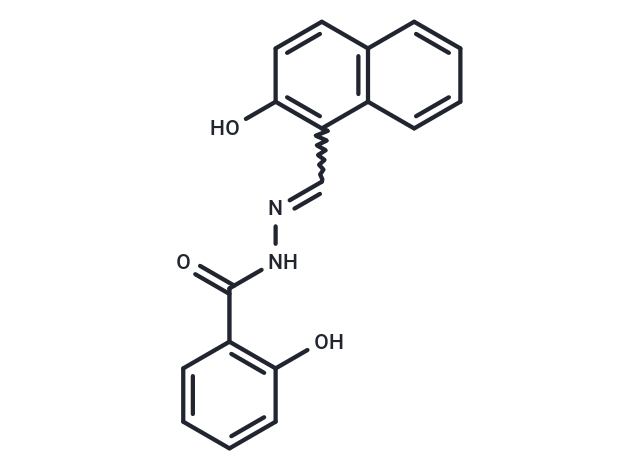
SD49-7
CAS No. 54009-54-0
SD49-7( —— )
Catalog No. M35980 CAS No. 54009-54-0
SD49-7 is an inhibitor of histone lysine demethylase 4 (KDM4) with an IC50 of 0.19 μM.
Purity : >98% (HPLC)
 COA
Datasheet
HNMR
HPLC
MSDS
Handing Instructions
COA
Datasheet
HNMR
HPLC
MSDS
Handing Instructions
| Size | Price / USD | Stock | Quantity |
| 2MG | 84 | Get Quote |


|
| 5MG | 126 | Get Quote |
|
| 10MG | 188 | Get Quote |
|
| 25MG | 366 | Get Quote |
|
| 50MG | 532 | Get Quote |
|
| 100MG | 744 | Get Quote |
|
| 500MG | 1485 | Get Quote |
|
| 1G | Get Quote | Get Quote |
|
Biological Information
-
Product NameSD49-7
-
NoteResearch use only, not for human use.
-
Brief DescriptionSD49-7 is an inhibitor of histone lysine demethylase 4 (KDM4) with an IC50 of 0.19 μM.
-
Description(E/Z)-NSAH is an isoform of NSAH (HY-114503), which is reversible and competitive nonnucleoside ribonucleotide reductase (RR) inhibitor, with cell-free IC50 of 32 μM and cell-based IC50 of ~250 nM, respectively.
-
In Vitro——
-
In Vivo——
-
Synonyms——
-
PathwayChromatin/Epigenetic
-
TargetHistone Demethylase
-
RecptorHistone Demethylase
-
Research Area——
-
Indication——
Chemical Information
-
CAS Number54009-54-0
-
Formula Weight306.32
-
Molecular FormulaC18H14N2O3
-
Purity>98% (HPLC)
-
Solubility——
-
SMILESC(=NNC(=O)C1=C(O)C=CC=C1)C=2C3=C(C=CC2O)C=CC=C3
-
Chemical Name——
Shipping & Storage Information
-
Storage(-20℃)
-
ShippingWith Ice Pack
-
Stability≥ 2 years
Reference
1. Md Faiz Ahmad, et al. Potent competitive inhibition of human ribonucleotide reductase by a nonnucleoside small molecule. Proc Natl Acad Sci U S A. 2017 Aug 1;114(31):8241-8246.?
molnova catalog



related products
-
IOX1
IOX1 is a potent, broad-spectrum inhibitor of 2OG oxygenases, including the JmjC demethylases.
-
RN-1 dihydrochloride
RN-1 dihydrochloride is an effective and selective irreversible inhibitor of lysine-specific demethylase 1 (LSD1, IC50 = 70 nM).
-
DDP-38003 dihydrochl...
DDP-38003 is an novel, orally available inhibitor of histone lysine-specific demethylase 1A (KDM1A/LSD1) with IC50 of 84 nM.
