


 Cart
Cart
 sales@molnova.com


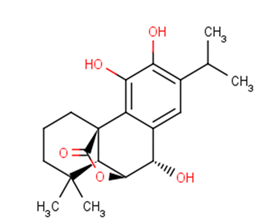
Rosmanol
CAS No. 80225-53-2
Rosmanol( Rosmanol )
Catalog No. M19118 CAS No. 80225-53-2
Rosmanol has antioxidant activity, it can activate the antioxidant response element. Rosmanol has biphasic modulation of GABAA receptors, demonstrates CNS activity in mouse models of antinociception, antidepressant and anxiolysis.
Purity : >98% (HPLC)
 COA
Datasheet
HNMR
HPLC
MSDS
Handing Instructions
COA
Datasheet
HNMR
HPLC
MSDS
Handing Instructions
| Size | Price / USD | Stock | Quantity |
| 5MG | 132 | In Stock |


|
| 10MG | 205 | In Stock |
|
| 25MG | 430 | In Stock |
|
| 50MG | 619 | In Stock |
|
| 100MG | 861 | In Stock |
|
| 200MG | Get Quote | In Stock |
|
| 500MG | Get Quote | In Stock |
|
| 1G | Get Quote | In Stock |
|
Biological Information
-
Product NameRosmanol
-
NoteResearch use only, not for human use.
-
Brief DescriptionRosmanol has antioxidant activity, it can activate the antioxidant response element. Rosmanol has biphasic modulation of GABAA receptors, demonstrates CNS activity in mouse models of antinociception, antidepressant and anxiolysis.
-
DescriptionRosmanol has antioxidant activity, it can activate the antioxidant response element. Rosmanol has biphasic modulation of GABAA receptors, demonstrates CNS activity in mouse models of antinociception, antidepressant and anxiolysis. Rosmanol potently induces apoptosis through both the mitochondrial apoptotic pathway and death receptor pathway in human colon adenocarcinoma COLO 205 cells. Rosmanol has anti-inflammatory activity, it potently inhibits lipopolysaccharide-induced iNOS and COX-2 expression through downregulating MAPK, NF-kappaB, STAT3 and C/EBP signaling pathways.
-
In VitroRosmanol exhibits the strongest inhibition on cell viability with IC50 approximately 42 μM. Rosmanol might suppress cancer cell proliferation or induce cancer cell undergoing apoptosis that lead to cell growth-inhibition. With 50 μM of Rosmanol treatment, the percentage of COLO 205 cells undergoing apoptosis increase dramatically from 9 h (29%) to 24 h (51%). Within 24 h of treatment with 50 μM Rosmanol, COLO 205 cells exhibit significant morphological changes and chromosomal condensation, which is indicative of apoptotic cell death. Carnosol is a lipid protector against attack by O2.
-
In Vivo——
-
SynonymsRosmanol
-
PathwayMetabolic Enzyme/Protease
-
TargetPhosphatase
-
RecptorAntioxidant| COX-2
-
Research Area——
-
Indication——
Chemical Information
-
CAS Number80225-53-2
-
Formula Weight346.42
-
Molecular FormulaC20H26O5
-
Purity>98% (HPLC)
-
SolubilityIn Vitro:?DMSO : 100 mg/mL (288.67 mM)
-
SMILESCC(C)c1cc2[C@H](O)[C@H]3OC(=O)[C@@]4(CCCC(C)(C)[C@H]34)c2c(O)c1O
-
Chemical Name(4bR,8aS,9S,10S)-3,4,10-trihydroxy-2-isopropyl-8,8-dimethyl-6,7,8,8a,9,10-hexahydro-5H-9,4b-(epoxymethano)phenanthren-12-one
Shipping & Storage Information
-
Storage(-20℃)
-
ShippingWith Ice Pack
-
Stability≥ 2 years
Reference
1. Abdelhalim A, et al. Antidepressant, Anxiolytic and Antinociceptive Activities of Constituents from Rosmarinus Officinalis [J]. J Pharm Pharm Sci. 2015;18(4):448-59.
molnova catalog



related products
-
CDC25 Phosphatase In...
BN82002 is a synthetic inhibitor of CDC25 phophatases.
-
N-Stearoylsphingosin...
N-Stearoylsphingosine (Cer(d18:1/18:0)) is an amide compound widely found in eukaryotic organisms that enhances protein phosphatase 2A (PP2A) activity by interfering with the binding of PP2A to PP2A inhibitor 2, leading to dephosphorylation of Akt.N-Stearoylsphingosine is used in prostate cancer research.
-
Calyculin A
Calyculin A ((-)-Calyculin A), a toxicant in the Japanese marine sponge CDiscodermia calyxC, is a selective and potent inhibitor of protein phosphatase 1 (PP1) and protein phosphatase 2A (PP2A).
