


 Cart
Cart
 sales@molnova.com


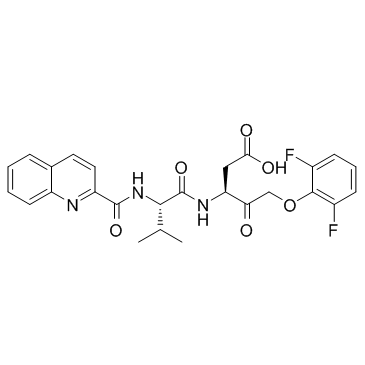
Q-VD-Oph
CAS No. 1135695-98-5
Q-VD-Oph( QVD-OPH | Quinoline-Val-Asp-Difluorophenoxymethylketone )
Catalog No. M10477 CAS No. 1135695-98-5
Q-VD-Oph is a potent pan-caspase inhibitor, inhibits human recombinant caspase-7 with IC50 of 48 nM in cell-free assay.
Purity : >98% (HPLC)
 COA
Datasheet
HNMR
HPLC
MSDS
Handing Instructions
COA
Datasheet
HNMR
HPLC
MSDS
Handing Instructions
| Size | Price / USD | Stock | Quantity |
| 5MG | 78 | In Stock |


|
| 10MG | 132 | In Stock |
|
| 25MG | 213 | In Stock |
|
| 50MG | 331 | In Stock |
|
| 100MG | 492 | In Stock |
|
| 200MG | Get Quote | In Stock |
|
| 500MG | Get Quote | In Stock |
|
| 1G | Get Quote | In Stock |
|
Biological Information
-
Product NameQ-VD-Oph
-
NoteResearch use only, not for human use.
-
Brief DescriptionQ-VD-Oph is a potent pan-caspase inhibitor, inhibits human recombinant caspase-7 with IC50 of 48 nM in cell-free assay.
-
DescriptionQ-VD-Oph is a potent pan-caspase inhibitor, inhibits human recombinant caspase-7 with IC50 of 48 nM in cell-free assay, also inhibits caspase -1, 3, 8, 9, 10, and 12 with IC50 of 25-400 nM; reduces doxorubicin-induced caspase-3 activation, increases expression of p21/WAF1 and senescence -associated -beta-galactosidase activity, but does not alter Akt activation, Q-VD-Oph is significantly more effective in preventing apoptosis than the widely used inhibitors, ZVAD-fmk and Boc-D-fmk; prevents activated caspase-7 and caspase-cleaved fragments of tau in the TgCRND8 brain, as well as pathology associated with TgCRND8 mice.
-
In VitroQ-VD-OPh is a potent inhibitor of caspase-7 with an IC50 of 48 nM utilizing a cell-free assay consisting of human recombinant caspase-7, Q-VD-OPh, and the substrate AMC-DEVD-pNa. Q-VD-OPh fully inhibits caspase-3 and -7 activity at 0.05 μM. Caspase-8 is also inhibited at low Q-VD-OPh concentrations. The cleavage of PARP-1 is fully prevented at 10 μM Q-VD-OPh. DNA fragmentation and disruption of the cell membrane functionality are both prevented at 2 μM Q-VD-OPh. Q-VD-OPh is significantly more effective in preventing apoptosis than the widely used inhibitors, ZVAD-fmk and Boc-D-fmk, and is also equally effective in preventing apoptosis mediated by the three major apoptotic pathways, caspase 9/3, caspase 8/10, and caspase12. Q-VD-OPh is not toxic to cells even at extremely high concentrations. QVD is also able to increase the expression of differentiation markers in acute myeloid leukemia (AmL) blasts. QVD alone or combined with VDDs increases differentiation and HPK1-cJun signaling in AmL cell context-dependent manner.
-
In VivoChronic treatment with Q-VD-OPh prevents caspase-7 activation and limits the pathological changes associated with tau, including caspase cleavage. Q-VD-OPh could be a potential therapeutic compound for the treatment of Alzheimer's disease.
-
SynonymsQVD-OPH | Quinoline-Val-Asp-Difluorophenoxymethylketone
-
PathwayApoptosis
-
TargetCaspase
-
RecptorCaspase-1| Caspase-3| Caspase-8| Caspase-9
-
Research AreaInflammation/Immunology
-
Indication——
Chemical Information
-
CAS Number1135695-98-5
-
Formula Weight513.49
-
Molecular FormulaC26H25F2N3O6
-
Purity>98% (HPLC)
-
SolubilityDMSO: ≥ 25 mg/mL
-
SMILESO=C(O)C[C@H](NC([C@@H](NC(C1=NC2=CC=CC=C2C=C1)=O)C(C)C)=O)C(COC3=C(F)C=CC=C3F)=O
-
Chemical NamePentanoic acid, 5-(2,6-difluorophenoxy)-3-[[(2S)-3-methyl-1-oxo-2-[(2-quinolinylcarbonyl)amino]butyl]amino]-4-oxo-, (3S)-
Shipping & Storage Information
-
Storage(-20℃)
-
ShippingWith Ice Pack
-
Stability≥ 2 years
Reference
1. Caserta TM, et al. Apoptosis. 2003 Aug;8(4):345-52.
2. Rebbaa A, et al. Oncogene. 2003 May 8;22(18):2805-11.
3. Rohn TT, et al. Int J Clin Exp Med. 2009 Nov 5;2(4):300-8.
4. Renolleau S, et al. J Neurochem. 2007 Feb;100(4):1062-71.
molnova catalog



related products
-
Z-VAD(OH)-FMK
Z-VAD-FMK (Caspase Inhibitor VI) is an irreversible pan-caspase inhibitor.
-
MLT-748
MLT-748 (MLT748) is a potent, selective, allosteric inhibitor of MALT1 paracaspase with IC50 of 5 nM.
-
Lucidenic acid B
Lucidenic acid B (Lucidenicacid B), a natural compound extracted from Ganoderma lucidum, induces activation of caspase-9 and caspase-3 and cleavage of PARP, which can induce apoptosis in human leukemia cells through mitochondrial mediation.
